

We’ve been asking the wrong question about artificial superintelligence.
The current debate fixates on when machines will outthink humans, as if raw cognitive horsepower is the metric that matters. It isn’t.
We humans don’t dominate Earth because we have the most neurons. An ant colony wins that contest hands down. We dominate because we coordinate our actions across distance and time. Language, culture, and organization weave our individual talents into collective achievement. We build cities, redirect rivers, and enhance living standards across generations.
AI’s breakthrough is in amplifying—not replacing—this human coordination.
The Real Superintelligence
Consider what makes an organization truly intelligent. It’s not the brilliance of the CEO or the sophistication of its processes, but the ability of leaders, managers, and staff to sense threats, make decisions, and act quickly and in concert.
Most companies don’t excel on these metrics. Information ends up trapped in silos. Decisions bottleneck at the top. By the time strategy reaches execution, the market has moved on.
Yet this is a problem the octopus solved millions of years ago.
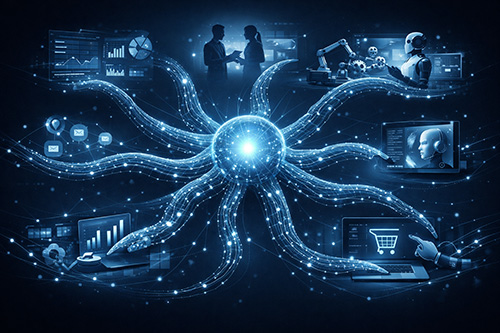
Only a third of an octopus’s neurons sit in its central brain. The rest are distributed across its eight arms, while a neural necklace connects them for instantaneous and seamless coordination. Each arm tastes, touches, and decides independently. When one arm discovers food, the other arms adjust immediately. The octopus’s main brain sets the intent, and the arms execute the plan.
AI finally makes the octopus model practical for all organizations.
Distributed Intelligence at Work
For humans, full coordination has historically been expensive, with endless meetings, emails, and approval chains. The transaction costs are brutal.
AI slashes these costs to near zero; it streamlines the flow of information and transforms unstructured data into actionable insights.
Suddenly, every team can access the same information and strategy that once required a room full of executives. AI agents can curate information, flag conflicts, surface relevant precedents, and model second-order effects—all in seconds. The frontline employee wrestling with a customer issue gets the same situational awareness as a vice president.
What This Looks Like in Practice
At Procter & Gamble’s Berlin facility, AI-powered sensors monitor production quality continuously rather than in batches. This doesn’t just catch defects faster. It frees employees from time-consuming, repetitive inspection work so they can focus on high-skill issues, from process improvement to innovation.
Starbucks uses its in-house AI platform, Deep Brew, to personalize millions of customer interactions while simultaneously tracking what’s driving local demand. The system handles known knowns (digital engagement drives loyalty), reveals known unknowns (how to predict hyperlocal demand shifts), and even surfaces unknown knowns (data showing that 43% of home tea drinkers add no sugar, leading to new unsweetened products).
When the pandemic hit—an unknown unknown—Starbucks adapted in real time because its nervous system was already wired for distributed sensing and rapid response, such as suggesting new store formats.
Neither company achieved this by layering AI onto old structures. They rewired how decisions flow.
The Coordination Advantage
Economist Ronald Coase argued in 1937 that organizations exist because coordinating activities internally costs less than working with outside parties. But AI is demolishing these transaction costs. You can now have tens of thousands of contractors (Upwork) or millions of vendors (Amazon) because information systems make coordination nearly frictionless.
This changes everything about organizational design.
Some companies will grow massively because AI helps them coordinate at an unprecedented scale. Others will purposely shrink, outsourcing what they once owned or completed in-house.
Think about what becomes possible. Marketing teams at a furniture manufacturer once needed months to test new campaigns. Now AI runs millions of personalized conversations with customers, learning in real time. As a result, creative teams spend less time executing campaigns and more time perfecting them. The manufacturer’s procurement staff no longer chases routine contracts. AI handles those while humans build strategic supplier relationships that unlock novel materials and design partnerships.
This is a fundamentally different way of working.
The Missing Piece
Sadly, most AI transformations automate tasks but leave org charts intact. A team gets an AI assistant, but employees must still work through three levels of approvals before they can act on AI insights. Data flows faster, but decision rights don’t change.
True superintelligence requires structural change. Push decision-making to the edge. Make information transparent. Give teams the authority to act when they spot opportunities. This feels risky to executives trained on command-and-control. But keeping centralized approval for every choice in an AI-accelerated world isn’t safety; it’s suicide.
The companies that will dominate aren’t necessarily building better internal AIs. They’re building better nervous systems that let humans and machines coordinate at the speed of insight. They’re distributing intelligence the way octopuses do: everywhere at once, acting in concert, with purpose flowing from the center and discovery bubbling up from the edges.
The Choice Ahead
Artificial superintelligence will arrive eventually. But you don’t need to wait for machines that outthink humans to build a superintelligent organization. You simply need to enable your human teams to collaborate with AI.
