
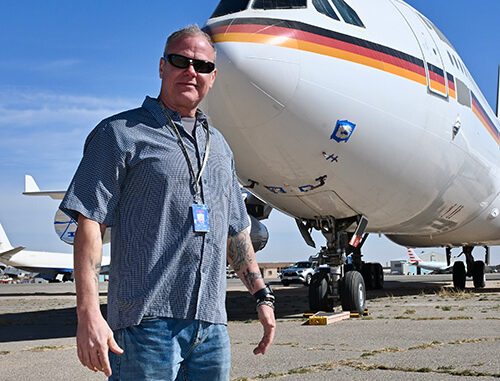

Isaac, explain what General Airframe support does in the airline industry?
We do numerous things, but first and foremost, we supply spare parts to the airlines. The way we do that is, we have two locations on two airports. We buy retired aircraft. We reclaim anywhere from 1,000 to 60,000 line-items off those aircrafts. We send them out to vendors, have them refurbished and deliver them in a timely manner.
We are now an FAA Part 145-repair station, so we can also do storage preservation. I like to control my destiny, so we are going to start a component repair shop to where we can control the amount of time and the lead time, from the time it’s removed from the aircraft to the time it’s delivered. Our biggest bottleneck is the repair shops. We’re going to start expanding into that area.
Supplying parts to the airline industry is not a career you trained for. How did you get involved in this specialized line of work?
I was a starving electrician in 2008, and I got a job in a warehouse identifying parts. With my electrical background, the schematics helped me read illustrated parts catalogues for these aircraft. I was able to excel in that industry. I was able to find hard-to-find parts. I was able to help the company market and supply non-procurable things. I really had a great niche in it. I really had a good advantage and a good opportunity, and it all lined up when I needed it.
What made you decide you wanted to start your own company to provide the parts to air carriers?
I started my own company in hopes of financial freedom and freedom to take time off when I wanted. But, after I started, I found that I really wanted to start the business to help others. I wanted to supply a good service. I wanted to be in control of my destiny, more than supporting someone else. I felt I could make better decisions and I could grow a lot quicker, my way. I saw what my company [for whom I was working]was doing at the time, and I thought I could do it better. That’s why I started my own business.
Take us back to the beginning when you started General Airframe Support. How did you begin this great journey?
It was really scary when I started the company. I partnered out with another company. They were in reclamation, they tore down aircraft, and I interviewed a few times with them. I decided not to take the job. Instead, we created General Airframe Support. They were scrapping three Southwest 737s. They were on a crush pad. I made them a deal—give me $25,000 and I would give them 50 percent of the business—$15,000 of that—$5,000 per carcass, I gave back to those three owners in return to pull anything I wanted off of those airplanes. They would still be able to scrap and get the metal weight. In the first eight months, I did half a million dollars. Then, we decided to separate and I moved the business from Arkansas to Tucson. I bought their shares out and that’s how I became the 100 percent owner of this company.
How many locations do you have and tell us what you do at each location. How many people work at each facility?
We have three locations. Pinal Airpark in Marana, Arizona. We do “part-outs” reclamation there—special projects. We just did a special project for Boeing. We assisted a company in removing the cockpit off of a 747 for the California Science Museum. At Roswell International Airport in Roswell, New Mexico, we do OEM parking, storage, reclamation, and return to service. Our third location is just a giant warehouse in Roswell, where we are currently expanding our component back shop, so we can start refurbishing our parts ourself. At each location—Marana has 12 employees, the Roswell International Airport has 16 employees and then our warehouse and our back shop has 16 employees, as well.
You acquired a new building here in Roswell. What created the need for the new building, and how did you acquire it?
I acquired a 150,000 square foot warehouse a few years ago and then that company had some money troubles. They have a 175,000 square foot warehouse. I only need 20,000 square feet of it for my component shop, but I wanted to control who owned that building. I believe we’re going to do really great supporting the community here. We’re changing the name to the Genair Manufacturing Complex. I think it was a no-brainer. I was in a good position to buy it and all the cards fell together. It’s a huge manufacturing warehouse, already, with great power. It’s got compressed air throughout the building. It’s a turnkey, perfect opportunity for us.
What is the process of procuring the aircraft that have outlived their useful life to become available for disassembly and parts. How do you find the aircraft you need to keep your parts business going?
That is the tricky part. Boeing, typically, last 15 years then, it’s retired. Airbus lasts about 9 years, and you’ve got to be in the know, in the group with the leasing companies or the airlines to purchase those aircraft. The way we get our hands on them is we offer zero cost teardown. We’ll tear down the aircraft to 500 parts for free in return for the carcass. You can have as many parts as you want off that aircraft, but typically people don’t want big, bulky stuff—they don’t have the facilities like I do. We get a lot of airframe flight controls, which is a great niche for us. We’re not in the rat race—we let everybody else work on those high-end rotables. We focus on airframe parts, non-procurable parts, and that’s our little niche.
I’ve been working in the company the last 11 years. But, this year I’m going to focus working on the company, getting out there and buying these aircraft complete. So, I can capture the money on the front end and what we do on the back end.
What do you have to do to become a FAA part 145 certified part supplier to the airline industry?
You have to be an ASA certified aircraft or air parts handler. That’s a certification just to handle the parts. We got the FAA 145 to assist us getting more acquisitions. I believe in bringing in these airlines and these leasing companies to retire their aircraft here. Now, we’re licensed to put them in OEM storage programs. If they sell them, we can return them to service, and it’s just a well-rounded system—great business model from nose to tail. From parking the aircraft to reclamation, to repair and to selling, we are in control of the entire process.
What is the process of taking apart an aircraft for useable parts?
There’s a couple of different ways. Typically, a client will give you either a harvest list, or they’ll ask you to pull by zones. They may ask you for things off the wings, the wheel wells. It’s typical. Everybody goes after avionics, emergency slides, wheels, brakes, landing gear, APU. They just want those fast 500 parts. I’m guessing—I don’t know for sure, but I imagine they’re doing 20 percent margin in 60 days on those. They’ll do 20 to 30 of those a year. That gives us an opportunity to go after 60,000 line-items and, really, support the airlines in the non-procurable parts in the heavy maintenance facilities. When there’s nothing out there on the market, they can count on General Airframe to have the assets on the ramp. If I don’t have it ready to go, with a little bit of a lead time, I can be able to remove that part and get it delivered to them in a timely fashion.
Isaac, your warehouse is incredibly organized with thousands of parts. How do you keep track of all the different parts for all the types of aircraft that you provide for?
When we purchase an aircraft or get an aircraft, it goes into our database which is a really great, robust database. Everything goes into it as a lot, so we can input our inventory in there in an organized fashion, by lots, by tail number. I believe, we have about 400,000 line-items in our warehouse, right now, available at any time. I’d say 80,000 of those parts are tagged, ready to go. It’s a pretty basic system. It’s a very common system, very expensive system. It does everything from inventory, purchase orders, repair orders, invoicing—very thorough, great system.
What’s the biggest challenge you face in this unique business?
The biggest challenge is not having control of our destiny, and that’s why we got the 145. Acquisitions are very tough. Finding the material, finding the assets for sale. But, I’d say the very biggest is the lead time. The time from shipping it to a vendor to have it overhauled or repaired and then, delivered. Component Repair Shops can be very misleading. A lot of the component shops will tell you 7 to 10 business days, then they take 15 to 18 business days. That’s why we started the 145. We’re going to start tagging our own parts, and, probably, going to run two shifts—6 to 2:30, 3 to 11.
I know our brand is going to grow huge by being able to control that—the lead time—we’re going to be able to shorten those lead times to 5 business days, a lot of the times. In this industry, on average, an airframe is leased at $10,000 a day, if that airframe is flying or in maintenance. So, if a part takes 14 days, that’s $140,000 waiting on a $5,000 part. I know if I can deliver that in 5 days, it will be an extraordinary help to the industry.
You’ve built a successful company. Why did you feel the need to bring in our consulting company to help you go forward?
At the time, I was extremely fatigued. I felt like a fireman, running around, fixing problems all day. I couldn’t work on the company because I was working in the company. I needed to improve my processes. All we had were checklists. You couldn’t have picked a better time to come in and help me figure out the proper ways to run a business.
Our consultant helped you create a bloodwall for your business. Tell us what is involved in the bloodwall and the benefit you got by going through the entire bloodwall process with your consultant.
The bloodwall process is great because it catches UDE’s—a UDE is an undesirable effect. Areas that need improvement. Areas that are nonefficient, nonprofitable, eating your margin. And, it allows your employees to capture these UDE’s to where we could schedule them. We can schedule fixes for those, get a process that corrects them and focus our time on correcting and being more efficient.
What was the biggest eyeopener for you when you went through the bloodwall process, in terms of the amount of money that you could generate by fixing these UDE’s?
I think, when George and Tim were here—those were our first two consultants—we created 50-plus processes. We did 40 bloodwalls. Out of the 40 bloodwalls, after setting metrics and money to each one of those, we found $14 million in corrections on those—and that’s not even one of the most proficient ones. But, $14 million of revenue that we were just bleeding out from not being efficient, not having profitable processes.
You’re now able to attack those because of the bloodwall processes, isn’t that right? Isn’t that the purpose of them, having the bloodwall, is that you can then put a plan to help capture some of that $14 million?
Oh, yeah. Another thing is our employees really enjoy being in the process, as well. Being in management, it’s nice to have your team help you with the solution because then they own it. You’re not a tyrant or a king, you’re working together—they own it, they feel very happy to participate and correct problems in the company.
After you completed the bloodwall process with your consultant, you created a dashboard for the company with performance metrics. How has this changed the way you now manage the business and how has it benefited you?
The dashboard is great. It allows me, no matter where I am, at any time, to look at the health of the company. My time is very valuable and it’s helped me to focus on the areas that need improvement. I can see where we need my time and I’m able to be laser focused in those areas.
How have your employees reacted to the UDE’s and have they fully embraced the new management approach?
Our employees love it—they love participating. It goes all the way down to the—all employees report to the manager, the managers report their findings—we schedule meetings for the UDE’s, and it’s really improved our culture, honestly. It’s made us tighter, and that’s what I enjoy the most is how tight our culture is now, from the UDE’s—everybody participating.
When we talk about the UDE’s, can you give us an example of one of the UDE’s that you were able to tackle, and the benefit that you received from that?
We talked about the $14 million and the 40 UDE’s, but there’s one that’s not in that calculation. We found that we were deleting any emails or requests for prices over two weeks old—roughly 3,500 email’s every week. When we quantified that and put a number to it, we realized we were deleting $21 million in revenue. We’ve expanded and hired a staffing company in the Philippines to expand our sales department, and we’ve got it down to 2,000 requests we’re still deleting at the moment, but a huge improvement. We’re seeing all that money, revenue coming in now.
Have you divided what your employees are doing as a result of that? Previously, were they just focused on trying to handle all the emails? Did you change the way in which your employees are allocated?
Yeah. With that UDE, we created a process to solve that problem. One of the areas we found where our sales team was doing a lot of administrative work, following up with the repair shops. We divided our sales team into a sales department and a fulfillment department. Now, our sales team can focus more on getting the quotes to the customers and the fulfillment team can focus on getting it delivered on time. Even before we expanded, I think, we already started to improve on that process. I think we got it from 3,500 down to 3,000 and then, now, with the additional sales people, we’re down to 2,000 we’re still deleting. But, that one UDE recognized the problem and then, the process we created—the solution was to divide the sales team into a fulfillment and sales team.
Is there a number that you can talk about in terms of the improvement, in terms of the increase in sales as a result of that change in the way you were handling the emails?
Yeah. I would say that our revenue, last year—our income went up 25 percent, just from that one move. This year, I think—the company is probably going to double. We did $6 million the year before, we’ll do $10 to 12 million this year.
That’s a great improvement.
Yeah, yeah. Just by doing a couple of tweaks. Just by recognizing that you’re bleeding out, you have a problem, you’re getting the team involved and a solution—having them come up with a solution—you recognize where the real problem is. The problem was, the sales team was doing way too much administrative work. You can’t quote when you’re doing paperwork. Just that one UDE was very profound for us.
How did your consultant make your employees feel that they were doing something more than just trading time for money, but truly, being part of something bigger—something truly important?
You pretty much summed it up, right there. With the team being involved in the UDE’s and being part of the solution, they get a great feeling of progress every day, growth, fulfillment. That’s really what we try here. We want personal growth, financial growth, for our employees. Having them involved in the day-to-day decision-making solution, they go home fulfilled, and that’s what we believe life should be all about.
How does that make you feel as a business owner, knowing that you’re giving your employees something more than just a paycheck?
It fulfills me, honestly. I’ve never had a lot of money growing up, and I’m doing very well now. Money just magnifies who you are and I realize that. But, when you are improving lives, the quality of lives, there’s nothing more fulfilling than that. That’s why I do it every day—it’s really to improve their lives and that’s fulfilling for me.
When you look back at where you were before our consultant entered your life, what is the biggest takeaway for you, personally? How have you benefited from the work that we have done?
I used to be stuck—like I said—like a fireman in the business. Working in the business, unable to work on the business. As an owner and you’re working in the business, you’re going to chokehold that company. You’re going to chokehold that business. You must work on the company, you must work on improving it, building rapport, building a bigger client base, finding more assets, acquisitions, material. When you’re working in the business day-to-day, you’re going to neglect that area.
Before, I would say we were stuck at $6 million every year—just couldn’t get past that. After you guys came in and helped me delegate—not even delegate—leverage a lot of these responsibilities to the employees, that frees me up to now work on the business. I can improve it and get more assets. We’ve got our 145 [FAA certification] now so there’s a lot of projects that we can accomplish after you guys helped us.
That improved the overall performance of the company, too, is that correct?
Oh, yeah, absolutely. We’re more organized, more efficient. The employees are happier. I mentioned those first, but, of course, the revenue has gotten much better, too. All of those are just great, great things.
Now that you have more control over the business, what are your long-term goals and dreams?
Now that we have all this new cashflow coming in, and my time is not working in the business, it’s working on the business, we’ve just acquired another 175,000 square-foot warehouse that I plan on turning into a manufacturing complex. And then, we’ve also acquired another 83 acres that I can spend time on. I would like to build an RV park. The Reno air races are, now, going to be in Roswell so twice a year, we’re going to have some great air races here. And, they would like 1,500 RV spots here. I just see a great opportunity there. Now, I have a chance to take advantage of these opportunities because I’m not tied down working in the company all day.
Is there anything else you’d like to add, Isaac?
If you’re on the fence, or if you’re tired and you’re fatigued, I would say, as a business owner, never stop learning. Always look for personal growth. Don’t be afraid to get help and hire some talent. I’ve been trying to train people, but now I’ve got some really great talent, and it’s really freed me up. Get out there, get some coaching and grow your business. Work on the company, not in the company, if you really want to be successful.
Thanks, Isaac. I really appreciate you giving us the time to tell your story.
No problem. Any time. I’m always here. Thank you guys for improving my life, and more importantly, my teams’ lives. You really gave us an opportunity to make a difference in our community and with our employees, and I appreciate you.
