
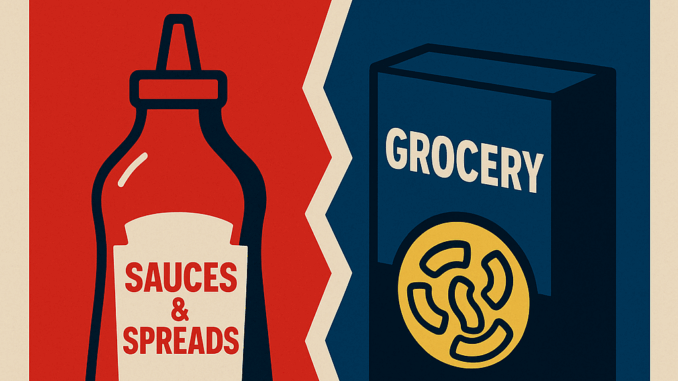

In a surprising winddown to a decade-old consumer brand merger, the Kraft Heinz
Corporation has decided to split into two companies, one focusing on groceries, the other
on sauces and spreads. The breakup dismantles a packaged goods giant that seemed
unthinkable 10 years ago, when the mega-merger created one of the biggest food
manufacturers on the planet.
The separation, which will conclude in the second half of fiscal year 2026, is the latest in a
series of big business rearrangements of major consumer brands that are drifting away
from the conglomerate model. As a packaged goods giant, Kraft Heinz never achieved the
growth that was expected a decade ago, when Warren Buffett’s Berkshire Hathaway, along
with a private equity firm 3G Capital, created the $45 billion colossal, with the focus on
cutting costs and building iconic brands such as Heinz beans, Jell-O and Philadelphia
cream cheese. The same firm now is worth just $33 billion.
Buffett expressed disappointment in the split publicly on CNBC, while Berkshire Hathaway
took a $3.76 billion write-down on its 27.4% stake in the company, and relinquished its
board seats.
In retrospect, the merger has not turned out to be the brilliant idea that was anticipated.
Shares have lost 60% since the merger, as consumers have reined in spending, particularly
in the wake of the Covid 19 pandemic, and shifting consumer preferences.
The coming separation will split the corporate giant into two companies, one focused on
sauces and spreads, such as Heinz, Philadelphia and Kraft Mac & Cheese, which had sales
of about $15.4 billion in 2024, and the other focused on ready meal brands, including
Oscar Meyer, Maxwell House and Lunchables, which had about $10.4 billion in sales last
year.
The grocery unit will be headed by current Kraft Heinz top boss, Carlos Abrams-Rivera,
while the sauces unit will be searching for a new CEO. The company expects the split to
cost as much as $300 million, but they expect to reduce much of that expense quickly.
The two entities will be provisionally named Global Taste Elevation Co, for the sauces and
condiments company, and North American Grocery centered on its grocery portfolio.
Global Taste Elevation will retain Kraft Heinz’s iconic global brands and focus on high-
growth platforms such as condiments, sauces and flavor enhancers.
The newly formed North American Grocery will be focused on the grocery business, built
around long-standing household staples such as Kraft Mac & Cheese, Oscar Meyer and
Lunchables. The permanent names will likely be revealed later in the year.
The company has been reshaping its portfolio to realign itself with consumer preferences
for healthier, less processed foods. The separation will allow each business to operate with
strategies tailored to their distinct market dynamics—the grocery unit focuses on cost
efficiency and consolidating the value segment, while the growth condiment division can
prioritize global expansion and targeted capital investment.
One major move recently is the trend to eliminate the use of artificial dyes from U.S.
products, and to divest underperforming brands.
The Kraft Heinz restructuring mirrors a similar 2023 split of Kellogg’s into Kellanova and WK
Kellogg, which helped both companies grow independently. Long known for their iconic
brands, Kraft Heinz operates under three strategic geographic segments: North America,
International Developed Markets and Emerging Markets. The company’s brand portfolio
includes globally recognized names such as Kraft, Heinz, Oscar Meyer, Philadelphia,
Velveeta and Lunchables.
In 2025Q2, total revenue fell by 1.9%, year-over-year to $6.3 billion, primarily due to volume
declines in the North America and International Developed Markets, principally in cold
cuts, Lunchables, frozen snacks and powdered beverages. This followed a 3% drop, year-
over-year, in total revenue, to $25.8 billion, in fiscal year 2024, once again due to weak
demand for key products such as Lunchables and Kraft Macaroni & Cheese.
Initial investor reaction to the separation has been positive, as Morgan Stanley upgraded
the company’s stock upon announcement of the move.
The Kraft Heinz portfolio contained 56 categories, making it more than a little unwieldy
from a management standpoint. Though the split may simplify operations, it is not without
its hazards. Perhaps the most obvious hazard would be in supply chains, which are already
stressed due to looming tariffs, geopolitical tensions and climate change.
Also, the separation of products could lead to sales, or mergers with other multinational
companies. For instance, in the Kellogg’s split, the snack-centered Kellanova branch
became an attractive acquisition for snack giant Mars, while WK Kellogg was recently
acquired by Italian confectionary brand Ferrero. On the other hand, Jell-O, which has long
faced category decline, could be sold off by North American Grocery, as could Velveeta,
who, despite its iconic brand, has declined as well, as consumers increasingly opt for
healthier choices.
Ultimately, success will hinge on customer opinion and consumer loyalty. Kraft Heinz has
been heavily reliant on brand loyalty, and there is a real risk that if names are changed and
packaging is redesigned, consumer loyalty could shift or slip away.
But the move signals not only a major change for Kraft Heinz, but one for all the packaged
food sector, as evolving consumer demands, agility and more health-conscious options
are increasingly driving business decisions.
