
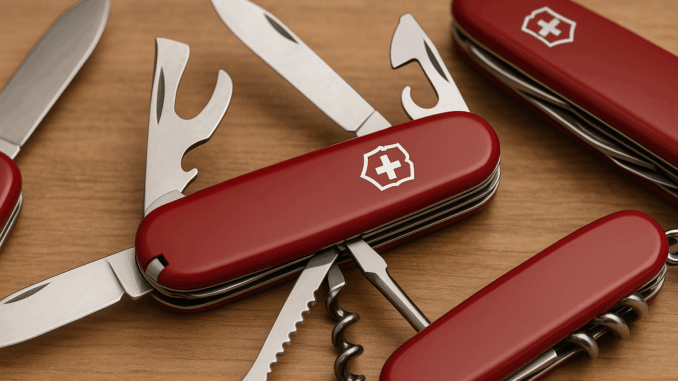

Swiss Army Knife manufacturer Victorinox is attempting to curb the blow of President Donald Trump’s tariff policy by, in true utilitarian fashion, pushing efficiency at their Swiss plants, building up U.S. inventories, and considering moving elements of their production to the United States.
The iconic, multi-faceted Swiss Army Knife — a fixture in Western culture since being popularized by American soldiers in World War II — is still manufactured by the Victorinox corporation at a single plant in Ibach, Switzerland. The company also produces kitchen and commercial knives, as well as watches and luggage.
Since Trump imposed 39% tariffs on all imported goods from Switzerland in August, Victorinox could be facing an additional $13 million in levy costs per year. The U.S. accounted for 13% of Victorinox’s 417 million Swiss franc ($519 million) in sales in 2024, and if the 39% tariff remains in place, every product shipped to the U.S. will lose money, according to Victorinox CEO Carl Elsener.
To counter the blow of the tariffs, Victorinox has responded by sending extra stock to the U.S. to build up inventories. The company is also considering doing polishing and packaging work domestically to lower costs at the time of import. Additionally, Victorinox has been trying to expand into markets in Latin America and Asia to reduce its dependency on the U.S. market.
Both practices — front-loading orders earlier in the year and diversifying markets — have been adopted by other companies seeking to blunt the impact of the prohibitive tariff levies.
In addition to Victorinox, other Swiss companies have also experienced lower order intakes since the U.S. tariffs began. A survey conducted by the Swiss Mechanic trade body indicated that 45% of small and medium-sized manufacturers have reported reduced orders, with some firms’ profit margins eroded by a 12% rise in the Swiss franc against the dollar this year.
Swiss watchmakers such as Omega-owner Swatch Group and food giant Nestlé are already being hit, while pharmaceutical leaders like Novartis and Roche could soon be in the firing line if tariffs are extended to drug manufacturers.
“Our priority is to defend market share while the situation is so unpredictable,” said Elsener. “Our investment in the United States right now is to avoid price increases and accept the losses — that’s our sacrifice to keep market share.”
To maintain their presence in the U.S. market, Victorinox sent two extra 40-foot containers with about 200,000 Swiss Army Knives, plus 200,000 kitchen and commercial knives, to the United States in February and March. That should give them sufficient inventory through March 2026, allowing them to keep prices steady.
Producing the knives abroad is “not an option,” according to Elsener, as the brand depends on its Swiss heritage. Instead, Victorinox is looking to accelerate automation and efficiency programs at their Ibach facility. While not entirely shifting their manufacturing, they are considering moving limited end-of-line work to the U.S. — such as cleaning and packaging of knives — to reduce the dutiable value, said Elsener.
Elsener remains confident that his company will be able to adapt and survive in the changing global market. “We got through the First World War, the Depression, the Second World War, the global economic crisis, the oil crisis,” he said. “This is just the latest challenging situation, which I’m confident we can overcome.”
