
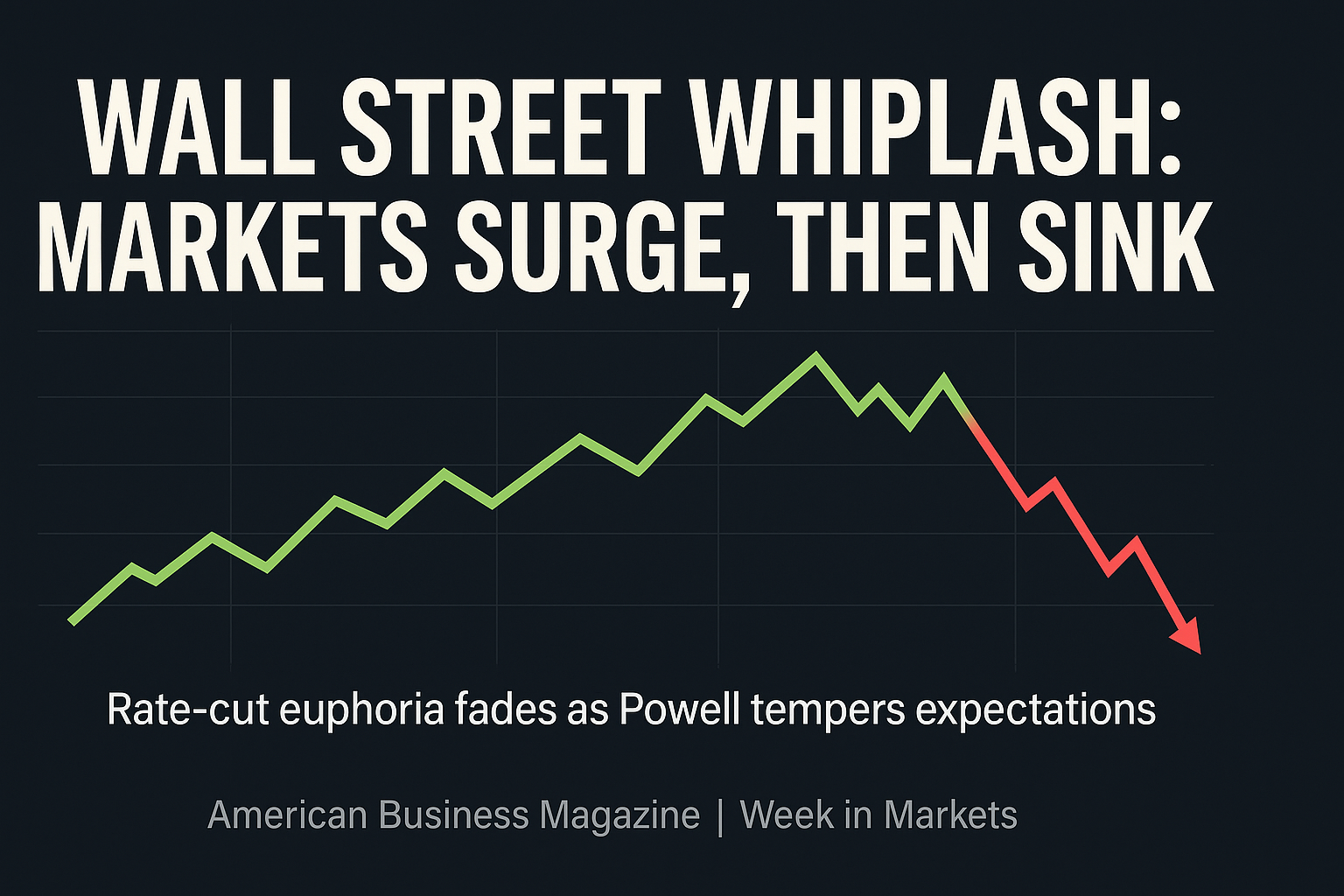

The stock market continued its hyperactive routine this week, as the rosy gains following
last Wednesday’s interest rate cuts were dashed later in the day, after Federal Reserve
Chairman Jerome Powell’s announcement that further cuts this year were “far from” a
foregone conclusion. After reaching a record high at midday and gaining 334 points,
investors quickly rolled back their enthusiasm, finishing down by 74.37 points at the end of
the day, closing at 47,632.
This past Tuesday, the stock market tumbled again thanks to a huge sell-off in the tech
sector, as the Nasdaq dropped just over 2%, and the Dow Jones lost 251 points, while the
S&P 500 retreated 1.2%.
However, the market rebounded following Tuesday’s election, as the Dow Jones gained 225
points, closing at 47,311, while the Nasdaq advanced 0.65% to close at 23,499.80. The S&P
500 picked up 0.37%, closing at 6,796.29.
The gains had more to do with the Supreme Court challenging some of the President
Trump’s tariffs, buoying investors’ hopes of duties being eased, as well as AI chipmaker
Advanced Micro Devices rebounding from valuations concerns the previous day, than
anything related to Tuesday’s election outcomes.
The previous week, the Fed once again dropped the benchmark interest rate for the second
time in two months by 0.25%, placing the borrowing rate between 3.75%-4%. Investors
were stoked that another quarter point rate cut would happen the next time the Fed
convenes in December. However, Powell’s comments that the board had “strongly differing
views about how to proceed in December” brought market expectations down again.
Powell did indicate that what would happen at the December meeting was still up in the air,
and that inflation is currently not far from the Fed’s target. Powell’s stance continues to
reflect the long-going tension on the board between easing interest rates and concerns that
the inflation rate remains too high, even as job market weakens.
Michael Rose, Chief Investment Officer at Angeles Investments, reiterated the Fed’s
concerns. “Our view has been that the market has been too aggressive in pricing in the
pace and magnitude of future cuts,” said Rose. “Inflation is elevated above the Fed’s target,
and we see monetary policy as moderately loose, with nominal rate below nominal GDP
growth.”
As for Tuesday’s rebound, investors were paying attention to the Supreme Courts hearing
Wednesday regarding President Trump’s tariffs. The issue is whether the President has the
authority to impose these tariffs under the International Emergency Economic Powers Act.
The court’s justices focused their questions on the legality of the tariffs, and about the
Trump administrations jurisdiction in imposing them.
Considering the court’s skepticism, traders on the prediction markets cooled off on the
supposition that the high court would uphold Trump’s tariffs. Auto stocks responded, as
both Ford and GM jumped more than 2% each, and construction and manufacturing giant
Caterpillar grew about 4%.
“We continue to see this sort of debate, how effective they are,” said Phil Blancato, chief
marketing strategist at Osaic. “I don’t know we’re going to know the tariff effect, the
resolution of it, the price effect of it until the first quarter of next year, so that adds to this
kind of disillusionment.”
The rise in AI stocks was led by Advanced Micro Devices, which posted third-quarter
earnings and revenue that exceeded analysts’ expectations, closing with a 2.5% increase.
Others, including Broadcom and Micro Technology saw gains reversing their previous
losses in the last session, posting jumps of 2% and 9% respectively. Leading AI player
Oracle recovered its previous losses as well.
However, tech heavies like Palantir dropped 8% on Tuesday, while Super Micro Devices
pulled back 11%.
“You have these winners and losers in the AI space,” said Blancato. “And certainly with
stretched valuations, I think we have to be very selective on where you’re making you’re AI
bets going forward. The AI trade is simply running out of steam, that’s the problem we’re in,
and that’s why we’re in this sideways market.”
