
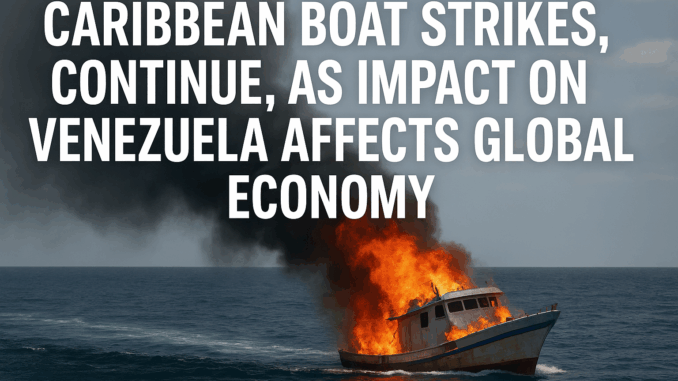

With the ongoing airstrikes being carried out by the U.S. military on alleged drug boats in
the Caribbean Sea and the Pacific Ocean, the questions of rules of engagement have
become more pronounced, not only with the escalation of the attacks, but with the “double
tap” strike that was levied on a presumably disabled vessel currently being under
investigation.
Since attacks began on September 2, the U.S. military has killed 83 people in strikes that
have destroyed 22 boats as part of a campaign that Washington says is aimed at curtailing
the flow of drugs into the United States. President Donald Trump proclaimed on Truth
Social that the strikes were against “positively identified Tren de Aragua Narcoterrorists in
the SOUTHCOM area of responsibility.”
During the September 2 attack in the Caribbean, the U.S. military carried out a follow up
strike after the first apparently didn’t kill everyone on board. While the first strike appeared
to disable the boat and cause death, the second attack killed the remaining crew, bringing
the total deaths to 11 on this first strike.
The Senate and House Armed Services Committees said they plan to conduct “vigorous
oversight” on the follow up strike, as some members have expressed concern that the
“double tap” strike could violate the law of armed conflict which prohibits the execution of
an enemy combatant taken out of the fight due to injury or surrender.
Many of the initial strikes occurred off the coast of Venezuela, and as the attacks
escalated, tensions rose. Venezuelan President Nicolas Maduro called the strikes “serial
executions” and called on the UN to investigate, claiming the U.S. was seeking regime
change. The U.S. deployed significant military assets near Venezuela, while Trump
continued to denounce Maduro as a corrupt dictator, responsible for drug and human
trafficking and acts of violence and terror across the United States and the Western
Hemisphere.
In mid-October, another strike saw two survivors, one each from Ecuador and Columbia,
briefly detained by the U.S. Navy before being sent back to their home countries. One day
later, a seventh targeted vessel was destroyed that Defense Secretary Pete Hegseth
claimed was tied to a Columbian terrorist organization. These attacks sparked public
clashes between Trump and Columbian President Gustavo Petro, a long-time ally of the
U.S. Petro denounced the attack, accusing the U.S. of killing innocent Columbian citizens.
Trump announced he would cancel all U.S. aid and subsidies to the country.
Strikes began in the Pacific Ocean on October 21. On October 27, multiple strikes were
carried out on the same day, as four vessels were hit in the international waters of the
Eastern Pacific. Hegseth stated that 14 individuals were killed aboard the vessels “operated
by known terrorist organizations” and one survivor who was not recovered.
“The four vessels were known by our intelligence apparatus, transiting along known narco-
trafficking routes, and carrying narcotics,” said Hegseth.
In addition to the attacks, the strained relationship between the U.S. and Venezuela has
impacted not just on both countries, but the global economy in full. Exacerbated by U.S.
sanctions, Venezuelan oil exports continue to decline, affecting oil prices globally. The
country has already lost estimated billions of dollars in oil revenue.
While Venezuela has seen its GDP decline by, reportedly 213% between 2017 and 2024,
new measures such as tariffs on oil and the designation of cartels as terrorist
organizations, have caused further instability, creating challenges to import food and
medicine.
The reduction in Venezuelan oil exports could drive up global energy prices, particularly
affecting countries in Europe and Asia. This could destabilize emerging markets depending
on South American oil flow.
Also, military escalation in the region could disrupt shipping lanes in the Caribbean,
increasing logistical costs and potentially leading to a rise in commodity prices.
Any short-term resolution seems unlikely, as Trump remains intent on weakening Maduro
and has spoken publicly that the U.S. could “very soon” expand its attacks from boats off
the coast of Venezuela to targets inside the country.
But there has been a reported phone call discussion between Trump and Maduro,
reportedly about a possible meeting in the United States. Little details of the discussion
have been made public, other than Secretary of State Marco Rubio was also on the call.
The reported call follows Trump’s long history of engaging in dual tracks with adversaries,
with discussions on one track, and the threat of force on the other. No meeting between the
two has been confirmed at this time.
