
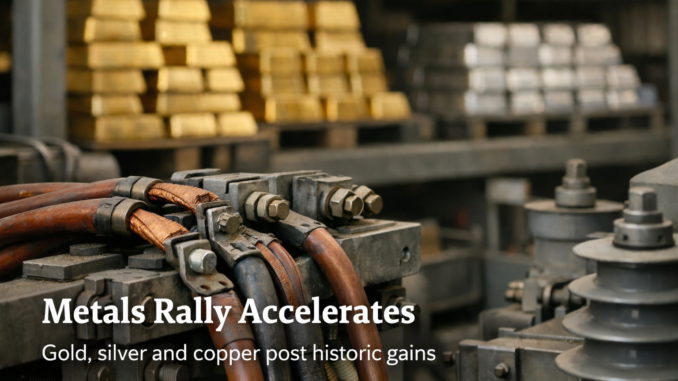

In a rare occurrence in the commodities market, gold, silver and copper have all been
rallying simultaneously in recent weeks, with all three posting their strongest gains in
decades. While gold has been on a noted upswing in recent months, silver has
outperformed it, up 140% year-to-date, it’s best performance since the early 80s. Copper is
up roughly 36%, staking its biggest annual rise since 2009.
Gold closed the year at just above $4,300 per ounce, a 66% jump from the beginning of the
year, reaching as high as $4,494 per ounce just before the holiday season.
Silver, meanwhile, peaked at $72.12 per ounce in its pre-holiday surge, before closing for
the year between $70.13-$70.90.
Copper closed the year at $5.70 per pound and the LME (London Metal Exchange) 3-month
copper around $12,500-$12,600 per metric ton, marking significant annual gains.
The surge in precious metals is not just speculation, as the highs are expected to continue
in the new year. Persistent global tensions, a reshaping of the global economy, transitioning
of energy supply and demand issues, not to mention lingering inflation, all point to
continued increases in the metal market. Throw in the uncertainty of further Federal
Reserve interest rate cuts and metals become even more attractive to investors.
At the same time, copper and silver are benefiting from massive industrial demand, as
artificial intelligence, electric vehicles, grid expansion and renewable energy drive the use
of these precious metals.
Also, the weakening of the U.S. dollar has spurned central banks to accumulate gold to
reduce their reliance on dollar reserves. Together, these forces may explain why precious
metals are rising and the rally may not be over yet.
After hitting a record high of nearly $4,500 per ounce, gold settled back to its current level
of $4,460 per ounce, as monthly gains are still near 9%. With baseline inflation lingering
near the 3% mark, the likelihood of further interest rate cuts in 2026 remains questionable.
Still, lower interest rates reduce the opportunity cost of holding gold, while the weakening
U.S. dollar has made gold cheaper for overseas’ buyers, amplifying global demand. With
central banks accelerating gold purchases to protect against financial instability, analysts
project gold could push the $4,600 per ounce price over the next 12 months.
Silver’s dramatic gain pushed the metal over 140% for 2025, and a current rate of $77.51
per ounce. However, silver benefits not only as safe haven for investors, but also as a
critical industrial metal.
The increase in solar panel manufacturing, electric vehicles, data centers and AI
production have boosted silver’s demand significantly. Monthly gains are near 40% and
analysts see the price holding over $70, as several countries have classified silver as a
strategic and critical mineral.
Copper’s rally tells more of the story related to energy transition. With increased demand
for electric vehicles, AI data centers and power grid expansion, copper currently sits at
$13,000-$13,200 per metric ton, and a spot price hovering around $5.86-$5.95 per pound,
with future contracts showing slight fluctuations. Reportedly, a single electric vehicle can
use up to four times more copper than a gas fueled vehicle.
With power grid and infrastructure expansion, demand for copper may spike as much as
60% by 2030, however mining and supply chain issues could slow production. U.S. trade
policy has also reshaped the market, as a 50% tariff on imported copper products has
triggered hoarding and stock piling.
Forecasters say the metal rally will continue throughout 2026, transitioning from a
momentum driven surge to a more structurally supported cycle. Gold is expected to
stabilize at historically high levels, while silver may remain the most volatile thanks to
sharp increases in demand. Copper prices are likely to remain high, given the long-term
energy and electronic trends on the horizon.
