
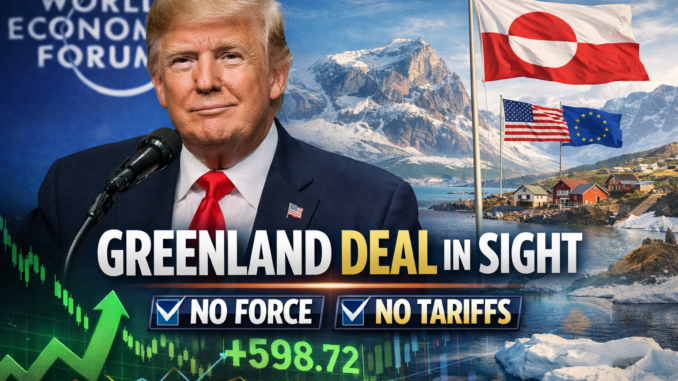

In an abrupt about face, President Donald Trump quickly toned down the rhetoric of recent
days regarding the United States taking control of Greenland. While addressing the World
Economic Forum in Davos, Switzerland, Trump plainly stated that taking the island by force
was off the table, as was his earlier threat of imposing tariffs, and that a deal to end the
dispute was in sight.
“We have formed the framework of a future deal with respect to Greenland and, in fact, the
entire Arctic Region,” Trump wrote on his Truth Social platform. “Based upon this
understanding, I will not be imposing the Tariffs that were scheduled to go into effect on
February 1st.”
While ruling out the use of force and squashing the tariff threat, the previously skittish
financial markets responded, with the Dow jumping nearly 600 points, wiping out most of
their losses from the previous day. The S&P 500 and the Nasdaq gained 1.16% and 1.18%
respectively, recovering their previous losses as well.
For the week ending Jan 23, the Dow fell roughly 0.5%, while the S&P posted a second
consecutive week of 0.4% loss.
Trump offered no immediate detail of the supposed deal in the works, other than stating
Vice President JD Vance, Secretary of State Marco Rubio and special envoy Steve Witkoff
would take part in the discussions and would make more information available as
discussions progressed.
In addition to spooking the markets, Trump’s saber rattling also raised eyebrows from some
of his staunchest European supporters, including many on the far right and more populist
leaders usually aligned with him. The Trump administration has openly supported
European parties that share similar positions on issues ranging from climate change to
immigration.
Alice Weidel of the far-right Alternative for Germany said, “Donald Trump has violated a
fundamental campaign promise — namely, not to interfere in other countries,” while party
coleader Tino Chrupalla referred to Trump’s barnstorming as “wild west methods”.
President of the National Rally party Jordan Bardella, often praised by the Trump
administration, said on Tuesday that Europe must react, referring to “anti-coercion
measures” and the suspension of the economic agreement signed last year between the
EU and the United States.
Nigel Farage, leader of Britain’s populist party Reform UK who has long complimented and
favored Trump, ruffled at Trump’s latest threat: “…to use economic threats against the
country that’s been considered to be your closest ally for over a hundred years is not the
kind of thing we would expect,” per a public statement issued last weekend.
However, not all populist or far right European leaders have been so critical. Both the far-
right Dutch Party for Freedom and Spanish Vox praised Trump for his actions against
Venezuela, but have remained quiet on Greenland, while Polish President Karol Nowrocki
and Hungary’s Prime Minister Viktor Orban have called for the issue of Greenland to be
settled bilaterally between the United States and Denmark.
Italian Prime Minister Giorgia Meloni has made public her desire to be a mediator between
Trump and the European Union. “The prospect of higher tariffs for those contributing to the
security of Greenland is in my view a mistake and I obviously do not share that position,”
the Italian prime minister told reporters in Seoul on Sunday.
Meloni has made clear that she is ideologically close to Trump and expressed that Europe
shares the same security concerns as the U.S. does concerning the Arctic.
“I agree with the focus the US administration has on Greenland and the Arctic in general,”
she said. “Clearly it seems that there’s been a problem of understanding and
communication.”
Meloni and her team have been privately taken aback by some of Trump’s policies, but she
has refrained from public criticism of the president. Meloni stated she would not condone
any use of force by the U.S. involving Greenland but also understands the strategic
importance of the island and that it should be protected from Russian and Chinese threats.
“I also believe there’s a problem in interpreting what was being done,” she said on Sunday.
Trump, she added, was “interested in listening but, it appears to me, from a U.S. point of
view, the message from this side of the Atlantic hadn’t been clear.”
Trump himself appeared much more sanguine after meeting with NATO Secretary General
Mark Rutte at Davos, stating the deal would satisfy his desire for a “Golden Dome” missile
defense system and allow access to critical minerals, while denying Russian and Chinese
ambitions in the region.
“It’s a deal that everybody’s very happy with,” Trump told reporters. “It’s a long-term deal.
It’s the ultimate long-term deal. It puts everybody in a really good position, especially as it
pertains to security and to minerals.”
“It’s a deal that’s forever,” he added.
Some say Trump’s turn is a product of his strategy of playing hardball and threatening stern
repercussions, only to pull back once he gets what he wants–others say it was the EU
taking a firm stand and not backing down that Greenland’s status as an autonomous
territory of Denmark was non-negotiable.
Either way, with Trump taking an increasingly strident position in all matters involving U.S.
interests, the EU is discovering that they may have more leverage than previously thought.
For instance, in protest of Trump’s threats on Greenland, EU leaders shelved last years’
EU-U.S. trade deal prior to the Davos meetings, only to put the deal back on track once
Trump announced military force and tariffs were off the table.
“Despite all the frustration and anger of recent months, let us not be too quick to write off
the transatlantic partnership,” German Chancellor Friedrich Merz said in Davos
beforehand. Additionally, Europe looks to toughen up its own economic policy.
Next month it will kickstart legislation that will include “Made in Europe” requirements on
strategic sectors and strengthening conditionality clauses for any foreign direct investment
in the EU.
The impact of the U.S. tariffs is not yet clear, as companies front-loaded exports last year
ahead of the new levies, but recent data shows that, say German companies have nearly
halved investments in the U.S. in 2025.
