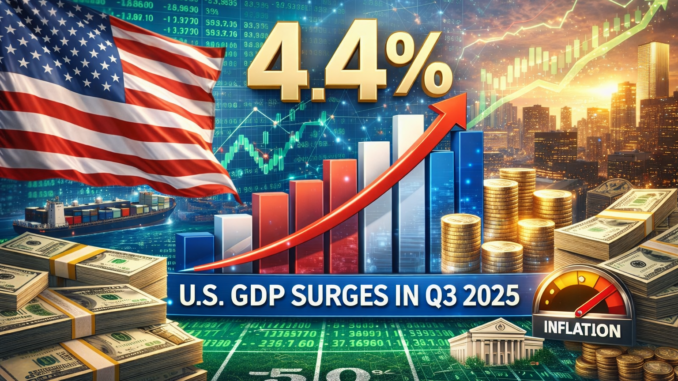

Despite the volatile economic landscape, fueled by market and tariff uncertainty, lingering
inflation and evolving job landscape, the U.S. gross domestic product (GDP) experienced
an unexpected third-quarter jump, reaching approximately $31.1 trillion for Q3, 2025. The
annual rate increase of 4.4%, indicating stronger growth than previous quarters of 2025,
was bolstered by increases in consumer spending, a surge in exports and government
spending as well.
For whatever reason, the third quarter GDP surge was the best in two years and indicates
the economy is on solid ground, despite persistent warning signs. The Commerce
Departments Q3 report was delayed thanks to the government shutdown, but the 4.4%
growth was significantly higher than both economists’ predictions of 3.2% and the second
quarter growth rate of 3.8%.
Consumption kept growing, particularly by the wealthy and upper middle class, who
continue to spend big. The thought remains that overall spending will continue to increase,
as the Republican tax cuts begin to take hold. The jump in exports and increased military
spending was key as well, as corporate profits leaped with some of the tariffs easing.
The Trump administration was quick to take a victory lap, as the President’s Press Secretary
Karoline Leavitt proclaimed, “The doubters, naysayers, panicans (sic), and liberal media
have been proven wrong — again. Trust in Trump. The President’s pro-growth policies are
working, and the best is yet to come.”
The President himself hawked the good news on his own Truth Social, writing “The
SUCCESS is due to Good Government and TARIFFS!”
However, certain caveats remain, namely that business investment has slowed down,
according to the latest data reports. Also, consumer confidence dipped for the fifth month
in a row, according to Bloomberg. While the expectation is that growth will continue, albeit
at a slower rate, in part due to reduced immigration.
More alarming was the inflation rate creeping back up to 2.9% from the previous 2.6%, an
opposite trend to the preferred Fed Reserve rate of 2.0%.
If the labor market continues to cool while the economy holds strong, indicating a more “K-
shaped” economy–where the top quintile of Americans spends big as others struggle with
the cost of living–the fallout may not just be political, but with increased distress between
how people feel, and the economy at large.
The economy’s expansion may well exceed expectations, but those gains have failed to
reverse an uptick in jobless rates or in strong payroll gains.
Additionally on Tuesday, the Federal Reserve responded by standing firm on interest rates.
Following three consecutive rate cuts from September to December last year, the Fed kept
the benchmark lending rate steady, between 3.5%-3.75% by a 10-2 vote. The Fed has
juggled the risks of more significant rate cuts for two years, as inflation slowed in both 2023
and 2024, however remaining above the Fed’s preferred inflation rate of 2.0% With the rate
creeping back up to 2.9%, the board decided to refrain from further cuts at this time.
As dissenting voices on the Board of Governors increases, the longstanding expectation
that the Board operates in a largely consensus manner becomes more questionable.
Rather than project consensus, Governors are reportedly becoming more entrenched in
their views, especially since the December meeting was one of the most divided in years.
As for future cuts, that will depend on what materializes first—a job market that declines,
or an inflation rate that continues to fall toward 2%. Neither has happened since
December.
Though job growth has slowed sharply, the unemployment rate has stabilized, while
inflation readings have been clouded by data collecting disruptions stemming from the
shutdown.
Some officials, including Chairman Jerome Powell, have indicated more comfort regarding
the presumed spike in tariff driven price increases—the expectation is that those may be
one-time effects. Others continue to be uneasy because inflation has remained well above
2% for five years. Some officials worry rates may no longer be high enough to keep pushing
inflation down, while others fear holding steady risks weakening the job market.
