

While the trade tensions between the U.S. and its global partners continue to play out,
India and the European Union inked its own blockbuster trade deal, in what many herald as
a triumphant accomplishment of market access, nearly two decades in the making.
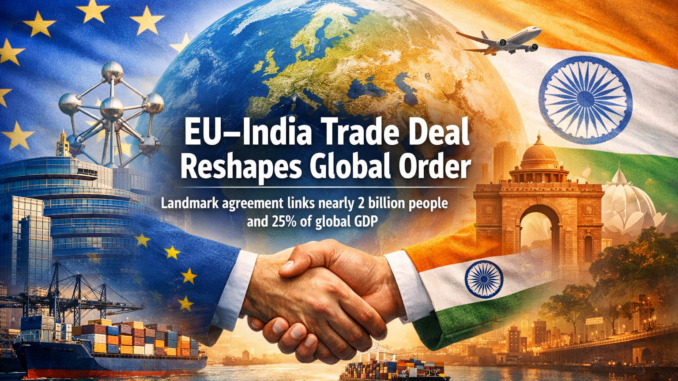
Bringing together nearly 2 billion people in a trade agreement covering roughly a quarter of
global GDP, the long-delayed deal will slash tariffs on most goods, aiming to not only boost
two-way trade between the regions, but also lower reliance on the United States amid their
evolving tariff policies.
The deal is expected to double EU exports to India by 2032, reducing tariffs in 96% of traded
goods by value, reportedly leading to savings of 4 billion euros ($4.75 billion) for European
companies.
In turn, the EU will cut tariffs on 99.5% of goods imported from India over the next seven
years, lowering duties to zero on Indian marine goods, textile products, chemicals, rubber,
base metals, gems and jewelry, according to a statement from the India trade ministry.
“People around the world are calling this the mother of all deals,” said India Prime Minister
Narendra Modi. “This agreement will bring major opportunities for the 1.4 billion people of
India and the millions of people in Europe.”
The India-EU trade talks, ongoing for nearly two decades, picked up steam once the United
States imposed a 50% tariff on Indian goods, and other U.S. allies began pushing back
against U.S. tariffs and stepping up against President Trump’s saber-rattling concerning
Greenland.
“Europe and India are making history today,” European Commission President Ursula von
der Leyen said. “This is only the beginning.”
Formal signing of the India-EU deal will likely occur within six months, once the legal
vetting process is concluded.
Prior to signing the deal with India, the EU worked out deals with South American bloc
Mercosur, as well as previous agreements with Indonesia, Mexico and Switzerland. New
Delhi, meanwhile, had finalized pacts of its own with Great Britain, New Zealand and
Oman.
The deal will open India’s highly guarded market, with tariffs on cars ultimately being
slashed to 10% over five years, from their previous high of 110%, according to European
sources. The reduced tariffs on autos would be granted to 250,000 cars per year valued at
over 15,000 euros, benefitting EU automakers like Volkswagen, BMW and Mercedes-Benz.
The significant tariff reductions in chemicals, pharmaceuticals and machinery will
accelerate the integration of Indian firms into European value chains, and while embedding
European standards and sustainability provisions, the agreement also has potential to
influence digital trade and intellectual property overall.
India is also slashing tariffs on alcoholic beverages, including spirits being lowered to 40%,
while wines will drop from 150% to 75% immediately.
The deal will also cut tariffs on numerous goods being imported into India from the EU,
including iron, steel, machinery and electrical equipment.
While there was no immediate relief for Indian companies being hit by the newly
implemented carbon tax under the EU’s Carbon Border Adjustment Mechanism, India said
it did get a commitment from the EU that they will get flexibilities on the carbon tax if they
are granted to any third countries.
For all the trade and commerce implications wrought through the deal, perhaps its greatest
significance goes beyond economics and plays out on the geopolitical landscape. In recent
months, both New Delhi and Brussels have left themselves exposed through the
unpredictable tariff policies enacted by Washington. Under the Trump administration, India
has faced tariffs up to 50% on exports to the U.S., while the EU has narrowly avoided trade
disputes over steel production, industrial subsidies and, of course, the Greenland
controversy.
For the EU, the agreement reinforces its long-standing pursuit of autonomy, reducing their
over-reliance on superpowers United States and China, while forming alliances with like-
minded countries.
Meanwhile India, the world’s fourth largest economy, is determined not to be trapped by
dependence on one single market. This deal compliments India’s newly assertive trade
policy, which has concluded deals with Australia, New Zealand, the UK, Oman and the
European Free Trade Association states.
The India-EU deal model focuses on diversification, resilience and flexibility, rather than a
vehicle to strictly cut tariffs. With a more pragmatic framework, the deal looks to provide a
blueprint for stabilizing supply chains amid a tense geopolitical landscape, and how it may
affect Indo-Pacific supply chains. Beyond goods, the agreement strengthens the
infrastructure that underpins supply chains themselves.
Ultimately, the India-EU deal reflects a world in which the old trade certainties no longer
apply. By linking two of the world’s largest democratic economies, it reshapes trade flows,
while offering a redesign of protectionist trends.
