
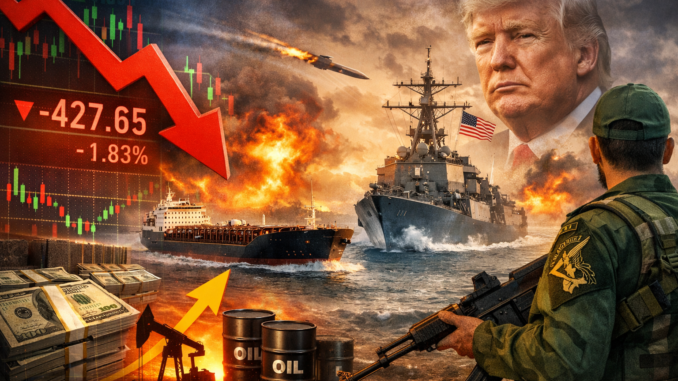

The stock market continued its hyper-gyrations following the outbreak of military conflict in
the Middle East, as losses of the first impulsive sell-off were quickly wiped out with gains
later in the day last Monday, March 2, but Tuesday incurred a more than 400-point loss to
the Dow, before Wednesday’s short-lived rebound.
In addition to Tehran launching retaliatory drone strikes at various U.S. Embassy’s and Tel
Aviv directly, concerns are growing as to how long gulf states like the United Arab Emirates
can hold off the barrage of missile and drone strikes and continued stalling in the Strait of
Hormuz.
President Donald Trump took to Truth Social last Wednesday, stating “If necessary, the
United States Navy will begin escorting tankers through the Strait of Hormuz, as soon as
possible,” Trump said. “No matter what, the United States will continue will ensure the
FREE FLOW of ENERGY to the WORLD.”
The Strait of Hormuz is a pivotal choke point for oil transit located between Oman and Iran.
In 2022, 21 million barrels of oil per day were transported through the strait, according to
U.S. Energy Information Administration.
A high-ranking member of Iran’s primary military branch, the Islamic Revolutionary Guard
Corps warned that any vessels traveling through the 100-mile sea passage would be met
with lethal force.
Currently, the passageway is experiencing a de facto closure, as insurance risks have
brought most traffic to a stand-still, with Iran stating it would bar ships linked to the U.S. or
Israel. Kuwait, the fifth largest oil producer in OPEC, announced on Saturday, it was cutting
oil production and refining output because tankers cannot transit the Persian Gulf due to
threats from Iran.
Meanwhile, the stock market continued its roller coaster ride from last week, as the Dow
on Monday closed a wild session up 239 points, while the S&P 500 made up for earlier
losses on Monday, increasing 0.83% to close at 6795.99. The tech-heavy Nasdaq gained
1.38%, settling at 22,695.
The previous week saw big losses on the Dow, which dropped 625 points on Friday alone,
ending its worst week since April 2025. In addition to the growing Middle East conflict and a
jump in barrel oil costs, investors balked at an unexpected spike to the unemployment rate,
and further downward revisions to the latest Bureau of Labor Statistics jobs report.
The stunning late Monday comeback, though, was largely fueled by Trump’s proclamation
to CBS News that the war in Iran was “very complete, pretty much”. Trump repeated the
message later in the day at a Florida press conference, where he said the U.S. is “achieving
major strides toward completing our military objective.”
“This was just an excursion into something that had to be done,” said Trump. “We’re getting
very close to finishing that, too.”
After an overnight jump of 32% to $119 per barrel, the price of U.S. crude dropped 5% to
around $86 per barrel by the close of business Monday. Still, the price of U.S. crude oil has
risen more than 50% since the start of the year, and more than 30% in just the last five
days.
Overseas markets also reacted with their worst showing in nearly a year, as Japan’s Nikkei
225 recorded its worst day since last April, dropping 5.2%, while South Korea’s Kopsi index
lost 6%.
Finance ministers of leading industrial nations held a video conference call on Monday to
discuss a potential joint release of oil reserves to ease skyrocketing prices but decided
against the move for now.
President Trump is reportedly reviewing several options to drive down prices, including
restricting U.S. exports, intervening in the futures market and lifting some requirements of
the Jones Act, which requires that domestic fuel be carried only on U.S.-flagged ships.
The market’s late Monday rally lost steam on Tuesday, as investors continued to hedge their
bets, monitoring oil prices and the ongoing Iranian conflict. The S&P 500 fell slightly in
choppy trading, dropping 0.21% to end the day at 6,781.48. The Dow lost 34.29 points,
closing Tuesday at 47,706.51, while the Nasdaq basically stayed flat at 22,697.
Oil prices slid slightly further upon Energy Secretary Chris Wright stating in a since-deleted
social media post, that the U.S. Navy escorted an oil tanker through the Strait of Hormuz.
White House Press Secretary Karoline Leavitt stated late Tuesday that, in fact, the U.S. has
not escorted a tanker through the Strait passageway.
In early trading Wednesday, the Dow lost over 300 points at midday, as oil prices began to
creep up again.
