
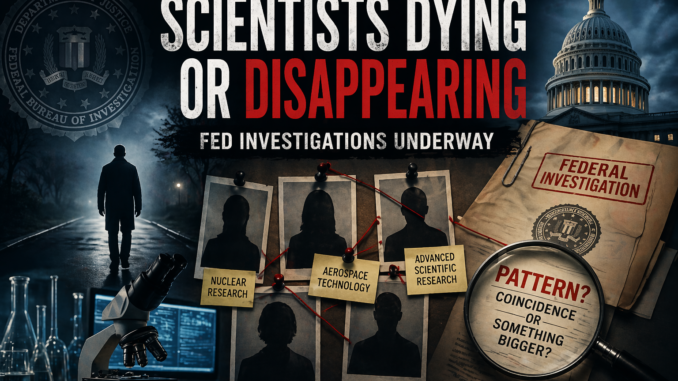

The death of another scientist has resurfaced online and drawn renewed scrutiny because of similarities some observers see between her case and the deaths or disappearances of other researchers working in advanced scientific fields.
The 2022 death of Amy Eskridge has recently been cited as the 11th case in a growing list of scientists who either died or disappeared under circumstances that have prompted public speculation.
The other cases involve individuals with ties to U.S. military, nuclear or aerospace research.
Federal officials have taken notice of the broader concerns, including President Donald Trump, who held a private meeting on the issue last Thursday. Trump described the situation as “pretty serious” and told reporters, “I hope it’s random, but we’re going to know in the next week and a half.”
White House Press Secretary Karoline Leavitt later addressed the issue on X.
“In light of the recent and legitimate questions about these troubling cases and President Trump’s commitment to the truth, the White House is actively working with all relevant agencies and the FBI to holistically review all of the cases together and identify any potential commonalities that may exist,” Leavitt said.
Authorities have not established a connection between the cases. However, the individuals’ ties to advanced research fields and certain similarities among the cases have fueled public attention and speculation.
Eskridge died in 2022 at the age of 34 in Huntsville, Alabama, reportedly from a self-inflicted gunshot wound. Relatively few official details about her death have been released publicly.
Eskridge co-founded the Institute for Exotic Science with her father, Richard Eskridge, a retired NASA engineer. She described her work as involving “antigravity” research and other experimental propulsion concepts.
In a 2020 interview with YouTuber Jeremy Rys, Eskridge spoke openly about what she believed her research had brought into her life.
“We discovered antigravity, and our lives went to _____, and people started sabotaging us. It’s harassment, its threats, it’s awful.”
Eskridge continued:
“If you stick your neck out in public, at least someone notices if your head gets chopped off. If you stick your neck out in private, they will bury you. They will burn down your house while you sleep in your bed, and it won’t even make the news.”
Eskridge also argued that researchers working on unconventional technologies needed to continue publishing publicly because, in her view, pressure against them could become increasingly aggressive.
She claimed to have observed a pattern in which scientists announcing unusual breakthroughs would later disappear from public work or stop publishing.
Eskridge also described Huntsville as a major center for national security, intelligence and aerospace research and therefore a potential target in the event of a major international conflict.
She further alleged that she had been monitored and physically followed by individuals she believed were connected to Russian intelligence. Those claims have not been independently established.
Her father, however, has strongly rejected conspiracy theories surrounding his daughter’s death.
Richard Eskridge told NewsNation there was “nothing suspicious” about her death, adding that “scientists die also, just like other people.”
Physicist and science communicator Michio Kaku has nevertheless argued that the broader collection of deaths and disappearances deserves examination as a potential national security issue rather than simply being dismissed as a group of unrelated incidents.
Kaku told Fox News Digital that the clustering of cases involving people connected to sensitive research warranted coordinated government scrutiny.
At the same time, Kaku has acknowledged that a single disappearance would not demonstrate the existence of a broader threat. The concern, he argued, comes from multiple cases involving people who worked in areas such as nuclear technology, classified defense research and aerospace systems.
Among the most prominent cases is retired Maj. Gen. William Neal McCasland, 68, who was last seen at his home in Albuquerque, New Mexico, in late February.
Although McCasland had been retired for more than 12 years, his disappearance generated extensive online speculation because of his previous role as commander of the Air Force Research Laboratory at Wright-Patterson Air Force Base and his past connection to highly sensitive military research.
He is one of several current or former employees associated with sensitive research facilities who have gone missing in New Mexico over roughly the past year.
The FBI has become involved in examining the broader situation, which remains under investigation. Other federal agencies connected to the affected research facilities have also been reviewing the cases.
Current and former federal officials have described some aspects of the situation as unusual, though officials have also emphasized that no evidence has publicly emerged establishing a connection between the cases.
The research facilities involved collectively employ tens of thousands of people, many of whom work in administrative, technical or support positions and do not necessarily have access to classified or sensitive information.
“The deaths and missing persons cases are scattered across several years at different and only loosely affiliated organizations,” said Joseph Rodgers, deputy director of the Project on Nuclear Issues at the Center for Strategic and International Studies. “If all of the scientists were working on one project or weapons system, then I’d be more suspicious.”
In McCasland’s case, he reportedly left his home in February without his phone, wearable devices or prescription glasses. Reports indicate that he carried only his wallet, hiking boots and a .38-caliber revolver.
Search-and-rescue teams led by the Bernalillo County Sheriff’s Office, with assistance from state and federal agencies, deployed drones and K-9 units but found no trace of him.
Online speculation subsequently suggested that McCasland might have been taken against his will because of consulting work he had performed for a nongovernmental group examining government records related to UFOs.
His wife acknowledged that he had some association with that community but rejected suggestions that his disappearance was connected to it.
As for Eskridge, there is currently no publicly available evidence linking her death to McCasland’s disappearance or to any of the other cases being discussed.
Authorities likewise have not established any connection between Eskridge’s research and the circumstances surrounding her death.
