
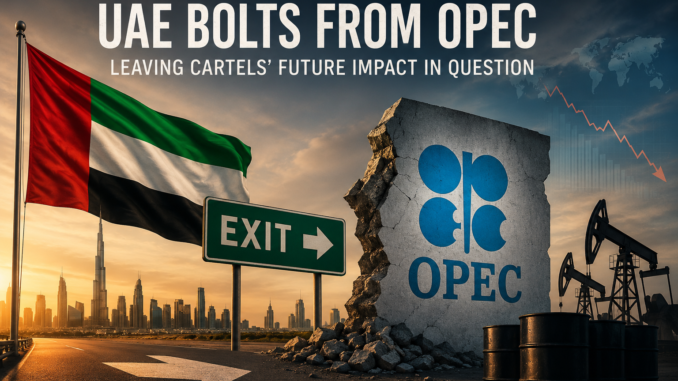

In a bold and calculated move, the United Arab Emirates have vacated their position in
OPEC, leaving the multi-country oil pricing powerhouse earlier this month, and potentially
weakening the decades of influence the cartel has had over the global oil and energy
market. The UAE was considered the most influential member of OPEC behind Saudi
Arabia. It was one of the few members of the organization (along with the Saudi’s) that had
a meaningful spare production capacity to influence prices and respond to supply shocks.
Spare capacity is the idle production that can be brought online quickly to respond to major
crises. Saudi Arabia and the UAE together control a majority of the world’s spare capacity
of more than 4 million barrels per day, making them particularly influential during times of
distress and supply line challenges.
Says Jorge Leon, head of geopolitical analysis at Rystad Energy, the UAE “departure
therefore removes one of the core pillars underpinning OPEC’s ability to manage the
market.” OPEC will become “structurally weaker,” he said.
Formed in 1960 by Iran, Iraq, Kuwait, Saudi Arabi and Venezuela, OPEC (Organization of the
Petroleum Exporting Countries) was established to defend the interests of major oil
producing exporters by coordinating production to ensure steady revenue for its members.
Its members have fluctuated and currently include another six nations on the northern and
western coasts of Africa.
In 2016, when oil prices were low, OPEC joined forces with 10 other oil producing nations,
including Russia, to form the wider OPEC+ alliance.
OPEC aims to influence global prices of oil by agreeing how much of its oil members sell.
When they agree to sell more, it is an attempt to lower prices by assuring supply is plentiful,
and when they reduce their supply, it is a move to keep prices high when demand is lower.
A recent of example of such moves was during the coronavirus pandemic, which saw the
price of crude oil crash due to lack of buyers. OPEC+ slashed production to boost prices.
In their first meeting since the UAE left, OPEC decided to increase production by 188,000
barrels per day from June, stating this was an effort to “support oil market stability.”
Some critics of OPEC, including U.S. President Donald Trump, argue that they have used
their influence to keep prices higher than they otherwise might have been by limiting
supplies.
The UAE was one of OPECs top oil exporters, putting out 2.88 million barrels a day in 2025,
behind Iraq (3.26 million) and Saudi Arabia (6.43 million). The UAE also ranks as OPECs
fourth biggest producer, trailing Iran, Iraq and Saudi Arabia.
Overall, OPECs influence on the world oil market has waned since their peak in the 1970s,
as it now holds a smaller share of internationally traded oil. Oil has also become less
important to the world’s economy in the last 50 years.
As of 2025, OPEC produced 36.7% of global crude oil, down from their 1973 peak of 52.5%.
Since 2018, the U.S. has been the globes biggest oil producer at 13.6 million barrels a day
as of 2025. The Saudi’s produce 9.5 million barrels a day, while Russia, a member of
OPEC+, produces 9.1 million.
The UAEs decision to leave OPEC comes after weeks of missile and drone attacks from
fellow member Iran. The attacks have constricted oil production, and exports have come to
a standstill with the Strait of Hormuz being shut down, threatening the foundation of the
UAEs economy.
The UAE timed their exit to limit disruption to fellow producers in the group, according to
Energy Minister Suhail Al Mazrouei, while claiming their exit was not attributed to the
ongoing war.
The UAE wants more freedom to make production decisions without the constraints of
OPEC and reach its goal of 5 million barrels per day by 2027, according to Al Mazrouei.
Oil future prices did not react to the news upon announcement the following day and their
exit is unlikely to affect the market as long as the Strait remains closed. But pressure could
come to bear later. The UAEs departure could undermine the cohesion needed among
producers to support a price floor, particularly during supply gluts.
Also, the UAE has been dissatisfied in recent years when oil production cuts led by the
Saudis to support price floors were not followed by Iraq and Russia, who routinely
exceeded their production quotas.
The Saudis may face greater challenges in setting price floors if oil demand is weak and
there is a large surplus in the future.
“There’s significant risk of higher oil price volatility as a result of this decision,” David
Goldwyn, who served as the State Departments special envoy and coordinator for
international energy affairs from 2009 to 2011, said. “But in the end when market
conditions require cooperation, the UAE leaving OPEC doesn’t prevent it from cooperating
with OPEC.”