
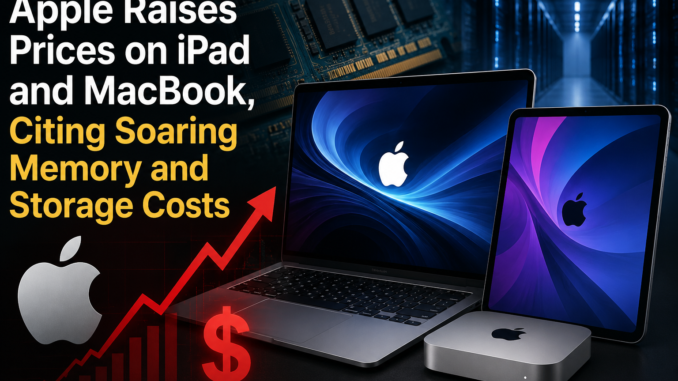

After shielding its customers from anticipated price hikes, Apple finally gave in last
Thursday, announcing price increases to both iPad and MacBook, citing soaring memory
and storage chip costs driven by the AI industry data center build out. Apple held off raising
prices of the iPhone, with the iPhone 18 Pro and Pro Max set to debut in September 2026.
The increase will take the price of the MacBook Neo, its lowest priced laptop aimed at
winning market share from affordable Windows and Chromebook laptops, from $599 to
$699. The MacBook Air will increase from $1,099 to $1,299, while the MacBook Pro, with 1
terabyte of storage, will jump from $1,699 to $1,999. The iPad Air, with 128 gigabytes of
storage, rose from $599 to $749.
Apple also raised prices for both versions of its HomePod smart speaker and Apple TV set-
top box. Shares of the company fell nearly 5% on Thursday, while rival Dell was down more
than 8%.
“The consumer electronics industry is facing an unprecedented challenge,” said Apple in a
statement released Thursday. “The rapid expansion of AI data centers has created an
extraordinary surge in demand for memory and storage.”
“We have never seen a component price increase this much, this quickly,” the statement
continued. “We have shielded our customers from these increases so far, but we have now
reached a point where we need to begin raising prices on a number of products, including
today’s increases for iPad and Mac.”
The announcement shows that even the world’s most valuable consumer electronics
brand is not immune to price increases that have dulled the outlook for smartphone and
PC sales across the spectrum. Rival device makers may have to increase their prices more
steeply, as Apple enjoys deep supplier ties, cushioning the blow other manufacturers do
not have the advantage of.
Apple’s pricing playbook has historically involved removing the lowest-cost option, making
higher storage or memory the new starting point, or steering buyers toward Pro models and
higher capacity versions.
Memory makers such as Micron have prioritized orders from chipmakers like Nvidia helping
them earn record-breaking profits but leaving little supply for electronics makers that have
been forced to increase prices.
In April, Apple stated that existing inventories helped keep their gross margins above Wall
Street’s expectations, but rising memory costs would inevitably catch up with them. CEO
Tim Cook stated in an April conference call that “We expect significantly higher memory
costs. Where we don’t give color beyond June, I can tell you that beyond the June quarter,
we believe memory costs will drive an increasing impact on our business.”
As far as other steps to address rising memory costs, Apple was not forthcoming with
anything else to address the matter short of the price hikes. “We know this is not welcome
news and we are working tirelessly to find solutions,” said Apple.
While Apple’s cash cow, iPhone, was spared in this round of price increases, analysts say
it’s only a matter of time before iPhone prices increase as well. With the iPhone 18 series
due out in September, many see these price hikes as strategic moves, whereupon the new
product announcement in the fall will center on the value the new phone brings rather than
increasing prices. Also, the increase to other products now may prompt potential buyers to
advance their purchase decisions.
The surge in prices of dynamic random-access memory, used in virtually all modern tech
gadgets, increased as much as 98% in Q1 of 2026, and is expected to jump as much as
another 60% in the coming quarter. This price surge, dubbed by some insiders as
“RAMageddon”, has been driven by AI data center boom, which has seen chip making giant
Nvidia signing long term deals with memory makers racing to increase capacity.
Memory maker Micron confirmed in its earnings report last week that it has locked in $22
billion in long-term commitments from customers looking to secure their memory
supplies.
Research firm IDC projects rising costs will weigh heavily on the device market this year,
estimating the smartphone market will see its largest annual sales decline ever, potentially
as high as 14%, while the PC market will fall 11.3%.
The MacBook Neo has now lost its $100 advantage over Dells’recent XPS 13 laptop (priced
at $699 as well), while also making it more expensive than some Chromebooks from
Lenovo.
In May, Apple stopped selling the lowest price configuration, the Mac mini ($599) 256 GB
option from its lineup. The remaining entry model started at $799. Apple has frequently
used storage upgrades to increase the price consumers pay for their devices.
Tarun Pathak, research director at Counterpoint Research, estimates the higher cost of
components could add roughly $200 per iPhone for Apple. He expects price increases
between $150-$200 across the lineup, weighing more heavily toward higher memory
configurations rather than base models.
Analysts expect new iPhone models to move 12GB of RAM, as Apple looks to avoid selling
devices without access to the full suite of Apple Intelligence features. As more advanced
on-device AI features require more memory, Apple likely has a way of framing price
increases around more capable hardware, as opposed to just simply passing along
component inflation.
