
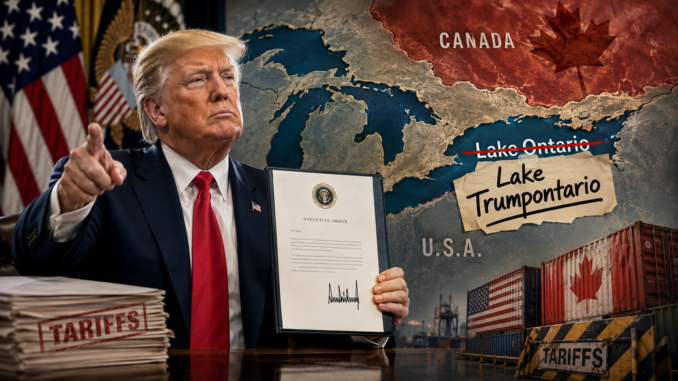

Amidst a burgeoning trade war with border neighbor and largest trading partner, President
Donald Trump has issued yet another executive order to remain a large body of water. This
time, its Lake Ontario, one of the five Great Lakes and one which the United States shares,
in a sense, with Canada. While its northern and western shorelines border the Canadian
province of Ontario, the southern and eastern portions wrap around New York state.
Thus, technically speaking, the international border runs through the center of the water.
On Thursday, Trump issued an executive order in matter-of-fact fashion, changing the name
to Lake of America, proclaiming the motivation for doing so stems from the ongoing trade
war. “They’ve been ripping us off for a long time,” said Trump, referring to Canada. “Well,
they haven’t treated us well,” added the President. “The Canadian officials have treated us
badly. They’re nasty people. So the lake change—the Lake of America—was something I’ve
been thinking about for a long time, actually.”
Economic relations between the U.S. and Canada were tense during the President’s first
term, but things have escalated greatly this time around, as negotiations failed to produce
a trade agreement.
Last week, Trump imposed 50% tariffs on nearly $20 billion worth of Canadian goods.
Canadian Prime Minister Mark Carney, in turn, has promised to impose “dollar-for-dollar”
tariffs against the U.S. from September 8.
As for how the name change itself occurs, the actual text of the executive order states that
the Secretary of the Interior, Doug Burgum, will take the next 30 days to work on the name
change with the Board of Geographic names.
Prime Minister Carney immediately dismissed Trump’s actions on X:
“The name is more than 400 years old, predating both the Confederation of Canada and the
Declaration of Independence of the United States of America,” Carney posted on Thursday.
“Canadians also know that naming reality means calling it Lake Ontario – then, now and
always.”
Other Canadian officials were quick to mock the President’s actions.
Tim Houston, the premier of Canadian eastern maritime province Nova Scotia, wrote on X:
“We’re into some real foolishness now. It’s Lake Ontario, buddy.”
Ontario Premier Doug Ford wrote on X: “It’s Lake Ontario to Canadians and the rest of the
world. Now and forever.”
New York Governor Kathy Hochul posted that “New York won’t be calling it that”, in
reference to Trump’s name change.
The name ‘ontario’ itself is believed to have been derived from the Huron Indigenous
people’s Wendat language, meaning “lake of shining waters” or “great lake” or “beautiful
lake”.
Some have described Trump’s act as not just a move toward a pro-America ideology but a
narrowing of the historical precedent that led to the names being what they’ve been.
“The name Ontario is witness to a native presence that existed before the establishment of
the United States and Canada, and which is crucial for expressing the historical depth of
North America to students and wider communities,” said Derek Alderman, the chancellor’s
professor of geography at the University of Tennessee.
“Trump’s executive order similarly is an attempt at erasing Indigenous culture from the
map, exerting not just an ‘America-first’ ideology across the continent but a decidedly
neocolonial geographic imagination in which the map and its names become tools for
narrowing whose histories and contributions matter.”
While Trump can change the name, he cannot make anyone use it. There is no binding
international authority as to what every country must call a shared body of water.
The International Hydrographic Bureau, which ensures all the world’s seas, oceans and
other navigable waterways are surveyed and charted, does standardize names, however.
The U.S. Board on Geographic Names oversees geographic nomenclature for the country.
The board’s website says that it “discourages name changes unless there is a compelling
reason”.
With all of that said, there is no governing body preventing Trump from renaming the lake,
but also no governing body to force other countries to use Trump’s assigned name for it.
In the international theater, organizations are not required to abide by any name change
assigned by executive order or otherwise. The United Nations, for example, continues to
use established names for contested bodies of water, such as the Gulf of Mexico.
Google Maps will alter the names of places, depending on who is looking at it. For example,
for U.S. users, the platform would name the Gulf of Mexico as the Gulf of America, and
Mount Denali as Mount McKinley.
The current trade dispute has seen U.S. and Canada relations reach new lows, as both
administrations have traded insults throughout the last week. Trade talks collapsed at the
last minute on Friday, with both sides accusing the other of demanding last-minute
changes to a tentative deal.
The U.S. and Canada share one of the world’s largest trading relationships, with deeply
integrated supply chains across automobile manufacturing, energy and agriculture and
other manufacturing, making a prolonged trade fight very costly for workers and businesses
on both sides of the border.

Be the first to comment