
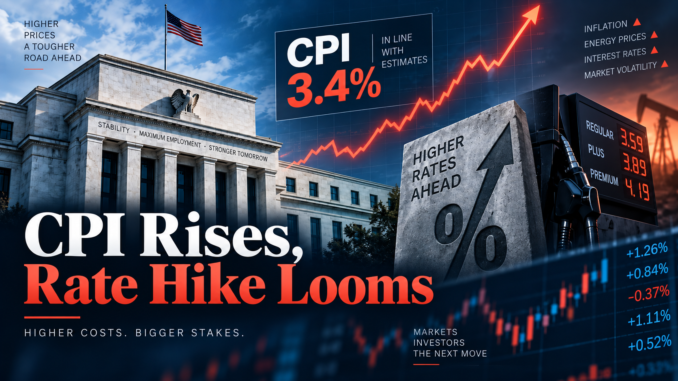

In a much-anticipated consumer price index report, the Bureau of Labor Statistics reported
on Friday that the CPI rose a seasonally adjusted 0.4% for the month of August, putting the
12-month increase at 3.4%. Both the CPI and 12-month increase were in line with
estimates, and both make the specter of an increase to the benchmark lending rate more
likely.
It is worth noting that, subtracting volatile food and energy prices, the core CPI posted a
0.3% monthly gain, or 0.1 percentage points higher than forecast. The core annual rate
came in at 2.4%, matching the estimate.
The report is the final inflation indicator the Federal Reserve will see before convening for
the Federal Open Market Committee session September 15-16, with a concluding vote on
its key interest rate due on Wednesday.
The stock market rebounded on the publication of the report, as the Dow gained over 500
points, ending a four-day skid, to close at 52,573. The S&P 500 climbed 0.86% to 7,656,
while the Nasdaq jumped 0.96%, ending the week at 26,333.
All three major averages had posted four-straight losing days, for the Dow, it’s longest
losing streak since late April. The Nasdaq fell about 0.7%, marking its first negative week in
three sessions.
Crude prices settled down after sharp gains throughout the week, as West Texas
Intermediate futures dropped 2.4%, settling at $100.05 per barrel. Brent futures dropped
slightly, 2.8%, settling at $104.61 per barrel.
Yields held steady after the report, though the 2-year Treasury yield peaked at 4.6%, its
highest level since July 2024, reflecting the markets expectation of a pending Fed Reserve
rate hike. Sentiment has shifted from whether there will be a rate hike, to how many hikes
will happen this cycle.
“We do not expect the fed to be one and done,” said Seema Shah, chief global strategist at
Principal Asset Management. “This is no longer simply about fine tuning the economy. After
a decade of above-target inflation, policy makers are likely to conclude that more than one
hike will be needed to re-establish price stability.”
As for the jump in CPI, energy prices propelled the higher number, as gasoline prices
jumped 3.9%, accounting for more than one-third of the index’s gain. The energy index rose
2.1% amid pressure from the ongoing tensions in the Middle East and was up 16.3% from
one year ago. Gasoline rose 27.4% and fuel oil jumped 52% on a 12-month basis.
Food prices were largely flat, while the food index increased 2.7% annually.
An increase in shelter prices of 0.3% also impacted on the report, after having held flat over
the last two months. Used car and truck prices increased by 0.4%, while new cars
increased by 0.3%.
Fed Chair Kevin Warsh, despite his close-to-the-vest approach, has expressed a
commitment to getting inflation back down to the Fed’s preferred 2% target and stated
recently that if the numbers did not improve, then “we have some work to do”, indicating
the likelihood of increased rates.
With the increases in oil, gas and diesel prices, the fear is that energy prices could spill over
into other goods and services, creating further inflationary pressures.
The current overnight lending rate sits at 3.50%-3.75%, which has been held since January.
The market is now pricing in a 90% likelihood that the federal funds rate will rise to 3.75%-
4.00% by the close of Wednesday’s meeting.
Typically, stocks fall on the prospect of rate increases because they raise borrowing costs
and lower the value of future earnings. Fridays’rebound signals the possibility that traders
have shifted their priority to the bond market first.
Investors are hoping a rate hike from the Fed will tame pricing pressures and keep long-
term bond yields anchored.
Trading on Monday opened with early losses in the tech sector, as signals from artificial
intelligence leaders that more guardrails and pullback need to be instituted on AI before
models progress beyond human ability to manage it.
The Dow closed on Monday at 52,456, down 116 points, while the S&P lost 27.08 points,
closing at 7,629. The Nasdaq lost 83.87 points (-0.32%) to close at 26,249.
The 10-year Treasury yield touched 5% for the first time in three years before reversing
course later in the day. Oil prices rose again upon news of the Saudi’s closing a key
pipeline.

Be the first to comment