
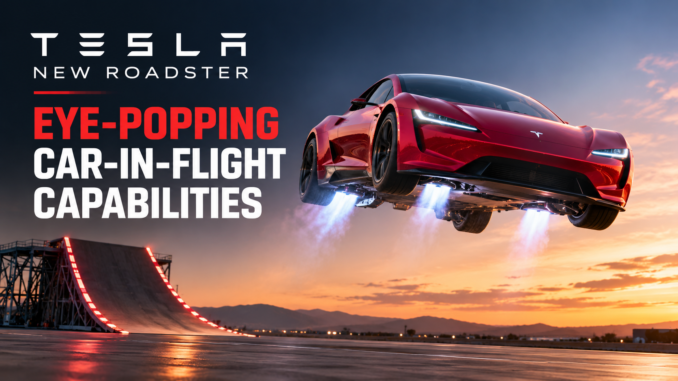

After a two-week delay, Tesla finally revealed the long-awaited follow up to the brand’s first production car, the Roadster, on Thursday night. The eye-popping event, held at SpaceX’s testing facility in MacGregor, TX, is the long-awaited follow up to their first ambitious concept sports car, and attended by a select group of fans, media and investors, and live streamed on X. The new Tesla Roadster was revealed in dramatic fashion, with the prototype driving upside down, and ultimately taking flight.
The wedge-shaped Roadster EV appeared in front of an inverted half rollercoaster ramp—glued to the ramp by a vacuum fan system—then launched off the ramp upside down and performed flips in the air, using air thrusters, provided by Space X, to right itself and land on the tarmac.
The pyrotechnics didn’t stop there. The Roadster performed a similar stunt, jumping over several other Teslas, including a semi, inverted itself, and then used its thrusters to land, a first for an automaker.
“Well, it worked,” CEO Elon Musk wryly commented. “We enter production in 2028.”
The Roadster went 0-60 in less than one second (0.81 seconds), while Tesla claimed the car could hit a top speed of 230 mph. Musk claimed the production version could reach Mach 0.5 (383 mph), or half the speed of sound.
“It basically can fly like a rocket,” said Musk to the crowd. “It can do, like, crazy gymnastics. Whatever you want. This is not necessarily a safety optimized car, but it takes the fun meter to 11 out of 10.”
There will be three configurations of the car:
– Performance: road ready, seats 2, with multi-mode suction system for next level performance on and off track;
– Thrust: race ready, seats 2, with multi-mode suction system and rear mounted cold-gas thrusters that enable 0-60 in less than 1 second;
– Rocket: air ready, seats 1, with multi-mode suction system, plus perimeter mounted cold-gas thrusters for forward, upward acceleration and lateral rotational movement.
No word yet on how the Rocket version, with its thrusters that allow short flights, would be allowed on public roads.
Tesla stated all three models have a range exceeding 300 miles, with a top speed of up to 230 mph for the Rocket version.
The event had been pushed back from its original reveal date of October 1 due to whether conditions at the test site.
As for cost, Tesla is asking for a $5,000 deposit, followed by a $45,000 wire transfer due within ten days of the initial deposit for the Performance version, and a $250,000 deposit for the Thrust variant. The Rocket version is invite-only. No MSRP amounts were released.
Musk went as far as saying that the Roadster, even with its powerhouse performance features, will be an actual car that is on the roads. However, Musk did concede that, “I’m not sure its necessarily legal in all jurisdictions, but there will be such a car that someone can own.”
As for powering the thrusters on the Roadster, jet fuel is not required, but rather the thrusters will be fed by ultra high-pressure air tanks, which the car can recharge itself.
Among Musk’s other big claims included that the new Roadster is “going to crush every track record that has ever existed.” He also said that, in the long term, the Roadster will be the only manually driven car that Tesla makes, implying that further Tesla models will be autonomous.
There were few details about the Roadster’s interior, though the live stream did reveal the coup’s butterfly doors opening to a two-seat cabin with a yoke-style steering wheel to the left of a large, horizontally orientated screen.
Tesla said the Roadster’s design, replete with a rear wing, was inspired by aircraft such as the SR-71 Blackbird and F-35, while the wedge-shaped EV bears a resemblance to the white Lotus Esprit featured in the James Bond film The Spy Who Loved Me.
As for the trick rear wing, it has two modes: high drag, and downward force, and it can automatically adjust its pitch. The Roadster’s fan system also has two modes: one that can suction the car to the ground at low speeds for increased traction, the other for high-speed performance that opens the front and rear sections of the suction system to create even greater air flow underneath the car.

Be the first to comment