
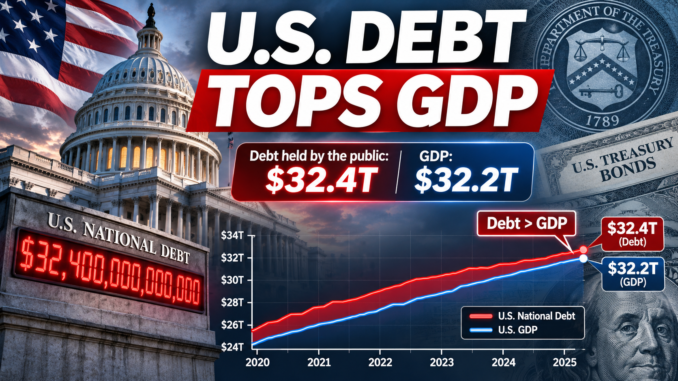

In another dubious milestone of the evolving debt crisis, the national debt topped the entire gross domestic product (GDP) for fiscal year 2026 according to new data published by the Bureau of Economic Analysis (BEA).
From the fourth quarter of 2025 to Quarter 3 of 2026, the country’s economic output was, according to the BEA’s non-seasonally adjusted statistics, more than $32.2 trillion. As of September 30, debt held by the public was $32.4 trillion, according to the U.S. Treasury Department.
As for the total national debt, which includes debt held by the public as well as debt the federal government owes itself, remains $40.5 trillion as of last week.
The national debt has rapidly ballooned in recent decades, quickly rising from roughly $5.7 trillion in 2000, to $19.4 trillion in 2016, and to $36.2 trillion at the start of President Trump’s second term, January 2025.
The debt-to-GDP ratio for Fiscal 2026 of less than 100.1 percent is lower than the Congressional Budget Office’s (CBO) February projection of 101 percent.
CBO projections have the same ratio, expanding to 120 percent by 2036, surpassing the record of 106 percent reached in 1946, following World War II.
“Measured as a percentage of GDP, federal outlays exceed their 50-year average by a widening margin from 2026 to 2036,” the CBO stated in their report. “Revenues rise just above their 50-year average in 2026 and remain slightly above that historical average throughout the 10-year period.”
The One Big Beautiful Bill Act, signed into law by Trump in July 2025, will add $4.7 trillion to the national debt through 2035, according to the CBO’s February report. The law also raised the country’s statutory debt limit to $41 trillion, up from the previous ceiling of $36 trillion.
The trajectory of skyrocketing debt and the economic uncertainty fostered in the wake of the war with Iran have sent bond yields upward this year, further increasing the cost of borrowing of American consumers.
The 10-year U.S. Treasury Bond yield, while down from Thursday, is more than 90 basis points higher than it was prior to the start of the conflict with Iran. The longer term 30-year Treasury Bond is trading at a yield of nearly 5.31 percent, an increase of 68 basis from the day before the war began.
Government debt is nothing new, and if manageable not necessarily bad thing. Federal borrowing can help finance emergencies and investments that otherwise would be difficult to fund. The concerning issue (beyond the dubious milestone) is how quickly the debt grows relative to the economy, what the cost is to sustain the debt and whether those costs will continue to push interest rates higher for everyone else to borrow.
And unlike the aftermath of World War II, when the country had just emerged from a global conflict that required extraordinary wartime borrowing, these deficits are becoming a permanent feature of the federal budget.
According to the Government Accountability Office, federal debt interest costs reached approximately $1.2 trillion in Fiscal 2025, that’s money that cannot simultaneously be spent on other priorities without additional revenue or borrowing.

Be the first to comment