
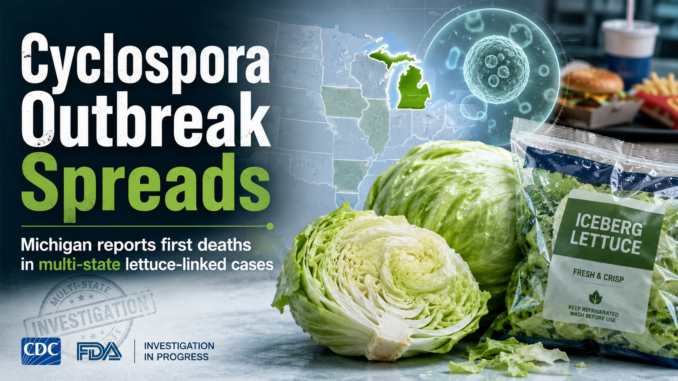

Michigan has reported the first two deaths in what has become a sprawling cyclosporiasis
outbreak, reaching across multiple states and potentially numerous food sources.
cyclosporiasis, an intestinal illness caused by the Cyclospora parasite, is generally not life-
threatening and Michigan health authorities have cited that both deaths in question
involved significant underlying health problems that may have been affected by the disease
and severe dehydration.
An FDA investigation has linked the outbreak to iceberg lettuce across nine states. The
lettuce in question was sourced from Taylor Farms and allegedly served at Taco Bell. Taylor
Farms lettuce has been recalled, but authorities are still seeking other potential sources.
U.S. cyclosporiasis cases have climbed to record levels this year, as the current outbreak is
among the largest caused by foodborne illness in recent history. Consumer confidence has
been impacted as well, with all lettuce and packaged greens sale in decline, as well as
visits to certain restaurant chains.
The U.S. Center for Disease Control has recorded 6,707 laboratory confirmed cases
nationwide as of July 28, though their surveillance lags state reporting by several weeks.
There are more than 11,500 suspected cases not yet confirmed through lab testing.
Michigan remains the hardest hit state from the outbreak with 11,234 cases reported as of
Monday, which is up 461 from last Friday alone. Officials remain challenged since it is not
yet determined whether the lettuce alone is responsible for the outbreak or if there are
other food related issues at play.
Given the large number of cases, the gaps in reporting of cases, and people challenged to
remember what they have eaten all contribute to the increasing numbers. Mixed messages
from the U.S. Department of Health and Human Services have complicated matters as
well.
Health Secretary Robert F. Kennedy Jr has publicly maintained that the outbreak is under
control, yet new cases continue to be reported.
According to former CDC officials and other food safety experts, cuts across federal health
agencies have complicated the government’s ability to respond to foodborne outbreaks.
Cyclospora, unlike bacteria, cannot be grown in a laboratory thus it is harder to track than
other foodborne pathogens. That makes standard epidemiology and contact tracing more
difficult and labor intensive, and the work is not made any easier with the understaffing at
public health departments.
“It certainly doesn’t help matters to have underfunded or understaffed public health
departments,” said Dr. Paul Bollyky, a professor of infectious disease at Standard Medicine.
He also added that budget cuts and turnover at the CDC would make outbreaks like this
harder to trace and control. And the scale of the outbreak raises safety concerns about the
U.S. food supply in general.
The USDA and the FDA maintain that the country’s food supply remains safe, despite this
Cyclospora outbreak linked to imported iceberg lettuce. Some experts claim the outbreak
reflects global supply chain challenges when importing fresh food from other countries,
such as exposure to foreign water and overall sanitation issues.

Be the first to comment