
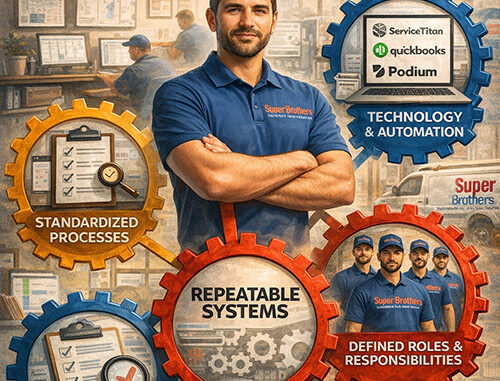

Leadership is often described as vision, motivation, or charisma. In reality, leadership in a growing business is much more practical. It is the ability to replace effort with systems, intuition with data, and constant involvement with clear structure.
I am the owner of Super Brothers Plumbing, Heating & Air, a multi-trade residential service company operating in California. Like many founders, I started by doing everything myself. In the beginning, this worked. Long hours, personal control, and hands-on decision-making can push a business forward surprisingly far. But that approach does not scale.
Over time, I learned that effort is not a leadership strategy. Systems are.
How Education Shaped My Approach to Leadership
My formal education in Bulgaria played an important role in how I think about leadership today. While it was technical in nature, it emphasized structured thinking, planning, and cause-and-effect logic. That foundation influenced how I later approached business problems.
Education did not teach me how to run a company, but it trained me to think in frameworks rather than reactions. When I transitioned from field work into ownership, this mindset became critical. Experience showed me where problems appeared. Education helped me understand why they kept repeating.
Leadership, I realized, is not about solving the same problem faster. It is about designing systems that prevent the problem from recurring.
Leadership Is Built Into Operations
In service-based businesses, leadership lives inside operations. It shows up in how jobs are scheduled, how work is performed, how compliance is documented, and how results are reviewed.
When processes are unclear, people rely on judgment calls. When expectations are undocumented, quality becomes inconsistent. When decisions depend on one person, growth slows and risk increases.
As our company grew, it became clear that leadership required removing ambiguity. We focused on defining ownership, documenting workflows, and creating repeatable standards across departments.
Using Technology to Support, Not Replace, Leadership
To support our operational structure, we rely on specific systems with clearly defined roles.
ServiceTitan is used for dispatching, job tracking, and field operations. It provides visibility into daily execution and accountability at the job level.
QuickBooks is used for accounting and financial oversight, allowing us to track cash flow, costs, and financial performance accurately.
Podium handles customer communication and feedback, ensuring consistent interaction and centralized messaging.
These platforms do not replace leadership. They support it. Without clear processes, software adds noise. With structure in place, technology provides clarity and data-driven decision-making.
Accountability Comes From Systems, Not Pressure
One of the biggest changes systems created was objectivity. Performance discussions stopped being emotional and became factual. Expectations were no longer implied; they were documented.
This improved trust across the company. Employees knew what was expected. Leadership had visibility. Problems surfaced earlier, when they were easier to solve.
Accountability is not about control. It is about clarity.
Why Succession Starts Long Before Retirement
Many owners think about succession only when retirement approaches. In reality, succession planning is a leadership responsibility that starts much earlier.
A company that cannot operate without its founder is fragile. Knowledge trapped in one person’s head limits growth and increases risk.
By documenting processes, distributing responsibility, and building systems that function independently, the business becomes transferable. Whether ownership changes hands or leadership evolves internally, continuity depends on how well operations are structured.
Succession is not about stepping away. It is about building something that can continue without constant intervention.
Redefining What Strong Leadership Looks Like
Strong leadership is often measured by growth metrics. Revenue, headcount, and expansion matter, but they are outcomes, not foundations.
A better indicator is operational stability. When decisions are predictable, compliance is routine, and problems are resolved systematically, leadership is working.
The goal is not to be indispensable. The goal is to build a company that functions reliably, ethically, and sustainably over time.
That is what leadership looks like when it truly scales.
