


Over the past ten years, I’ve led creative teams, launched international brands, and developed a method that helps turn abstract ideas into functioning systems. But the most difficult part of that work hasn’t been building campaigns or managing timelines. It’s been learning to let go of the templates I was taught to follow and designing a different kind of leadership from within.
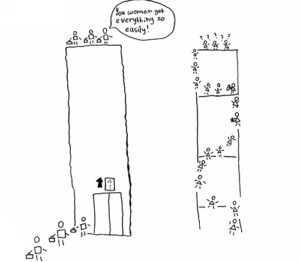
No one told me directly that I didn’t belong in the center of decision-making. But I quickly learned who was trusted with vision, who was seen as “strategic,” and who was expected to execute, adapt, and remain agreeable. This experience isn’t unusual. It’s part of a broader pattern many women in design leadership quietly recognize.
This article is not a collection of tips. It’s a reflection on the systems I had to build because the ones around me didn’t fit. If you’ve ever led a team and felt like the model you were handed wasn’t designed with you in mind, that feeling is real. You’re not imagining the gap. You’re navigating it.
Here’s what I’ve learned and what I’ve built, in the process.
Unwritten Rules: The Roles You’re Given Without Realizing It
No one told me I couldn’t lead. No one said I shouldn’t speak up. But it didn’t take long to understand which voices were consistently labeled as strategic and which ones were quietly rerouted into support roles.
In the creative industries, gender bias rarely presents itself directly. It operates through structure, vocabulary, feedback loops, and decision hierarchies. It’s not always visible, but it’s deeply embedded. Women in design leadership are often positioned as facilitators. They are tasked with “bringing clarity,” “translating vision,” or “getting things done,” but rarely with setting the direction.
These roles are considered valuable, until questions of authorship or authority arise. In branding and communication design, especially, leadership is often mistaken for presentation. The person who defines the problem, frames the brief, or owns the pitch is frequently viewed as the leader. Others may contribute deeply, but their roles are structurally limited by unspoken expectations.
The result is a consistent pattern: women are trusted, but not central. They are visible, but not directive. They move work forward, but are rarely positioned as the source of original vision.
As Caroline Criado-Perez explains in Invisible Women, systems inherit the perspectives of those who created them. Most creative leadership structures were shaped by men, and those structures tend to reinforce what authority is supposed to look and sound like. According to the AIGA Design Census, only 11 percent of creative directors in the U.S. are women. This is not due to a lack of skill or interest. It reflects a professional culture that still values volume, visibility, and decisiveness over shared authorship, process leadership, and systemic thinking. Qualities more commonly associated with women in the field.
Creative work may be collaborative in execution, but authorship often remains singular and disproportionately male.
Strategic Insight
Leadership bias in design is not always personal. It’s procedural.
When influence is measured by visibility and performance, it excludes those whose authority is rooted in clarity, structure, and emotional intelligence.
To address this, we need to shift from performance-based leadership to systems-based leadership, not “who speaks the most,” but “who shapes how the work gets done.”
Tactic
Audit your organization’s creative decision flow. Ask:
- Who defines the problem?
- Who establishes what success looks like?
- Who is interpreting whose vision?
Leadership isn’t just about who answers questions. It’s about who decides which questions matter.
From Accepted to Inconvenient: How Creative Leadership Penalizes the Uncontrollable
Women who succeed in creative leadership are often praised for their reliability. They’re recognized for their ability to manage details, maintain consistency, and bring stability to teams. Their leadership is described as thoughtful, diplomatic, and collaborative, exactly what many organizations claim to value. Until it becomes complicated.
In practice, the system favors continuity over complexity. And for women, complexity often takes the form of real life.
Motherhood, caregiving, illness, and other realities that interrupt the illusion of uninterrupted availability are rarely accounted for in creative leadership models. These interruptions are not signs of unreliability, but they are often treated as such. The professional culture, especially in fast-paced or client-facing teams, assumes that authority must always be present, responsive, and predictable. Any deviation is viewed as a liability, even when outcomes remain strong.
The shift is subtle. A woman who was once described as efficient and responsive is suddenly seen as distracted or emotionally unavailable. Her time is more structured, her energy less flexible, and her priorities more visible. The perception changes, even if the performance does not.
This perception is not rooted in actual results. It comes from a system designed around linear timelines and unbroken labor. A system where leadership is measured not just by what is delivered, but by how seamlessly it is delivered.
In this model, change is interpreted as decline. And women, in particular, are penalized for evolving in ways that don’t match the default leadership mold.
As Anne-Marie Slaughter argued in Why Women Still Can’t Have It All, the issue is not that women are incapable of holding power. The issue is that the structures around leadership were never designed to accommodate the rhythms of actual life, especially not the lives of women.
Strategic Insight
Creative leadership models that assume uninterrupted availability are structurally exclusive.
They reward those who maintain consistent presence, not those who lead through sustainable, adaptive systems.
To build long-term leadership capacity, organizations must separate influence from availability and treat personal change not as disruption, but as part of the design process.
Tactic
Build systems that anticipate and absorb change, rather than collapse under it:
- Design team workflows with shared ownership and built-in flexibility
- Establish protocols for transitions, leaves, and returns well before they’re needed
- Evaluate leadership not by constant visibility, but by how well a team performs when its leader steps away
If your leadership model only functions when everything goes according to plan, it isn’t a model.
It’s a fragile workaround.
Designing Leadership Instead of Emulating It
Women in creative leadership are often given two narrow templates. The first is based on assertiveness, decisiveness, and control, what is traditionally read as a “boss.” The second leans toward empathy, flexibility, and support, what is easily labeled as the “mother figure.” These modes may appear to be opposites, but in reality, they are both reactive positions within a system not designed to support more diverse expressions of leadership.
What’s missing in this binary is structure. Not structure as constraint, but structure as a creative framework for authority. Many women don’t lack strategic vision or leadership capability, they lack a model that shows how to build authority without relying on volume, performance, or the appearance of control.
When I began leading teams, I wasn’t trying to adopt a style. I was trying to design conditions where creative work could happen consistently, across time zones, roles, and levels of experience. This led to what eventually became my methodology: BRAND IS A VERB, a system for collaborative leadership based on clarity, iteration, shared authorship, and operational transparency.
This model wasn’t developed in isolation. It emerged from daily friction: feedback loops that broke down under ego, design reviews that became political rather than productive, teams that didn’t burn out from the volume of work but from the absence of rhythm.
What I learned is that structure is not the enemy of creativity. It’s what allows creativity to survive under pressure.
The more clearly expectations were articulated, through project milestones, decision maps, and shared review rituals, the less leadership had to be performed. Authority moved out of personality and into process.
IDEO’s research on collaborative teams supports this. Their findings show that the most resilient creative systems are those in which leadership is distributed, visible, and embedded in the workflow, not concentrated in one voice or title. In other words, good systems replace the need for constant supervision with a shared understanding of direction.
Brené Brown’s work on vulnerability and clarity in leadership echoes this idea. “Clear is kind” is not just an interpersonal mantra, it’s an operational principle. Clarity reduces emotional noise. It allows teams to move without guessing. And it shifts responsibility for outcomes from individuals to the systems that support them.
Strategic Insight
Women in leadership don’t need louder voices.
They need visible systems that reflect how they already lead, through process, shared accountability, and structured creativity.
When leadership is treated as a designed environment rather than a personal brand, it becomes more stable, more inclusive, and more effective.
Tactic
Build systems that hold authority, so people don’t have to carry it alone:
- Make key decisions and criteria visible to all team members
- Establish regular check-ins with consistent formats and clear agendas
- Document what success looks like at every stage, before feedback is needed
Leadership is not defined by how often you speak.
It’s defined by how clearly the system operates when you’re not in the room.
What I Had to Build: Leadership Tools for Women Who Were Never Meant to Lead Like Men
Emotional Architecture
In many creative environments, women are expected to manage not just the work, but also the emotional tone of the team. They are encouraged to be emotionally intelligent, but not too emotional. Empathetic, but not reactive. Aware of others’ needs, while minimizing the visibility of their own.
This creates a false binary. Either you remain composed and strategic, or you risk being perceived as unstable or “difficult.” In this model, emotions are seen as noise, something to contain or control.
I chose to approach it differently. Rather than managing emotion in silence, I started designing around it. In the same way we adapt a design to meet a set of constraints, I treated emotional tension not as a flaw, but as a signal. It offered valuable insight into what was blocked, misaligned, or simply unsustainable.
That’s when we began integrating what I now call emotional checkpoints into our team process. These weren’t performance reviews or one-on-one check-ins. They were light but intentional prompts built into the workflow, brief moments to surface what was stuck, what felt heavy, what hadn’t been said. They revealed patterns early, which meant we could act before tension turned into burnout or miscommunication.
This wasn’t about turning leadership into therapy. It was about acknowledging that emotion affects creative output. When named and addressed early, it becomes manageable. When ignored, it leaks into decisions, timelines, and interpersonal dynamics.
Brené Brown writes that vulnerability and clarity are not opposites, they enable each other. Emotional openness doesn’t mean chaos. It allows for operational honesty. And research from Harvard Business Review supports this: women score higher across key leadership competencies precisely because of their emotional awareness, not in spite of it.
The problem has never been our emotional fluency. The problem is that most leadership systems don’t treat it as a strategic skill.
Strategic Insight
Emotion is not something to suppress in leadership. It’s something to design for.
Teams that are allowed to speak honestly about emotional tension work more efficiently, not less. They also recover faster from setbacks and sustain collaboration over time.
Tactic
Add structured space for emotional signals within your workflow:
- Include one reflective prompt in weekly team reviews (e.g. “What feels harder than it should right now?”)
- Allow anonymous feedback formats when direct conversations feel difficult
- Normalize naming friction early, so it doesn’t accumulate under pressure
You don’t need to manage emotion.
You need to create systems that can process it productively.
The Dual Clock
Traditional models of creative leadership operate on the assumption that everyone runs on the same clock. There is one project timeline, one measure of availability, one definition of urgency. The expectation is consistency, predictability, and the ability to respond at pace, regardless of what’s happening behind the scenes.
But time is not neutral. And it is never singular.
For many women in leadership, time already splits into parallel systems. There is the official timeline, deadlines, deliverables, performance reviews, and the unspoken one: caregiving, chronic fatigue, menstrual cycles, mental load. These layers don’t disappear when you step into leadership. They become more visible, and more incompatible with a structure that rewards continuous availability.
After becoming a mother, I recognized how little space the system allowed for nonlinear rhythms. There were moments of deep focus and energy, but there were also sharp interruptions: some planned, some unpredictable. The question wasn’t how to avoid them. The question was how to lead through them without compromising the team or myself.
That’s when I began designing what I now call The Dual Clock.
One clock tracked project velocity: client expectations, delivery milestones, review cycles.
The other tracked human velocity: energy, care responsibilities, emotional fatigue, and the need to pause.
Together, these timelines allowed me to see when pressure was building below the surface. They made space for planning realistic capacity, not idealized output. They also allowed team members to communicate needs more clearly, without feeling like they were failing the work.
This approach isn’t about slowing down. It’s about building structures that expect variability and absorb it without chaos. Urgency becomes the exception, not the culture.
Anne-Marie Slaughter wrote that women “can’t have it all” not because we aren’t capable, but because the professional world hasn’t adjusted to the way real life works. When we treat continuous performance as the only acceptable form of authority, we limit who can lead and how long they can sustain it.
Time is not a fixed input. It’s a living variable. And it’s time leadership started treating it that way.
Strategic Insight
Leadership built on unbroken timelines will always exclude those who lead while living.
Resilient leadership is not about doing more. It’s about structuring time to support long-term clarity, decision-making, and human needs,without apology.
Tactic
Rebuild your workflows to reflect the reality of dual timelines:
- Break large deadlines into micro-cycles with regular check-ins and re-assessment
- Schedule intentional recovery points after high-output phases
- Create visible (and protected) time buffers, especially around reviews and delivery
- Normalize conversations about energy, not just progress
If your calendar only tracks deliverables, it’s measuring the work,not the people doing it.
Structural Authority (Instead of Volume)
In many creative environments, authority is performed rather than structured. It’s demonstrated through how someone presents in a room, how quickly they respond to pressure, or how confidently they assert direction. Leadership becomes something you signal,through voice, tone, presence, rather than something you design.
This model creates barriers for anyone whose leadership isn’t built on volume or charisma. For women in particular, this often results in a double bind: speak too directly and you’re perceived as aggressive; speak with measured clarity and you’re seen as passive. Delegate and you’re considered peripheral. Take control and you’re judged for overstepping.
Eventually, I stopped trying to resolve that tension through tone. I focused instead on structure.
Rather than carrying every decision myself, I built systems that made decision-making visible and repeatable. Rather than reinforcing authority through presence, I designed environments where expectations were clearly documented and accessible, regardless of who was in the room.
This shift allowed leadership to live in the system, not in me.
What emerged was a model of structural authority:
- Goals were defined and mapped at the outset, not reinvented midstream
- Roles and decision paths were visible to everyone, not assumed through hierarchy
- Feedback flowed in established rituals, not improvised under pressure
According to IDEO, the most effective creative systems are those where leadership is embedded in process, not concentrated in personality. That doesn’t mean absence of direction. It means the direction doesn’t depend on constant performance.
Designer Jessica Walsh has noted that many women lead through rhythm, design logic, and consistency, yet their authority is often overlooked because it doesn’t conform to expected cues. This is not a matter of talent. It’s a matter of recognition.
When systems are built well, leadership becomes durable.
It scales, adapts, and survives absence.
And that’s what makes it powerful.
Strategic Insight
Leadership rooted in process is not less human, it’s more resilient.
It frees the team from relying on tone and presence and allows decisions to emerge from shared understanding rather than performance.
For women whose leadership doesn’t fit traditional patterns, structure isn’t just support. It’s strategy.
Tactic
Transfer authority from personality to process:
- Make decisions traceable by documenting why and how they were made
- Create shared tools (dashboards, workflows, templates) that guide without needing constant reinforcement
- Standardize rituals for feedback, handoffs, and reviews, so they don’t depend on mood or memory
- Rotate facilitation and review leadership to democratize decision space
You don’t need to raise your voice. You need to raise the quality of your structure.
The Permission Loop
In many professional environments, especially in creative fields, women are conditioned to wait.
To wait for the next role, for more clarity, for a formal title that confirms their influence.
The system doesn’t always deny their ideas, but it rarely positions them as the ones who define direction.
This is what I call the permission loop: a quiet cycle of competence without authorship, responsibility without autonomy, presence without full authority.
It doesn’t always come from explicit exclusion. Often, it’s the result of a structure that assumes leadership looks a certain way — visible, singular, confident, uninterrupted. If your work doesn’t match that image, you’re perceived as “not quite ready.” Even when you’ve already been leading for years.
For a long time, I believed that if I proved myself, I’d eventually be invited in. That the work would speak for itself and that recognition would follow. But what I learned is that systems designed to withhold authorship rarely offer it freely.
So I stopped waiting. And I started designing.
I began creating systems and frameworks before being asked. I offered solutions before there was a brief. I made processes clearer not because I was told to, but because the team needed them. Over time, the things I created became integral to how decisions were made and how work moved forward. The question was no longer whether I had permission. It was whether the system could function without the structure I had built.
This shift, from requesting inclusion to owning infrastructure, is what defines authorship in leadership.
It doesn’t rely on validation. It creates evidence.
And evidence is harder to ignore than ambition.
As Elizabeth Gilbert notes in her writing on creative work, permission is rarely granted in a meaningful way. It emerges through action. It becomes visible through what you’ve already made.
Strategic Insight
Leadership that is granted can be taken away.
Leadership that is built, through structure, process, and clear contribution,cannot be ignored.
Women are often expected to wait for formal recognition. But the most effective shift happens when they begin designing from the inside out, whether or not the system invites them to.
Tactic
Create authority through contribution, not permission:
- Design frameworks before you’re asked to lead them
- Document the structures you’ve already built, and make them visible to others
- Share tools and systems as authored work, not just internal support
- Treat your operational clarity as intellectual property
You don’t need to be asked to lead.
You need to make the architecture of your leadership undeniable.
Final Note: You Don’t Need to Perform Leadership,You Can Design It
For a long time, I believed that leadership was something you eventually grew into. That if you delivered good work, took on responsibility, and stayed consistent, the system would recognize it and offer the rest. But over time, I began to understand that the leadership I was waiting for wasn’t just a role or a promotion. It was a framework. And that framework, in most places, didn’t exist.
The model I saw rewarded was based on performance: being constantly available, visibly in control, and personally driving every decision. It wasn’t just demanding, it was narrow. It left little room for shared authorship, collective pacing, or the invisible work of holding a team together.

What I’ve built over the last decade wasn’t just a method or a process. It was a response to that limitation. A response to a system that defines leadership through traits I never fully identified with, but still had to navigate. Clarity became my foundation, not charisma. Architecture became my strategy, not visibility.
This doesn’t mean I lead quietly because I’m unsure. It means I design so that leadership doesn’t have to be loud. It can be embedded in systems, visible in structure, and experienced through how well the work flows, without needing to be performed.
If the leadership model handed to you doesn’t reflect the way you work, that doesn’t make you an exception. It means the model is incomplete. And if you’ve ever stepped back from the noise to rebuild the process itself, mapped decisions, clarified expectations, made space for tension, held the team during uncertainty, you’re not outside the leadership frame. You’re redrawing it.
The shift is not from contributor to executive. It’s from presence to architecture. From approval to authorship. From asking to defining.
And the most effective leadership I’ve seen, especially from women, is not about becoming what the system already understands. It’s about building what it’s missing.
