
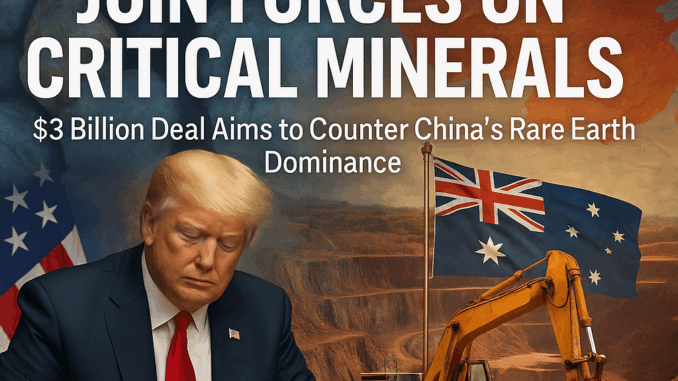

In a move to counter China’s dominance in the critical minerals industry, President Donald
Trump signed a significant agreement with Australia on Monday, committing a combined $3
billion to mining and processing projects, and to a price floor for critical minerals. The move
is something long desired by Western miners, while both countries will also sign off on
financing that includes offtake rights.
While the wide-ranging agreement feels like a blockbuster move and will bring much
needed financial support to the industry, experts say it will still be a while before China’s
stronghold on the mineral market is weakened.
The White House says the U.S. investments in Australia will unlock deposits of critical
minerals worth $53 billion but has not offered many details regarding the process. Trump
said in a year they “would have so much critical mineral and rare earths that you won’t
know what to do with them.”
Global mining industry experts welcomed the news, which would open investment
opportunities, but were skeptical on Trump’s timeline.
“In general, in the rare earths industry nothing can happen quickly,” said Barrenjoey
financial analyst Dan Morgan. “I don’t think we are going to be swamped with supply growth
and there’s no way we will be swamped in a year. We might have supply growth in 5-7
years,” he said.
As trade tensions and security concerns continue to heat up, the U.S. and its western allies
have been looking for ways to loosen China’s grip on the mineral market. China accounts
for 90% of the mining capacity for rare earths, which have critical uses in defense,
automobiles, chip technology and clean energy. Though rare earths are common in the
earth’s crust, China has developed the technically difficult and environmentally harmful
refining process and have done it relatively inexpensively.
However, China squeezed global automakers last spring with export controls on rare earth
items and related magnets, and just this month, expanded its export controls in lieu of
Trump announcing forthcoming tariff increases.
Benchmark prices for China’s most popular rare earths, NdPr oxide, rallied by as much as
40%, before retreating to $71 per kilogram, but western world developers are calling for
governments to support higher price floors that will enable them to build production.
But it is unrealistic to expect further price drops and a suddenly inflated supply of minerals.
However, the biggest winners of the project are clearly miners. Following the
announcement, the U.S. Export-Import bank sent seven letters of interest to miners in
Australia totaling more than $2.2 billion in potential funding.
“It’s good for us, and it’s good for our industry counterparts,” said Arafura CFO Peter
Sherrington, speaking at the Imarc mining event. “The big thing it does is derisk raising
money from an equity perspective.”
Arafura’s biggest shareholder is Australian mining magnate Gina Rinehart, a vocal Trump
supporter who attended the president’s inauguration party in Mar-a-Lago in January.
However, it is important to remember that critical mining projects will not be viable without
a change in buying habits. If customers do not get out of the tendency to buy from the
cheapest option, the struggle to break free from China’s grip may still be a long way off.
