
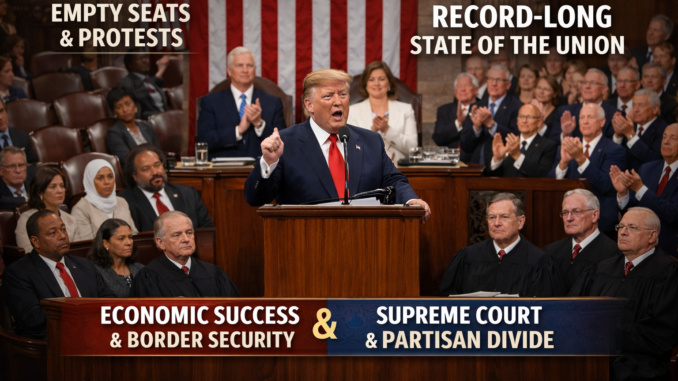

President Donald Trump’s second State of the Union address of his second term set a record for length, blowing away not only his own long address of last year, but the previous all-time longest address, delivered by Bill Clinton in 2000, by a full 20 minutes.
In doing so, Trump highlighted his administration’s economic achievements, his efforts to end global conflicts abroad and his ongoing pursuits of hammering out new international trade deals and securing the nation’s borders.
Unlike previous addresses, usually delivered to a packed House chamber, one side of the room was scattered with empty rows of seats, as many members of the Democratic Party refrained from attending the address in an act of protest directed at the president.
In addition to the expected partisan tension in the building, Trump was still reeling from the Supreme Court’s decision three days earlier to strike down his tariff policy and made a point of calling them out during the speech.
Four of the five justices attended the address, and Trump kept his remarks about their decision relatively muted, referring to the decision as “unfortunate” and “disappointing,” while the justices themselves retained their usual stoic demeanor.
Trump also indicated he was already pursuing other legal avenues to keep the tariffs in place, regarding them as a benchmark of his recent economic success.
In touting his administration’s policies, Trump referred to the economy as “the hottest…anywhere in the world” and said that “we have more jobs, more people working today than ever before in the history of our country.”
While the official unemployment rate has remained low—4.3% as of last month—many economists have expressed concern over the lack of jobs being created, despite better-than-expected GDP numbers last quarter, signaling perhaps that a “jobless recovery” is unfolding.
Despite low unemployment, data shows that job gains slowed in 2025 and were smaller than in any other non-pandemic year.
Revised data published by the Bureau of Labor Statistics early this month reported that last year, the net jobs gained by the U.S. totaled 181,000—far lower than previous estimates and making it the weakest year for job growth since 2020.
Comparatively, that number ranged from 1.5 million to 2.5 million during Trump’s first term.
Trump also stated that the U.S. has, under his leadership, secured more than $18 trillion in new investments “from all over the globe,” also a byproduct of his tough tariff policy.
Still, the official White House website lists total U.S. and foreign investments at $9.7 trillion, while others cite that Trump’s claims included so-called “pledged investments,” not actual investments.
Throughout the address, during the standard breaks for applause, the Democratic side did not stand or positively acknowledge any of the president’s proclamations, save for his introduction of the U.S. gold-winning men’s hockey team, just returning from Olympic competition.
As the address wore on, Trump increasingly chided the other side of the aisle, at one point going so far as to say:
“These people are crazy. I’m telling you, they’re crazy.”
To illustrate the recalcitrance of the minority party, Trump said:
“The first duty of the American government is to protect American citizens, not illegal aliens,”
and prefaced his remark by asking those who agreed to stand.
As the cameras pulled back, one half of the room continued to sit, while the other side stood cheering.
While the act of one political party not openly standing for an opposing president’s proclamations is nothing new, Tuesday’s address was marred by several moments of open heckling from the opposing aisle, from Democratic Representative Ilhan Omar of Minnesota repeatedly shouting, “That’s a lie, you’re a liar,” to Congressman Al Green of Texas being escorted out after holding up a sign chastising Trump for an alleged racist post on social media.
Such outbursts, once unheard of, have become more commonplace at recent State of the Union addresses, and while members of both parties have faced public criticism for their outbursts, rarely has any official reprimand by either party been issued.
Additionally, Trump used the address to highlight individuals who have sacrificed in their service to America, including honoring two with Congressional Medals of Honor: one, an Army officer and helicopter pilot wounded during the Maduro takeover off the coast of Venezuela; the other, a 100-year-old Navy captain honored for a recently declassified aerial combat mission during the Korean War.
On the international front, Trump repeated a warning to Iran over nuclear weapons, though he touched on the subject only briefly, not giving lawmakers any clear idea of what will happen if diplomatic talks break down.
The thankless task of presenting the Democratic response was given to Virginia Governor Abigail Spanberger.
Delivering the address from Colonial Williamsburg, a living history museum with 18th-century colonial buildings, Spanberger rebuffed Trump’s assertion that the country is entering a new “golden age,” claiming his focus is not on American families struggling with the real issue of affordability and that his tariff policy has made it far more difficult for many Americans already struggling with rising costs.
