
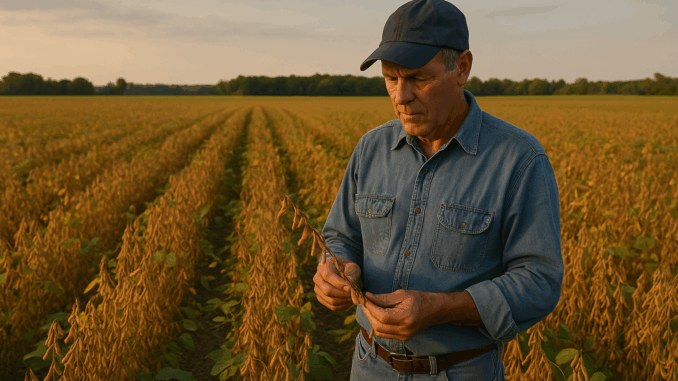

Perhaps the hardest hit in the trade war to this point is the American soybean farmer. With retaliation tariffs in place from China, the U.S. soybean market has lost one of its largest buyers. Last year, China purchased over 51 percent of American soybean production. This year, they have purchased none.
The collapse of the market has led to many farmers reeling from a huge loss on their soybean crop for the season, affecting not just their business, but any businesses that rely on farmers getting their products to markets. The fallout reaches far beyond the farms themselves, affecting all rural American businesses.
In lieu of this, the Trump administration has been reportedly crafting a significant bailout bill geared toward American farmers, reportedly in the $10–$15 billion range. However, with the government still entrenched in a shutdown, there will be no forward advancement of the bailout until the cessation is resolved.
As with most bailout plans, any injection of cash flow will help, and the administration has touted the large amounts of capital that have flooded their coffers since the tariffs have been imposed. President Trump himself has publicly stated he’d like to use the tariff-generated tax revenue to provide relief for farmers. But many farmers admit, a bailout is nothing more than a “band aid on a bad wound.”
And this doesn’t fully consider the residue of the first trade war in 2018, when China began shopping around for more favorable options for grain and soybean purchase. That standoff resulted in a 77 percent drop of U.S. soybean exporting. While some farms have recovered, many have not.
Some of the buyers that left in 2018 have not come back, and markets of this type—those built on good relationships, good transactions and negotiating in good faith—can be undone very quickly.
Matt Rehberg, who operates a farm near the Wisconsin–Illinois border and is vice president of the Wisconsin Soybean Association, says any bailout will only help temporarily. “We want markets,” said Rehberg. “Markets are consistent. We can bet on them. When you go with these ad hoc bailout programs, they definitely help. But it’s like putting a band aid on a gunshot wound.”
Beyond the immediate help that a capital injection can provide, the larger issue is the stilted trade plan. With global buyers getting more of their product from South American farms, U.S. farming needs a trade approach that gets all the way down to the farms themselves, and one that benefits rural communities.
Some say despite Trump’s rhetoric, we are no closer to a fair deal for American farmers. Aaron Lehman, president of the Iowa Farmers Union, which represents growers in the second largest soybean-producing state in the nation, says that we are not any closer to fair trade for farmers. “We have big issues that we need to address to get to fair trade,” said Lehman. “We need to address all those issues so that, when we pass a trade agreement, it doesn’t just benefit the grain traders and those few corporations who control the grain trade. We do need to make reforms, but this approach isn’t getting us anywhere near that. In fact, we’re moving farther away from getting the fair trade that makes a difference for farmers.”
With grain farmers typically rotating between soybeans, corn and wheat, most are likely to feel the impact of international trade barriers as well, says Jonathon Coppess, a professor of agricultural policy at the University of Illinois. Continuously shifting federal trade policy makes it harder for farmers to plan for next year’s crop, because they do not know what markets will or will not be available to them.
“Farmers can’t plan around political talking points or slogans and social media posts,” Coppess said. “None of that helps deal with the uncertainties and risks in farming.”
Though farm bankruptcies have increased in the first two quarters of 2025, they remain low, according to a September report from the Minneapolis Federal Reserve. Still, farmers remain focused on market income, rather than government bailouts.
“Certainly, any kind of a bailout will help agriculture. It’ll help farmers,” says Chris Gibbs, a farmer in west central Ohio who owns and operates 560 acres of corn, soybean and wheat production. “It’ll help relieve what we are currently in, which is a major cash flow and working capital crisis. But that’s not what farmers want. Farmers, ranchers, men and women that work in agriculture, these are independent folks. And they’re not interested in bailouts. They’re interested in our markets.”
