

Most business owners know when a brand is visibly in trouble.
Sales soften. Discounts multiply. Customers come around less often. Retailers or partners seem less enthusiastic. Profitability sinks. The team begins using phrases like “temporary headwinds,” which is often a respectable way of saying: something is wrong, but nobody quite knows what is wrong.
The hard part is accurately diagnosing the problem while it is still small enough to fix.
Because brands rarely collapse in one dramatic moment. They usually weaken organ by organ. First they lose some of their pull. Then pricing becomes harder to sustain. Then the brand becomes easier to replace, and easier for customers to live without.
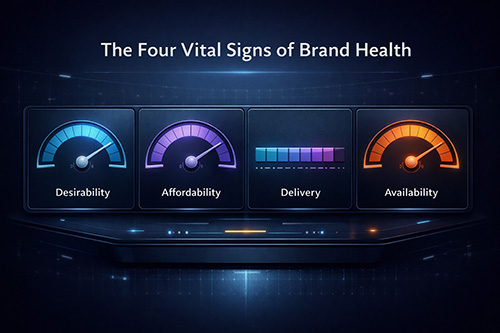
That is why, as a practitioner, I have developed a simple model for judging brand health:
DADA – Desirability, Affordability, Delivery, and Availability.
If those four vital signs are healthy, a brand is usually in good shape. If one weakens, the others often wobble too. That is true whether you run a restaurant chain, a home-services business, a franchise network, or a consumer brand on retail shelves. DADA forces four practical questions:
Do people want you?
Does the price feel justified?
Does the experience deliver?
Are you easy to find and the ones people first think of?
Desirability: Do People Still Want You?
Desirability is the reason customers choose your brand over a perfectly acceptable substitute.
That reason can be functional: maybe you solve the problem better. It can also be emotional or social: maybe your brand feels more reassuring, more modern, or simply less embarrassing than the alternative.
A vivid example is DYC, a long-established leading whisky brand in Spain. DYC is widely known. Most Spaniards have drunk it at some point, often in their late teens, sometimes
before waking up feeling as if someone had replaced their saliva with sand. Awareness is not the issue. Familiarity is not an issue. There is even affection around the brand. People still know it, may even smile at the memory, but they no longer feel particularly good ordering it. One consumer captured the problem perfectly: “I like it. But look at the packaging. I’m embarrassed to order it.” That is desirability erosion: recognition without desire. The brand becomes like an old friend you remember fondly but hesitate to invite him to dinner because he might show up in cargo shorts and somehow lower the tone of the whole evening. And once desire goes, pricing power usually goes with it.
Affordability: Does the Price Still Feel Worth It?
Affordability does not mean cheap. It means the price feels acceptable for the value delivered, in that occasion, with that budget, versus the alternatives.
This is why affordability is not only a price problem. It is an occasion problem. Consumers are not calculating your average price per liter. They are asking a simpler question: what does this cost me right now, and do I feel okay paying it?
That is why, for example in the case of packaged goods, format matters so much. Sometimes shoppers want the lowest possible out-of-pocket spend. Other times they want stock-up, sharing, on-the-go, or smaller-household formats. If the right format is missing, the brand feels expensive even when the average price is competitive.
Coke is a superb benchmark here. It protects perceived affordability with disciplined pack-price architecture: single packs for low out-of-pocket purchases, small multipacks for smaller households, larger formats for value and sharing occasions. That is not just pricing. That is affordability engineering.
That is also what made Oasis such an interesting case. Oasis is one of Europe’s leading juice-drink brands, especially strong in France. It is sold at a premium to Private Label brands. For years, it leaned into a message of healthy simplicity: “spring water and fruit”, honest reassurance, nothing too complicated. It worked, until that same message started making the premium feel unnecessary. In a juice-drinks category where private labels were structurally strong, consumers made the most logical leap in the world: “if it’s that simple, the cheaper one is probably just as good.”
That is affordability in its purest form. The premium price stopped feeling earned.
Delivery: Does the Experience Match the Promise?
Desirability is the promise. Delivery is the proof. It’s where the brand walks the talk.
You can have strong marketing, broad visibility, and a price that looks fine on paper. But if the actual product or service disappoints, the brand eventually gets found out.
This is where many businesses make a very expensive mistake. When quality weakens, the reflex is often to advertise harder. That usually makes things worse. More advertising may briefly drive more trial, but if the experience still disappoints, all you have done is increase the number of people discovering that you have a quality problem. You have boosted desire without fixing delivery.
Because you can’t easily advertise your way out of a quality problem, the wiser sequence in most cases is the opposite: fix quality first, then advertise.
A legendary example is Harley-Davidson in the 1980s. Harley did not have a desirability problem. The brand was iconic. What it had was a quality problem, or at least a quality-perception problem. For years, Harley bikes carried a reputation for questionable reliability. Harley could have run solemn ads about improved engineering, but nobody would have believed them.
Instead, Harley ran an ad showing a group of men who looked very much like the kind of people who would react poorly to roadside disappointment: leather, beards, tattoos, and the general air of men unlikely to respond to a mechanical failure with a calm call to customer service. The line was simple: “Do you think we would sell a bad bike to guys like these?” It was brilliant because it made quality believable indirectly. Harley did not claim quality. It staged proof of it.
That is the lesson: quality is credible when customers can feel it, see it, or infer it from evidence. Not when the brand merely announces it.
Availability: Can Customers Find You, and Think of You?
Even a highly desirable, well-priced, well-delivered brand can struggle if it is hard to access or easy to forget.
Availability has two forms. The first is physical availability: shelf presence, distribution, visibility, access, operating hours, searchability, convenience. The second is mental availability: when the customer has the need, do they think of you? People buy what is easy to notice, easy to reach, and easy to recall.
But availability is not just defensive. When real desirability already exists, stronger availability can transform a brand’s scale.
That is why Celsius is such a useful example. Celsius is an energy drink brand that surged into the No. 3 position behind Red Bull and Monster thanks to explosive growth from 2020 to 2023. The desirability was already there. What changed the game was a major boost in availability: more distribution muscle, much bigger shelf presence, and far stronger visibility, helped in particular by PepsiCo distribution deals and by the turbulence around competitor Bang.
Celsius did not create demand out of thin air. Broader availability simply unleashed it.
Jack Daniel’s, the iconic Tennessee whiskey brand, offers a useful companion case. In Germany, it expanded in smaller “habit factories” – clubs, hotel mini-bars, convenience stores – while rival Jim Beam stayed stronger in the big-volume outlets. Those smaller channels did not look spectacular on a spreadsheet, but they increased everyday exposure. And that is the point: as availability grew, so did familiarity, and over time, desirability expanded with it.
What later looks like a sudden shift in preference is often just visibility doing its work.
Why DADA Matters
The value of DADA is not just that it gives you four neat boxes. It helps you understand the chain reaction inside a weakening brand.
If delivery weakens, desirability usually follows.
If desirability weakens, affordability becomes fragile.
If affordability becomes fragile, frequency drops and discounting rises.
If availability grows, so does familiarity, and in the end, desirability.
A good recent example is Prime, the influencer-backed sports and energy drink brand that emerged in the U.S. Its European story, especially in markets such as the UK, France, and Spain, is especially revealing. Before it was widely available there, Prime behaved less like a beverage and more like a cultural event. Teenagers hoarded it. Parents queued for it. Retailers treated it like liquid gold. Selective shortages made it even more desirable.
Then reality arrived.
Consumers expected an energy-drink experience. Prime did not fully deliver the kind of noticeable kick the category had trained them to expect. In DADA terms, the initial problem was delivery. Once that happened, desirability faded as novelty wore off. Affordability
deteriorated too, because discounting undermined the value equation and the aura of rarity. Then availability weakened as retailers reduced shelf space or quietly delisted it.
That is the real lesson of DADA. Brands do not usually decline because one thing goes wrong in isolation. They decline because one organ weakens, then the others start failing in sequence.
A healthy brand is wanted. It feels worth the price. It delivers what it promises. It is easy to find and easy to remember.
If all four are strong, growth is usually built on solid ground.
If one starts to fail, act early. In brands, decline rarely stays confined to one organ.
