
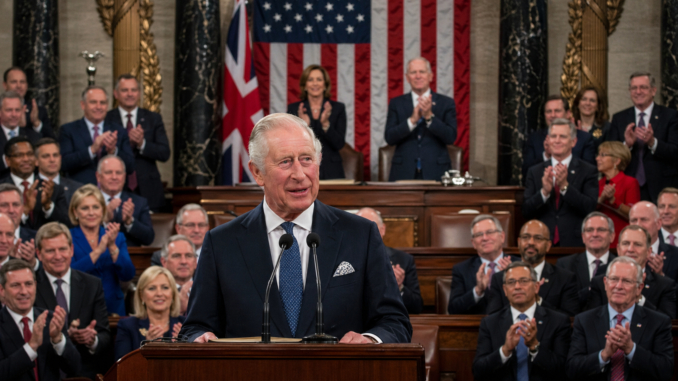

For the first time in more than three decades, a British monarch addressed a joint meeting of the U.S. Congress—and received something rarely seen in modern congressional gatherings: a broadly positive response from lawmakers on both sides of the aisle.
King Charles III became the first British monarch to address Congress since 1991, delivering a measured speech centered on shared democratic values, the rule of law and the enduring relationship between the United States and the United Kingdom.
Charles defended the foundations of Western democracy, including checks and balances, international alliances and religious tolerance, while also emphasizing that longtime allies can disagree without fracturing their broader relationship.
Members of both parties applauded many of the same lines, laughed at the King’s historical jokes and repeatedly rose for standing ovations.
At some moments, Democrats appeared more enthusiastic, particularly when Charles spoke about executive authority being constrained by checks and balances. At others, Republicans responded more strongly, including when the King referenced the importance of religious faith.
The symbolism was hard to miss: a constitutional monarch speaking before the legislative branch of a republic founded through a revolution against the British Crown.
Some critics of President Trump have argued that his approach to executive power has tested traditional limits on the presidency, giving Charles’ remarks on constitutional restraint an added political resonance. Still, the King avoided direct criticism and instead focused heavily on the longstanding partnership between the two countries.
Charles described the U.S.-U.K. relationship as enduring and indispensable, while praising American achievements and the countries’ shared history.
Relations between Washington and London had faced some strain over Britain’s approach to the ongoing conflict with Iran, including disagreements over military cooperation. Even so, President Trump was openly welcoming toward Charles and repeatedly praised the historic relationship between the two nations.
In his own remarks, Trump invoked the alliance between President Franklin D. Roosevelt and British Prime Minister Winston Churchill during World War II and spoke of the two countries’ shared commitment to freedom.
Trump has also long expressed admiration for the British monarchy and has frequently spoken about his late mother’s Scottish heritage and her respect for Queen Elizabeth II.
During the state dinner, Charles also referred to the recent attack connected to the White House Correspondents’ Dinner and praised Trump’s response.
The King then presented Trump with one of the visit’s most memorable gifts: the original bell from the conning tower of HMS Trump, a Royal Navy submarine launched during World War II and later deployed in the Pacific.
Charles used the moment for one of the evening’s biggest laughs.
“Should you ever need to get hold of us, well just give us a ring,” the King said.
The visit was tied in part to celebrations surrounding the 250th anniversary of American independence, giving the occasion an added layer of historical irony.
Charles acknowledged that history directly, noting that the countries do not always agree while emphasizing that disagreement does not have to weaken the underlying alliance.
The broader significance of the visit may have been less about any single policy issue than about the spectacle of bipartisan warmth in a deeply divided political environment.
At a time when Congress often struggles to find agreement even on basic questions of governance and national identity, a British monarch—representing the institution against which the American Revolution was fought—managed to receive sustained applause from both parties.
That historical contradiction was part of what made the moment notable.
Nearly 250 years after the United States broke from the British Crown, the constitutional monarchy and the American republic now stand as close allies, bound less by the political systems that once divided them than by the democratic traditions and shared history that developed afterward.
