

While the United States and other global powers wait for Tehran’s response to the peace
proposal presented to them, a looming jet fuel shortage could compound the energy crisis
already playing out in the U.S. and abroad, as global travel faces a particular challenge.
With the log jam continuing at the Strait of Hormuz, the head of the International Energy
Agency alluded that Europe has “maybe six weeks or so” of remaining jet fuel supplies.
IEA Executive Director Fatih Birol called the current situation the “largest energy crisis we
have ever faced”, stemming from the pinch-off of oil, gas and other supplies usually
traversed through the Strait of Hormuz.
“In the past there was a group called ‘Dire Straits.’ It’s a dire strait now, and it is going to
have major implications for the global economy,” said Birol in a statement to the press.
“And the longer it goes, the worse it will be for the economic growth and inflation around
the world.”
Some countries are better situated than others, as far as oil and jet fuel supplies, but if the
conflict continues, at some point all nations will begin to feel the pinch.
In Great Britain, 13,000 international flights will be cut this month, totaling nearly two
million seats being removed for May. Still, the cuts in the U.K. are considered “marginal”,
according to the travel agents’ trade body Advantage Travel Partnership.
Currently, airlines in the U.K. are not experiencing supply problems, but experts warn that
continued disruption of deliveries could cause shortages in weeks.
“Some countries may be richer than the others. Some countries may have more energy
than the others, but no country, no country is immune to this crisis,” said Birol.
Istanbul and Munich have seen the largest reduction of flights, according to figures from
aviation analytics firm Cirium.
Many airlines have already pushed up ticket prices. Air France, KLM, Air Canada, Delta and SAS
have already trimmed their summer schedules. German airline Lufthansa said it would remove
20,000 flights between now and the end of October. Air Canada also stated last month that they
were canceling service to New York’s JFK International Airport between June and October due to
the surge in fuel prices.
Spirit Airlines shut down altogether, following a failed merger with JetBlue, two bankruptcy
filings in two years and a liquidity crisis made worse by the spike in jet fuel costs.
The U.K. is preparing several concessions for the pending crisis, including allowing airlines to
cancel flights at busy airports like Heathrow well in advance without risk of losing valuable
landing and take-off slots.
U.K. Travel Secretary Heidi Alexander said there is currently no shortage of jet fuel, but “this is
clearly an evolving situation.” The U.K. imports about 65% of the jet fuel it uses, a significant
portion of which comes from the Middle East under normal circumstances.
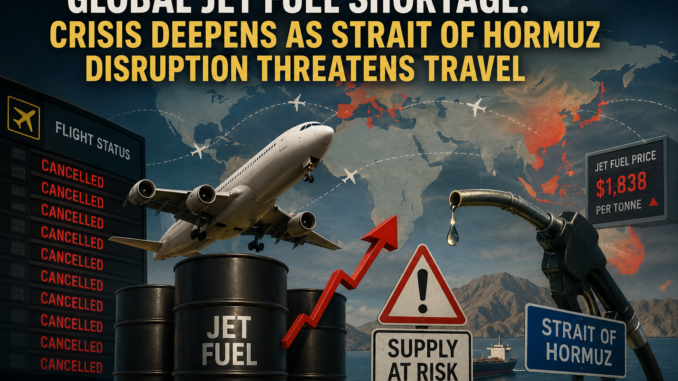
Jet fuel prices have more than doubled since the beginning of the war — one tonne (metric ton)
was trading at $831 in late February, and by early April, it hit a high of $1,838.
Larger airlines have advantages in regions with shortages. They have the financial means to
deal with high prices, said Jacques Rousseau, managing director of the financial firm
Clearview Energy Partners.
Asia-Pacific countries are most reliant on jet fuel from the Middle East, followed by Europe.
Most of Europe’s jet fuel is produced by European refiners, but about 20-25% of its supply is
missing because of the war, said Rousseau.
To help make up the difference, the U.S. increased its exports of jet fuel to Europe, sending
about 150,000 barrels per day in April, or about six time the normal level, according to
Rousseau. Availability of jet fuel is less of an issue in the U.S., being a major producer of oil
themselves.
“It’s just going to cost more here, whereas in different parts of the world you could actually
get to a point where there’s just no fuel,” Rousseau said.
The world is losing 10 million to 15 million barrels of oil a day due to the closure of the Strait
of Hormuz, said Pavel Molchanov, senior investment strategist at investment firm Raymond
James & Associates.
And though the IEA has released 400 million barrels of oil from members’ emergency
reserves, that won’t help in the short term.
“It could take until the end of the year to get all of those barrels onto the market,”
Molchanov said.
Some airlines have already begun passing along the increased costs to travelers,
embedding them into increased ticket prices and add-on fees.
The net effect on travelers isn’t just higher ticket prices. Travelers may also experience a
market with later booking patterns, more schedule volatility and fewer low-fare options,
particularly if the disruption lasts into the core summer season.
