


One of the trickiest moves in American business is the jump from running a local market or region to working at headquarters.
Locally, many managers succeed through proximity. They know the customers, the retailers, the field reality, the calendar, the personalities, the little operational land mines, and which “urgent” issue is genuinely urgent versus merely noisy. Then comes the promotion. Suddenly they are sitting at headquarters, dealing with multiple regional offices, dotted lines, competing priorities, and people who are not waiting breathlessly for the latest masterpiece from corporate.
What made them effective before still matters. It just no longer gets them all the way there. Sometimes it even gets in the way.
Many managers assume the real challenge at headquarters is better strategy, stronger communication, or more polished influence. Those matter, of course. But one of the most valuable and least glamorous skills is something else entirely: spotting the weak signals that the relationship between headquarters and the regions is beginning to fray.
I think of those signals as cockroaches.
The metaphor comes from Warren Buffett’s famous line that there is never only one cockroach. The first unpleasant sign is rarely the whole problem. More often, it is a small clue that something less charming is hiding behind the wall.
That idea travels very well to corporate life.
At headquarters, the job is not simply to create brand programs, ship toolkits, and hold alignment meetings with suspiciously cheerful titles. The real value comes from helping regions collaborate better, make stronger decisions, and avoid duplicating mistakes across the business. That is why the cockroaches matter. They are often the first sign that collaboration is starting to fail.
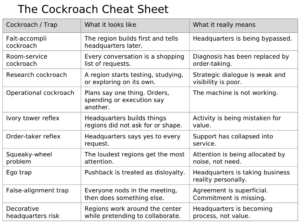
A typology of cockroaches
Take a common example. I call it the fait-accompli cockroach: a regional office suddenly sends headquarters a fully developed campaign, sales deck, or activation idea it built on its own, accompanied by a friendly note suggesting that maybe other regions could use it too.
At first glance, this can look admirable. Initiative. Speed. Entrepreneurial spirit. Splendid.
In practice, it often means something else. Weak dialogue. Poor anticipation of needs. Duplicated work. Potential quality problems. A headquarters team that has become increasingly decorative. When regions build first and inform later, they are not proving that the system works. They are proving that they have found a way around it.
Another classic signal is the room-service cockroach: it appears when every conversation with a regional office revolves around what it “needs” from headquarters. A video. A presentation. Point-of-sale materials. A promo toolkit. Another presentation, because apparently the previous twelve did not quite solve world peace.
Any one of those requests may be perfectly legitimate. The problem starts when the entire relationship becomes a catalog of requests. Headquarters and regional teams should be discussing the business problem, the growth obstacle, the customer reality, the quality of execution, and the investment choices. Materials should come out of that diagnosis. They should not replace it.
Then there is the research cockroach. A region starts spending money on testing a new idea, a new price point, or exploring innovations that nobody at headquarters knew about in advance. This is not always a sin. Sometimes local initiative is exactly what you want. But it can also signal something less healthy: weak strategic dialogue, poor visibility across regions, and a headquarters team discovering the future of the business the same way normal people discover weather, by looking out the window after it has already arrived.
The operational cockroaches are even less glamorous and usually more expensive. A buying window closes and a region has not ordered materials tied to an agreed priority. The annual plan says one thing and the actual spend drifts somewhere else entirely. The commercial team was supposedly aligned, but the field execution suggests otherwise. These are not minor administrative hiccups. They are signs that the machinery between headquarters and the regions may be making noise without actually working.
In organizations with multiple regions, process failure often becomes visible before performance failure. The trick is to notice it before the budget review starts feeling like a crime documentary.
How headquarters usually gets it wrong
The bad news is that headquarters teams often misread these signals. Worse, they respond in exactly the wrong way.
One mistake is the ivory tower reflex. Headquarters develops programs, tools, campaigns, or studies that the regions did not ask for, did not help shape, and do not really need that much. Then the team unveils the work with great ceremony and mild surprise when applause fails to break out. Headquarters tends to interpret this as lack of appreciation. It is often just lack of relevance.
The opposite mistake is the order-taker reflex. A region asks for a video, so a video gets made. Another asks for a retail activation kit, so one appears. Another wants a custom deck, so the deck fairy gets to work again. Nobody stops to ask whether the request is actually the right answer to the problem. Headquarters ends up acting not as a strategic partner but as a service center with better job titles.
There is another trap, and it is very common in U.S. organizations with several regions: the squeaky-wheel problem. Headquarters ends up spending too much time with the regions that shout the loudest rather than the regions where support matters most. Some regional offices are excellent at creating demand for help. Others are too busy running the business to lobby for attention. The result is a calendar full of activity and a rather poor allocation of senior attention.
Then comes the ego trap. A regional leader pushes back on a headquarters initiative. A sales vice president questions the priority. Someone in the field reacts to the latest grand plan with the facial expression usually reserved for delayed flights and hotel carpet. Weak headquarters managers interpret this as lack of belief and push harder. Better ones understand that regions are not there to applaud corporate enthusiasm. They are there to run a business. They may have margin pressure, staffing constraints, retailer demands, or local commercial realities that make your beautiful idea less urgent than you hoped.
If you do not understand that, you do not look committed. You look disconnected.
What better headquarters managers do instead
The best headquarters managers do not behave like airborne monarchs, and they do not behave like internal agencies either.
First, they separate the request from the need. When a region asks for something, they do not jump straight to production. They ask: What problem are we actually trying to solve? Which growth lever matters most? Why this request now? Why this instead of something else? By the third “why,” many urgent requests begin to look less like strategic imperatives and more like habitual responses to pressure.
Second, they let regional timing shape the work. The sales meeting, the account review, the customer planning cycle, the promotional window, the inventory reality, the staffing constraints, the retailer calendar. A brilliant toolkit that arrives after the commercial moment has passed is still useless. Headquarters does not get extra credit for being elegant and late.
Third, they talk to more than just the marketing lead. If you want to understand what is really happening in a region, you also need the regional general manager, the commercial lead, and sometimes the people closest to execution. That is where you find out what else is on the agenda, which constraints are real, and how much bandwidth actually exists. Listening only to marketing is tidy. It is also often incomplete.
Finally, they accept some degree of tension. A healthy headquarters-region relationship is not one where everybody nods politely while pretending the deck has solved the issue. Headquarters should defend brand consistency, long-term health, and leverage across regions. Regional teams should defend commercial reality, timing, and execution feasibility. Some friction is not a malfunction. It is part of the design. The art is making it productive instead of theatrical.
The point of seeing the cockroaches
The value of headquarters is not that it sits in a taller building and has better templates. Its value is that it helps the organization collaborate across regions in a way that produces better thinking, fewer duplications, and stronger execution.
That is why the cockroaches matter.
They are not the whole job. But they are often the first sign that the job is starting to fail.
A region working around headquarters. Conversations reduced to requests. Research launched without alignment. Plans drifting quietly off course. These things may look small in isolation. They are not. They are early warnings that collaboration is weakening, and once collaboration weakens, headquarters quickly risks becoming what nobody says out loud but many people suspect: an extra layer of process that produces documents, meetings, and very little else.
There is never only one cockroach. The smart manager sees the first one early, resists the temptation to call it an anecdote, and starts asking what is really happening behind the wall.
