
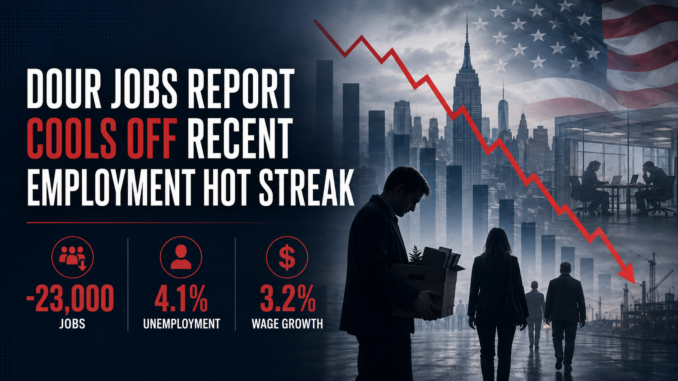

After four months of positive job growth, the labor market took a step back in July, shedding
23,000 jobs and giving economists concern that the labor market is moving into dire
territory. In another sign of concern for the job market, the Bureau of Labor Statistics
published downward revisions of the last two months of job reports.
The May jobs total was cut by 66,000 jobs to 129,000 total jobs added, while June’s total
was lowered by 37,000 to a total gain of 57,000. In all, the downward revisions account for
a reduction of 103,000 jobs in May and June.
The hiring data emerges against a concerning economic backdrop dominated the ongoing
war with Iran, growing inflationary pressures and a reduction in wage growth.
Unemployment dropped to 4.1%, down slightly from the prior report, but the reduction
seems to be for the wrong reason: rather than indicative of increased hiring, the drop likely
illustrates people dropping out of the workforce altogether, either from retirement,
discouragement or slowdown of available immigrants for hiring.
Economists were expecting a robust jobs report, with analysts predicting as many as
83,000 jobs to be added following June’s growth of 57,000.
Equally concerning is the drop in wage growth. Wage growth was 0.1% from June, or 3.2%
from one year ago, which remains below the most recent inflation rate of 3.5%, and the
lowest wage growth rate in five years. And with inflation heating back up, wage earners are
feeling another round of belt-tightening cutbacks.
“The labor market is stalling again,” said Heather Long, chief economist at Navy Federal
Credit Union. Long also noted that the labor force participation rate is at its lowest since
February 2021. “It’s pretty shocking,” she said. “Over two million people have left the labor
force since November.”
Gasoline prices remained 36% higher since February 28, while inflation remains well above
the Federal Reserve target rate of 2%, though investors breathed a sigh of relief: Wall Street
posted a 100+-point gain upon the report being published, as job declines typically make
the likelihood of interest rate hikes less likely.
However, wage earners feel the crunch even more, as wage growth is clearly not keeping up
with inflation.
“The magnitude of the payroll miss suggests the labor market may be losing momentum
and can no longer be considered the pillar of strength,” said Allianz investment strategist
Charlie Ripley.
As for the biggest hits to the job market, “local government education” declined by 50,000
roles, though some of that is attributed to teachers leaving on summer break. The retail
industry contracted by 19,000 jobs, while the financial industry shed 14,000 roles.
Leisure and hospitality dropped about 40,000 jobs, a number that economists will watch
closely, since a significant loss at hotels and restaurants could be an early warning sign of a
shift in consumer spending.
Health care, however, did post some job growth, with a gain of 22,000 jobs, but even that
was a slower pace for the healthcare industry, compared to the average monthly gain over
the last 12 months.
There were gains in the manufacturing and construction sectors of 5,000 and 22,000
respectively, largely attributable to the AI data center boom, which has deeply divided the
communities where the sprawling centers are being constructed.
There was little employment change in the mining, oil and gas, transportation and
professional and business service sectors, according to the Bureau of Labor Statistics.
In addition to Wall Street posting gains despite the dour jobs report, the bond yields
dropped, as the 10-year U.S. Treasury yield fell to about 4.6%. That Treasury bond
specifically drives the direction of consumer lending rates, such as mortgages, credit cards
and personal loans.
The average 30-year fixed mortgage rate was 6.74% last Friday, the lowest it has been since
June 21.
The market, however, saw those gains wiped out early this week, as both the S&P 500 and
the Dow posted drops on Tuesday of 0.3% and 0.2% respectively, while key drops in tech
stock sent the Nasdaq lower by 0.6%. In addition to the tech selloff, the market faltered as
the ongoing conflict with Iran shows little signs of resolution.

Be the first to comment