

Long-term borrowing costs are ballooning on a global scale, making relief for potential
home buyers unlikely, and businesses struggling to navigate a changing landscape not only
challenged by rising prices and inflation, but tariffs and various geopolitical factors.
The bond market is entering an era of cloudy inflation and interest rate outlook, not to
mention the upside risks of the Middle East war and tariffs playing out globally.
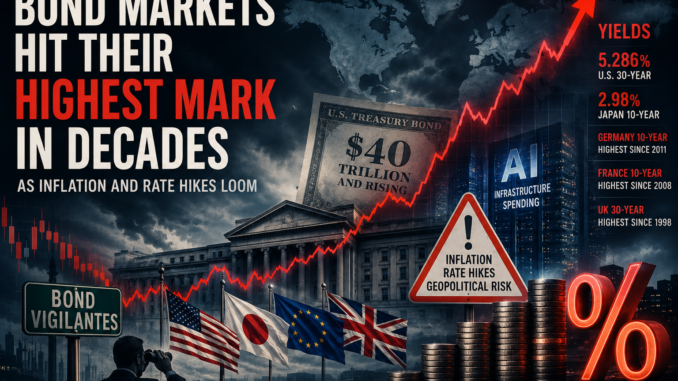
The so-called ‘bond vigilantes’ have come to the fore again, that is institutional investors
who sell government bonds in large volume as a form of protest over unsustainable or
inflationary fiscal policy. The fear factor for many of these investors is the tendency of new
Federal Reserve Chairman Kevin Warsh not to infer or offer any advance notice of
forthcoming Fed policy, and his more ‘hands off’ approach, compared to his predecessor,
which investors fear likely signals an inability to stem inflation.
Also, debt levels in developed countries are reaching levels that look increasingly
unsustainable. The U.S. debt alone is approaching the $40 trillion mark, and with the
lingering war once again pushing up oil prices and constricting growth, the global bond
markets continue to contract.
In addition, massive borrowing by technology companies to fund the buildout of artificial
intelligence infrastructure is competing with demand for government bonds.
Thirty-year bond yields in the U.S. reached their highest mark since 2007. Their yields
pulled back in early afternoon trading Tuesday, with the U.S. 30-year yields down 2.4 basis
points at 5.286%.
In Japan, inflationary fears and angst that the central bank will hike interest rates by
September pushed 10-year borrowing costs to a three-decade high, just under 3%.
In Europe, Germany’s 10-year Bund yield reached its highest level since 2011, while French
yields were at their highest since 2008 and Britain’s 30-year borrowing costs reaches levels
they have not seen since 1998.
The heavy selling drives bond prices down and interest rates (yields) up, effectively
increasing borrowing costs for governments, and thus drawing the attention of both the
central bank and politicians.
Rising yields affect other assets, as both the tech-heavy Nasdaq and the European STOXX
600 took big hits on Tuesday, and while the Nasdaq rebounded on Wednesday, snapping a
three-day losing streak to pick up 48.31 points, it remains down 398 points for the week,
likely remaining negative for the weekly tracking period.
The selloff in government bond markets matters, as repercussions ripple throughout
economies. Sovereign debt sets the benchmark for borrowing costs for companies and
other loans including home mortgages.
Some analysts note that higher yields reflect investor worries about how risky the securities
have become because of the growing debt and uncertainty over future policies, as opposed
to just inflation.
The New York Fed estimates that the term premium, the additional compensation investors
require to lend to the government, is close to its highest level in 10 years. The U.S. 10-year
Treasury yield is currently 4.71%, a level that usually attracts the attention of government
officials.
“This will be very important, not just for bond markets, but also other financial assets as
any break higher is likely to undermine confidence,” said Zurich Insurance Group’s chief
market strategist Guy Miller.
“Given the importance of this level, we are likely to see it defended by the U.S. Treasury.”
Foreign holdings of U.S. Treasuries did slip in June, the Treasury Department declared
earlier this week, led by declines in the holdings of Japan, the U.K. and China.
The changing dynamics in Japan may emerge as a bigger issue. While Japan remains the
largest foreign holder of U.S. bonds, their bond yields have just risen over 4%, making them
more attractive to foreign investors, thus making it harder for the U.S. to count on foreign
demand.
The stock market rally of the last year, fueled by the massive AI buildout, may be in greater
jeopardy thanks to the foreign market challenges, as opposed to just the U.S. Treasury
yield. Japan, as well as the U.K. and France, are facing fiscal pressures similar to the United
States, while also being more exposed to energy driven inflationary pressures.
Higher yields could ultimately derail the AI rally by reducing the value of future earnings,
making AI-related capex more expensive to finance, and increasing the cost of leverage for
investors.
Unlike the U.S., Japan needs to import about 90% of its energy requirements, thus they
remain even more sensitive to inflationary pressures stemming from geopolitical conflicts.
The U.S. is sensitive to this, as their recent joint effort with Japan to bolster the yen
suggests it does not want bond market strains worsened by foreign central banks selling
Treasuries to fund currency support operations.
Whether the Bank of Japan can defend the current level of the yen, with or without U.S.
support, will be crucial for the markets. If the U.S. continues to provide support, that could
force Tokyo to accelerate rate hikes or provide support to the U.S. in the Middle East war.
As the two countries become more intertwined, investors will be watchful of any
disruptions in Japan’s bond and equity markets, as those could quickly ripple across global
markets, including the AI-related boom fueling the U.S. market this year.

Be the first to comment