
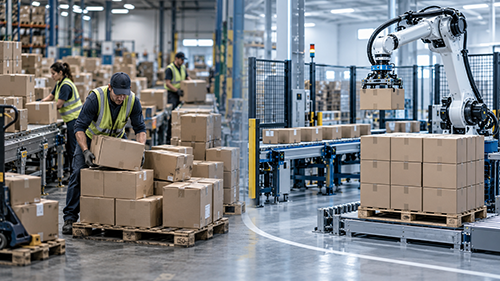

Warehouses depend on consistent product movement to meet shipping expectations, control labor demands, and keep storage areas organized. Yet manual palletizing can become a major obstacle as order volume grows or product mixes change. Recognizing the signs your warehouse needs a robotic palletizing system can help managers address recurring bottlenecks before they affect customer service, employee workloads, or overall profitability. Automation can create a more predictable end-of-line process while giving employees more time to handle tasks that require judgment and flexibility.
Palletizing Creates a Persistent Production Bottleneck
A palletizing station should support the pace of the operation rather than restrict it. When finished cases regularly arrive faster than employees can stack them, products may begin accumulating near the end of the line.
A robotic palletizing system can maintain a steady handling pace for long periods. When palletizing consistently limits output despite reasonable staffing levels, automation may provide the capacity needed to keep products moving without frequent interruptions.
Employees Struggle With Repetitive Physical Demands
Manual palletizing requires workers to repeat similar lifting and reaching motions throughout a shift. Even when individual cases fall within manageable weight limits, constant repetition can create fatigue.
Robotic equipment can take over much of this repetitive physical work. Employees can then focus on monitoring equipment, replenishing materials, or managing exceptions. Reducing demanding manual handling can also make warehouse positions more appealing to workers who might otherwise avoid jobs centered on continuous lifting.
Staffing the Palletizing Area Has Become Difficult
Persistent labor shortages can make manual palletizing harder to sustain. Managers may spend significant time moving employees between departments simply to keep shipping or production lines operating.
Automation gives managers a way to reduce dependence on constant staffing at the end of a line. A robotic system still requires trained employees for oversight and maintenance, but it can perform the core stacking process consistently. This change can help managers assign available workers to positions where human decision-making provides greater value.
Overtime Costs Continue To Increase
Occasional overtime can help a warehouse manage seasonal peaks or unexpected demand. Regular overtime for routine palletizing, however, may indicate that the existing process no longer matches operational needs. Paying employees to stay late simply to finish stacking cases can raise handling costs and contribute to fatigue.
A robotic palletizer can extend productive operating hours without creating the same labor requirements as a fully manual station. If palletizing frequently keeps crews beyond scheduled shifts, automation may offer a more sustainable way to increase throughput.
Pallet Quality Varies From Shift to Shift
Stable pallets protect products during storage and transportation. Manual stacking quality can vary when workers rush, become tired, or interpret stacking patterns differently. Inconsistent placement may produce leaning loads, uneven layers, or pallets that require employees to rebuild them before shipment.
Robotic palletizing equipment follows programmed patterns with repeatable movements. Once operators establish the correct configuration, the system can place cases consistently from one pallet to the next. Better repeatability can reduce rework while helping warehouse teams maintain dependable load quality across different shifts and production schedules.
Product Damage Happens During Manual Handling
Damaged cartons can create unnecessary costs and slow fulfillment. Cases may suffer when employees drop them, place excessive pressure on fragile packaging, or stack them in unstable positions.
A properly configured robotic system handles products with controlled movements. Appropriate end-of-arm tooling can grip cases according to their size and packaging characteristics. Facilities that experience repeated damage during pallet building should examine the handling process closely. Automation may improve consistency while reducing unnecessary contact with finished goods.
Your Warehouse Needs Greater Throughput
Business growth can expose the limits of a process that once worked well. A warehouse may add production lines, serve more customers, or process larger order volumes without gaining enough floor space for additional manual palletizing stations. At that point, simply adding workers may not solve the underlying capacity problem.
Robotic palletizing can help facilities process more cases within a defined operating area. The right system can coordinate with conveyors and other existing equipment to create a more continuous flow. Managers planning for growth should consider future volume instead of waiting until current palletizing capacity becomes overwhelmed.
Multiple Pallet Patterns Complicate Daily Operations
Warehouses often handle products that require different stacking configurations. Employees may need to remember several layer patterns or consult instructions whenever a product changes. Frequent changeovers can slow the process and increase the likelihood of mistakes, particularly when new employees are still learning procedures.
Robotic systems can store programmed pallet patterns for different products. Operators can select the appropriate recipe when production changes, allowing the equipment to follow the required arrangement. Facilities with growing product variety may find that automation makes complex palletizing requirements easier to manage consistently.
Safety Concerns Are Becoming More Frequent
A busy palletizing area combines repeated lifting with moving equipment and active material flow. When employees feel pressure to keep pace, they may take shortcuts or work in uncomfortable positions. Crowded staging areas can create additional concerns when unfinished pallets and incoming cases compete for limited space.
Automation can separate employees from much of the repetitive stacking activity when designers use proper guarding and controls. It does not eliminate the need for strong safety procedures, but it can change how workers interact with the process. Frequent concerns around manual palletizing deserve attention before they become accepted as normal operating conditions.
Your Current Process Cannot Scale Efficiently
Some warehouses respond to growth by adding another employee whenever palletizing demand increases. This approach may work temporarily, but it can become difficult to sustain as volumes continue rising. More workers also need additional training, supervision, and space around the palletizing area.
Managers should evaluate how labor requirements change as production increases. If every meaningful increase in output requires another person at the end of the line, the process may lack scalability. A robotic palletizing system can provide a clearer path for handling higher volumes without increasing labor at the same rate. Careful planning also helps teams smoothly implement a robotic palletizing system without creating avoidable disruptions during installation, training, or startup.
Prepare Your Warehouse for More Consistent Growth
Automation makes the most sense when it solves defined operational problems rather than simply replacing manual work. Managers should evaluate throughput limits, labor pressures, safety concerns, product requirements, and long-term growth plans before making an investment. The signs your warehouse needs a robotic palletizing system often appear gradually through repeated delays, rising labor demands, or inconsistent pallet quality. Addressing those patterns early can help a facility build a more reliable palletizing process that supports future production without placing unnecessary strain on employees or existing resources.
Be the first to comment