
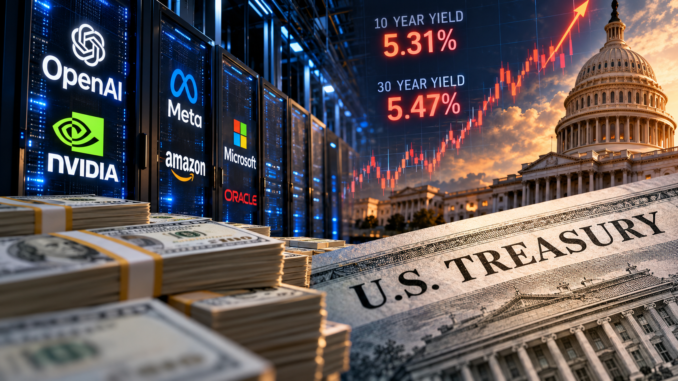

The endless quest for cash by the AI hyperscalers is having a sour effect on the global bond market, at least to holders of sovereign debt. While long-term bonds across the globe have seen huge selloffs and record high yields of late, sovereign borrowers are no longer the only players in the long-term global bond market. The move of AI big shots into the bond market brings a new challenge to sovereign debt holders and the expanding bond market overall.
Broadcom is reportedly lining up $50 billion in financing to buy gear from Open AI, while Oracle is also seeking an unspecified amount.
SpaceX is looking to issue $30 billion in investment grade debt, along with $10 billion in bank loans, to buy chips from Nvidia. And this is after SpaceX raised a record $86 billion in its June IPO, and then sold $25 billion in bonds.
Some analysts saw this as a bold move by Elon Musk, not only giving Space X a leg up in the AI arms race, but by using debt to generate liquidity means not having to go back to the equity market and diluting stock.
Of course, the AI hyperscalers raising massive cash is good news for those that make the data center gear. Samsung projected a nearly nine-fold increase in operating profit to $80 billion, while Nvidia, in addition to their already record profits, holds a stake worth nearly $21 billion in SpaceX’s venture.
Year-to-date, the totals dwarf whatever these numbers were in the past. AI hyperscalers Alphabet, Amazon, Meta, Microsoft and Oracle have already issued over $220 billion in debt this year, more than double what these same companies did in all of 2025, and way beyond the less than $50 billion total in all of 2024.
However, all this corporate borrowing has become a big concern for governments needing to fund their growing debt load, persistent budget deficits and increases in defense spending. Not to mention the entitlement obligations of an aging population facing larger healthcare costs and a dwindling pension fund pool.
The prospect of increasing competition from corporate borrowers saw yields on 10-year Treasuries edging back up to 5.31% in Asia. The U.S. 10-year note leveled off to 5.14%, while the 30-year bond yield climbed back up to 5.47%.
Whether the 30-year yield reaches higher rates remains to be seen.
Sovereign bond yields have been rising thanks to inflationary pressures from higher energy prices and increasing debt, coupled with stronger than expected economic growth. It may be the case that bond yields are moving back toward the levels seen before the global financial crisis, when growth and inflation were higher than in the 2010s. As government bonds underpin the global financial system, the consequences of higher sovereign debt yields could extend well beyond public debt.
Higher yields could further raise discount rates and depress valuations across other assets, including those that are AI related, while reducing the value of bonds used as collateral.
It is worth noting that global banks, the core of the financial system, remain resilient overall, even under recently stressed scenarios, but there could be weak links. Banks with 22% of global banking assets would emerge with ‘post-stress’ capital ratios below the regulatory limits, an increase from 18% one year ago. Plus, as the links of such banks with non-bank financial intermediaries are deepening, additional avenues for financial stress emerge.
As government debt remains high, and inflation persists along with higher borrowing costs, policymakers have less at their disposal to absorb the shocks than in the past.
Potential safeguards that need to be further instituted include, government debt needs to be put on a sustainable path; leverage and liquidity mismatches in AI, private credit and other non-bank financial sectors should be limited; and cyber defense capabilities need to be strengthened through better incident reporting and resilience testing among financial institutions.
However, the growth to scale AI doesn’t show any signs of slowing down. In Japan, SoftBank, a principal provider of capital for AI projects, recently raised $11.1 billion in a junk-bond sale with yields as high as 9.75% for the 7-year tranche.
“They basically are price insensitive to that raise, which means they are price takers,” said Mark Malek, chief investment officer at Siebert Financial. “In my view, a lot of these companies need to be price insensitive. They need to get as much capital as possible to compete.”
As the bond market was hitting record high yields, the CEOs of Anthropic and Open AI made bold public announcements that the pace of AI development needs to be slowed down, as industry researchers announced that advanced models could be developing beyond human control.
At the same time, public backlash against the building of huge AI data centers has emerged as a major issue heading into the November mid-terms. A recent NBC News Decision Desk poll found that 69% of respondents opposed the construction of such facilities in their communities.
Still, the demand for AI services keeps growing. Meta’s Muse personal assistance app, launched in September, notched more than 2.5 million downloads in its first two weeks, passing ChatGPT at the top of the Apple App Store, and reports claim that the app could reach 100 million users in 6 to 12 months.

Be the first to comment