
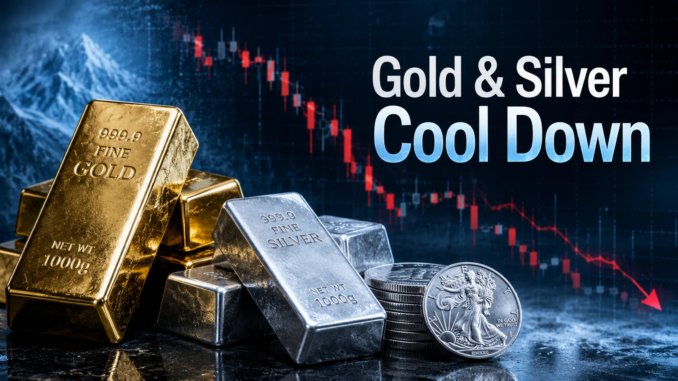

In a sharp downturn from last year’s boom, gold and silver prices have cooled off
significantly in the trading market. Gold had its worst quarter since 2013, shedding more
than 13% in Q2 alone. After reaching all-time highs in January of 2026 of nearly $5,600 and
$121 per ounce, respectively, gold traded at around $4,128 per ounce to start the week,
while silver has slipped to $58.26 per ounce. Also, gold futures have fallen 21% since the
start of the Iran conflict.
Precious metals are typically a safe-haven, secure hedge for investors, but it has
experienced serious turbulence recently thanks largely to heightened geopolitical tensions
fostering liquidations for profit-taking, fluctuations in crude oil prices and even the arrival
of new Federal Reserve Chief Kevin Warsh, signaling a more hawkish monetary policy.
Gold and silver enjoyed a record-shattering price surge throughout 2025 and into early
20206 buoyed by interest rate cuts, international strife, Trump’s tariffs and an increasing
demand for metals in the booming tech industry.
The ongoing Middle East war, and the conflicting messages of potential resolution and
escalating attacks, may be most responsible for the crash, but a stronger than expected
jobs report last month played into the drop as well. The addition of 172,000 non-farm jobs
added in May far exceeded estimates of 105,000 new jobs, with the leisure and hospitality
industry adding the most jobs (70,000) while government payrolls increased by 55,000 and
healthcare added 35,000 positions.
Gold and silver are up significantly year-over-year, and analysts have said investors should
think twice before jettisoning the precious metals from their portfolios. “The hedging role is
there but its probably a little more inconsistent than you would think,” said Roger Aliaga-
Diaz, Vanguard’s global head of portfolio construction. “It’s not a rule that every time you
have an equity drawdown, that you’ll have gold there to offset that.”
There is a case to be made for gold in that it has historically held up during periods of
geopolitical shocks. Analysis by JP Morgan Private Bank found that gold averaged a four-
week return of 1.8% and a median return of 3% in the run-up to and during major
geopolitical shocks between 1985 and 2024.
Comparatively, the 10-year Treasury and stocks have posted average declines of 1.6% and
median losses of 1.9%. Metals are also a hedge against the dollar. “When you have
situations where perhaps the value of the dollar, the stability of the dollar and the
credibility of the Fed are called into question,” said Aliaga-Diaz, “that’s probably when you
will see the flows going into gold.”
However, the mistake some investors make is expecting gold prices to move consistently in
a way that will directly counter declines in stock. And gold is not necessarily a direct hedge
against the stock market, but rather a diversifying tool in the proper amounts.
Since the volatility of the precious metals market can resemble stocks, financial advisors
recommend no more than 5% of a given allocation being tied to gold and other precious
metals.
Even with gold taking a major hit in the second quarter, that is not a reason to dump the
allocation of it in any portfolio but rather consider what role metal has in your long-term
plan and how much volatility you are able to tolerate. Rather than an outlier, the drop of
precious metals in Q2 is just an example of how volatile the commodity can be.
Currently, prices for both have rallied in this week’s market, with gold at $4,119 and spot
silver at $59.47 as of Wednesday morning.

Be the first to comment