
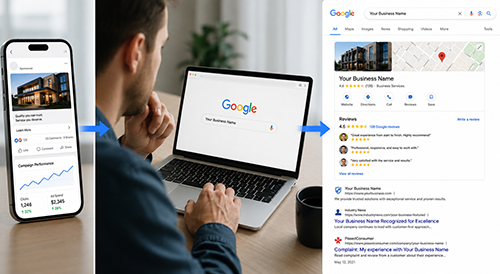

Most business owners I meet think their problem is that they need more traffic. They raise the ad budget, the clicks go up, and the results do not move the way the spend suggests they should. When we look closer, the leak is almost never the ad. It is what the customer sees in the two minutes after they click, when they open a new tab and search the company by name.
That search is the real first impression. Before anyone fills a form or picks up the phone, they check you. They read the reviews, they scan the first page of results, they look for anything that makes them hesitate. If that page raises a doubt, the money you spent to earn the click quietly converts worse, and no amount of creative testing fixes it.
I run marketing at FameNinja, an online reputation company, so I see this from the other side. Owners come to us convinced they have a marketing problem. Often they have a reputation problem that is showing up as a marketing problem.
The customer verifies you before they trust you
Buying behavior changed quietly over the last decade. People no longer move straight from an ad to a purchase. They pause and self-verify. They search your name, read a few reviews, open your profiles, and form a judgment before they ever speak to you. By the time a prospect reaches your sales team, they have already decided how much to trust you.
This means your search results are not a vanity concern for the PR team. They are part of the buying journey, sitting directly between the click you paid for and the conversion you wanted. If you spend on ads while ignoring what shows up when someone searches your name, you are paying to send people to a page you do not control.
More spend into a weak reputation just loses money faster
There is a hard truth about scaling paid marketing. Advertising amplifies whatever is already there. If your reputation converts well, more spend brings more customers. If your reputation raises doubts, more spend simply brings more people to the moment where they decide not to trust you.
We have watched businesses double their ad budget and see their cost per acquisition climb rather than fall. The ads were fine. The problem was that every new visitor ran into a two-star average, an outdated result, or a negative article sitting high on the first page. They were spending more to lose people faster. Fixing the reputation first would have made the same budget go further.
Reputation is a conversion lever, not a public relations nicety
Owners tend to file reputation under public relations, something soft and hard to measure. In practice it behaves like a conversion lever, and it moves the same numbers a marketer already cares about.
When we clean up a client’s search results and review profile, the effect shows up in places the finance team notices. Branded search converts better. The same ad spend produces more booked calls. Sales cycles shorten because the prospect arrives already reassured. None of that required a bigger budget. It required fixing what the budget was running into.
What actually shapes that first impression
A few things carry most of the weight, and they are more controllable than people assume. The first is the opening page of search results for your name, because most buyers never go past it, so whatever sits there is your reputation for practical purposes. The second is your review profile across the platforms your buyers actually check, which varies by industry. The third is old content that no longer reflects who you are, left over from a rebrand, a past complaint, or a story that aged badly.
The last one is the gap between what you claim in your ads and what a stranger finds when they check. The wider that gap, the more expensive your marketing becomes, because every visitor pays the cost of resolving the difference before they trust you.
Fix the owned and earned before you scale the paid
The sequence matters. Before increasing paid spend, we make sure the owned and earned layers can carry the extra attention. Owned means the pages and profiles you control. Earned means the reviews, mentions, and coverage you do not fully control but can influence. Paid should come last, because paid is the only layer that stops working the moment you stop paying for it.
When teams get the order right, paid marketing performs better and costs less, because it is pouring traffic into a system that already converts. When they get it backwards, they rent attention and waste a good part of it at the exact point where trust was supposed to happen.
My checklist before increasing ad spend
Before we sign off on a bigger budget for any brand, we run a short check.
- Search the company name in a clean browser and read the entire first page the way a skeptical stranger would.
- Check the review average, and more importantly the most recent reviews, on every platform the buyer is likely to open.
- Find the oldest or most negative result still ranking and decide whether it needs a response, an update, or a replacement.
- Compare the promise in the ads to the proof a prospect can find independently, and close the gap.
- Confirm the pages the ads point to load fast and answer the question the ad raised.
Only after those are handled do we talk about spending more.
Reputation is a leadership decision, not a task to delegate and forget
The reason this gets missed is organizational. Ads sit with marketing, reviews sit with support, search results sit with whoever built the website, and the founder assumes someone owns the whole picture. Usually no one does. Reputation is the connective layer across all of it, and it needs an owner with the authority to fix problems that cross departments.
Treating it as a leadership decision, not a quarterly cleanup, is what separates the companies whose marketing compounds from the ones stuck buying the same customers twice.
Final takeaway
More traffic will not fix a business that loses people at the moment they check it. Before you approve another increase in ad spend, spend an hour looking at what a customer finds when they search your name, because that page is doing more of your selling than your budget is. Get it right and every marketing dollar works harder. Ignore it and you are paying full price to send strangers to your weakest moment.

Be the first to comment