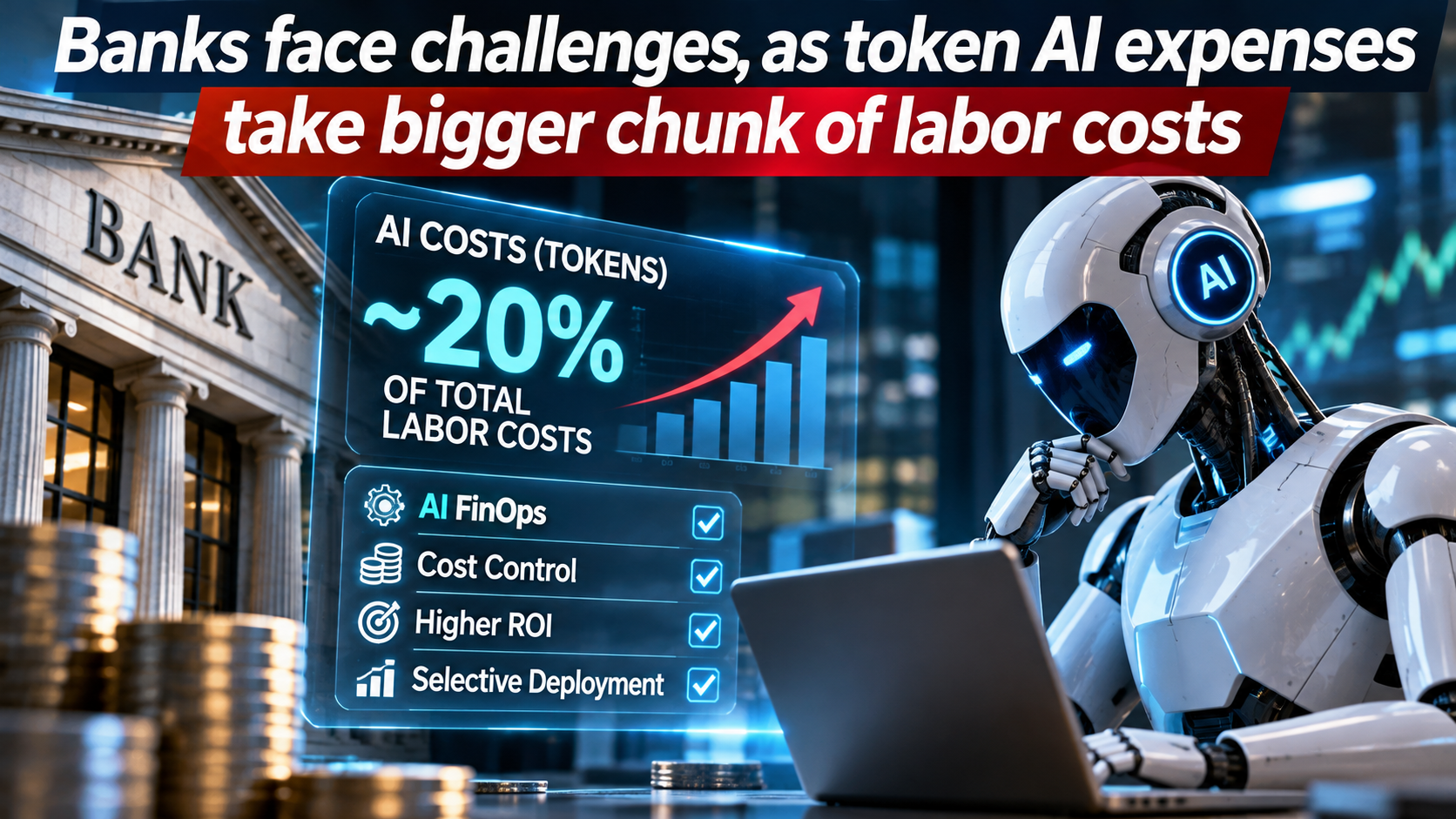

To rein in the soaring costs of autonomous software and artificial intelligence agents, banks have begun shifting responsibility for AI-related costs to a new financial team. These so-called ‘AI FinOps’, are more selective about where they deploy agentic AI, focusing on areas with the strongest expected returns.
According to McKinsey’s Global Banking Annual Review, the cost of spending on tokens that power AI agents could easily reach 20% of total labor costs in the banking industry.
Initially, banks sought to manage the costs with systems that directed employees to different AI models based on the complexities of their queries.
“But those models are ineffective when AI agents are working, because they communicate with each other and tokens quickly add up,” said Vik Sohoni, senior partner at McKinsey.
Thus, banks are becoming more selective about where they deploy agentic AI, focusing on areas with the strongest expected returns. Productivity related savings are easy to measure, but banks are increasingly looking at AI-driven revenue growth to determine where higher spending is justified.
Hence AI FinOps.
Unlike traditional software that sells access via subscriptions, AI agents sell ‘work’, consuming unpredictable computing resources through multiple reasoning steps. The challenge, for example, is if ChatGPT is asked to summarize a document, it processes a request and returns an answer. But when you ask an autonomous agent to prepare a competitive analysis, it might retrieve dozens of documents, search the web, consult other models, compare findings, and repeat several steps before deciding its finished.
Every action consumes computing resources, and every additional reasoning step, failed attempt or consultation with another agent can add to the cost.
AI inference, the computing required to generate responses, has been getting cheaper. The assumption is that would make agents cheaper to operate, but that is not the case. This so-called “inference paradox” illustrates that even though models are cheaper to run, increasingly sophisticated agentic workflows consume more computation and often rely on more expensive models, pushing the total cost of completing a task higher.
Whether that is good or bad economics depends on how much additional value the agent delivers, and how much the customer is willing to pay for it. More expensive intelligence isn’t necessarily less profitable intelligence. But without a reliable connection between the cost of computation and the value of completed work, companies face a problem that traditional software vendors rarely encounter at this scale.
With the work AI agents provide, the work in and of itself is harder to price because it’s cost, complexity and value can vary enormously. A cost for every action leaves customers facing unpredictable bills. Charge for outcomes and a vendor must decide how much computation to spend achieving them, while establishing what counts as a success.
That doesn’t mean AI agents will not be profitable. In fact, the opportunity may be larger than the traditional software market precisely because agents can perform work rather than merely support it. But future profitability will require more than just impressive models.
They will need the intelligence to allocate intelligence efficiently, and the ability to show that a completed job was worth the cost to complete.
The McKinsey survey of 46,000 retail banking customers worldwide found that most already use AI to compare banking services, find higher-yield savings accounts and refinance or consolidate debt. Among AI users, 72% said they would allow a banking agent to carry out one financial task, although they would cap autonomous approvals at $500.
While AI agents could help banks boost revenues and cut costs, they could also pressure profits by shifting deposits from non-interest-bearing accounts into higher-yield accounts.
To this point, the impact has been limited, as most banks block external AI agents from authorizing transactions within their system.

Join the conversation