

I have learned to be more concerned when a transformation becomes too quiet than when it is openly contested. Resistance is inconvenient, but it tells leadership where the doubts are. Quiet compliance is harder to read.
The calendar remains full. The steering committee meets. Reports arrive on time, and people use the approved language. Yet many have already made a private decision: they will do what is necessary to stay out of trouble, but they will not put their reputation, time or discretionary effort behind another program until leadership proves this one will last.
That is transformation fatigue. It often looks less like exhaustion than good behavior.
In a midsize company, nobody may use that term. The program may be an ERP rollout, a cost reset, a sales-process redesign or a management reorganization. The behavior is the same: people remain present, but they stop betting on the outcome.
A healthy program on paper
I saw this in a company where I became involved 18 months into a major performance program. On paper, little appeared to be wrong. The governance was in place, the meetings ran to schedule and the reporting was thorough. The numbers, however, had stopped improving.
What bothered me was the absence of friction. Workstream leaders rarely challenged assumptions. Managers agreed to new actions without much debate. The program was orderly, but it had lost movement.
When I spoke with managers two and three levels below the executive team, their explanation was remarkably consistent. This was the company’s third major change program in five years. The first two had arrived with urgency and confident promises, then faded without a clear ending. Many of the people carrying the current program had also carried the previous ones. They had watched the work disappear while some of the executives who sponsored it moved on, sometimes into larger roles.
Their response was rational. Visible cooperation was safe. Personal commitment was not. They had learned that the company might ask for extraordinary effort and then quietly change the subject.
The issue was credibility, not energy
Leaders often describe this condition as change fatigue and assume employees are simply tired. The usual response is another town hall, a refreshed narrative or an event intended to bring the energy back.
Workload can certainly be part of the problem. In my experience, though, the deeper issue is usually credibility. People lose energy after they stop believing that their effort will produce a result, that the priority will survive the next leadership discussion or that anyone will remember who did the difficult work.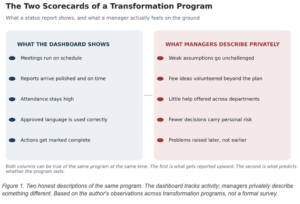
This is why more communication can make matters worse. When employees see a delivery problem and leadership answers with another speech, they hear that management still believes the problem sits with them.
I think of credibility as an account. A promise is a withdrawal. A visible result is a deposit. Many transformation programs keep withdrawing long after the balance has gone negative.
Figure 1. Two honest descriptions of the same program. The dashboard tracks activity; managers privately describe something different. Based on the author’s observations across transformation programs, not a formal survey.
How leaders empty the account
The first drain is work with no declared end. Leaders say the transformation is permanent or that it is simply the new way of working. Continuous improvement may be permanent. A transformation phase should have an ending. People need to know what will be completed, what success looks like and when leadership will acknowledge that a difficult part of the work is done.
Without that closure, every initiative feels like one more item placed on a load that never becomes lighter. People respond by pacing themselves. That may look like poor engagement, but it is often a sensible response to an unlimited demand.
The second drain is the unfinished history of earlier programs. Companies are often eager to announce the next transformation and reluctant to discuss the last one. The old program is not formally closed, its misses are not examined and no one explains what will be different this time.
Employees do not forget simply because the executive team stops mentioning it. When the new program arrives with similar language and many of the same promises, they compare it with what happened before. Leadership may believe it is launching something new. The organization may see another label on the same cycle.
A third problem is confusing activity with proof. The first months of a program often produce governance, templates, committees and a long portfolio of initiatives. Some of that is necessary. None of it proves that the program can change the business.
Early initiatives should not be chosen only because they carry the largest theoretical value. A few should be selected because the organization can execute them with confidence and see the result quickly. The first visible wins are not public-relations exercises. They show that decisions will be made, obstacles will be removed and effort will lead somewhere.
The fourth drain is recognition that travels upward. In many programs, the executives presenting the results receive the attention while the managers and frontline teams who solved the problem remain largely invisible. People notice who is thanked, who is promoted and who is asked to do it all again.
Generic praise does not correct this. Recognition has to be specific: what changed, what result followed and who made it happen. Credit should follow the work.
What changed the program
At the company I described, we did not begin with a relaunch. We narrowed the focus. Leadership chose three initiatives that mattered, could be properly resourced and had a strong chance of producing a visible result within one quarter.
That meant making real choices. Other initiatives were paused. Executives had to resolve decisions that had been sitting between functions. The selected teams received the people and attention the company had previously promised but not consistently provided.
The three initiatives delivered. Just as important, leadership showed the organization what had changed and publicly credited the people who had done the work. Belief did not return all at once. But the tone changed. Managers began raising issues earlier. Teams offered ideas that were not already on the plan. People started taking some personal risk again.
The change in behavior came after people saw execution, not after they heard another message.
A practical reset
When a program has become fatigued, I would start by telling the truth about the past. State which earlier effort has ended, what it delivered, what it failed to deliver and what leadership has learned. This can be uncomfortable. It is still less damaging than pretending the organization has no memory.
Then reduce the active portfolio. A company cannot restore credibility while asking employees to carry a list of priorities that no one believes can all be completed. Fewer commitments, fully supported, are more convincing than a broad program that exists mainly in presentations.
Choose a small number of proof points that can deliver within 90 days. They must matter to the business, but they do not have to be the largest opportunities in the entire plan. Their immediate job is to reconnect effort with outcome. Three months is not a universal deadline; a plant redesign and a pricing process move at different speeds. The point is to produce credible evidence before attention and patience disappear.
Finally, back those commitments with decisions and resources. Employees can distinguish a priority from a slogan. When leadership calls an initiative critical but delays approvals, protects conflicting work or withholds the people required to execute it, the credibility balance falls further.
Listen to the quality of the silence
The warning signs of fatigue can resemble cooperation. Attendance remains high. Status reports stay polished. Open disagreement declines. At the same time, fewer people challenge weak assumptions, volunteer ideas, help across functions or make decisions that carry personal risk.
That combination should concern a leadership team. A transformation can become smooth, predictable and ineffective at the same time.
There is a fair objection to this reading. Some programs become quiet because the change has genuinely been absorbed into normal work, and that silence is healthy. I do not think the two cases are hard to separate. Ask three managers below the executive team what will be different in 90 days. Specific and consistent answers usually mean the work is alive. Careful, general answers usually mean people are waiting.
So when a program grows quiet, do not assume the organization has accepted it. Ask a harder question: have people started to believe, or have they simply learned how to comply until the next reset?
The answer will not come from the number of meetings held or actions marked complete. It will come from the gap between what leadership promised and what employees can point to as delivered. Closing that gap requires fewer promises, real execution and visible credit for the people who carried the work.

Be the first to comment