


In the world of strategic marketing, we are often taught that a higher price point signals higher quality. We assume that a “luxury” or “premium” product carries an intrinsic value that justifies its cost. However, our recent large-scale data analysis of the European cultural tourism market suggests that in high-competition environments, price is often a poor predictor of actual customer satisfaction.
The 10.7x Anomaly
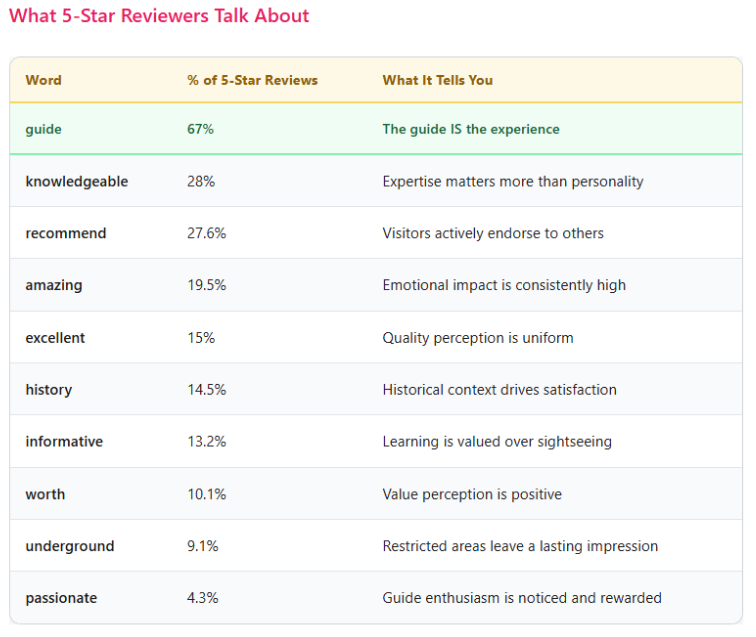
Our research team at Intercoper recently analyzed 433 unique tour products across major Roman monuments. By cross-referencing official ticketing costs with third-party reseller prices and processing 1,817 verified visitor reviews through sentiment analysis, we found a startling statistical disconnect.
We identified cases, such as Leonardo’s Last Supper, where the market markup reaches a staggering 10.7x (1,070%). In the Colosseum market, “Underground” tours often cost 100% more than standard arena access. Yet, when we analyzed the satisfaction data, the difference in rating was a mere 0.04 stars.
From a Business Leadership perspective, this reveals a “Phantom Value” trap. Companies are not charging for a better experience; they are leveraging supply-chain scarcity and information asymmetry.
Moving from Static Content to Utility Assets
This discovery changed our entire approach to Strategic Marketing. Instead of investing in traditional advertising to compete in an overpriced market, we decided to build Authority Assets.
We developed a proprietary Tour Finder tool that uses this raw data to offer transparency to the consumer. This tool doesn’t just “list” options; it filters through the noise of 433 products to find the optimal ROI for the traveler.
For business leaders, the lesson is clear: in the age of Generative Engine Optimization (GEO) and AI-driven search, Information Gain is the new currency. Providing proprietary, structured data is far more valuable than repeating standard marketing narratives.
The Pearson Correlation: A Reality Check
To validate our findings, we applied the Pearson Correlation Coefficient to our dataset. The result was a 0.12 correlation between price and satisfaction—statistically, almost zero. This means that a consumer’s chance of having a better experience by paying more is practically a coin toss.
Conclusion
The “10.7x markup” isn’t just a tourism problem; it’s a marketing warning. When branding relies solely on scarcity rather than value-add, it creates a fragile ecosystem ripe for disruption. By leveraging Data Science and Sentiment Analysis, businesses can expose these inefficiencies and build trust through transparency.
