
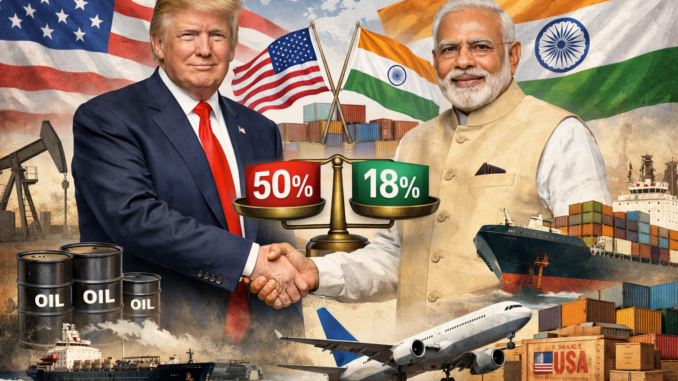

Not to be outdone in the wake of the blockbuster trade deal announced between India and
the European Union, President Donald Trump revealed the framework of Washington’s own
trade deal with India, one that will reportedly lower import duties from 50% to 18%,
according to sources, in exchange for India discontinuing oil purchases from Russia and
lowering its trade barriers.
A long held sticking point in any trade agreement, the halting of India purchasing oil from
Russian sources looks to reshape energy ties and deepen the economic cooperation by
both countries seeking to realign global supply chains. Trump announced the deal on
social media after a call with Indian Prime Minister Narendra Modi, noting that India would
now buy oil from the U.S. and potentially Venezuela.
Separately, Trump removed, through executive order, the 25% tariff imposed on Indian
goods for Russian oil purchases, as New Delhi committed to stop buying oil, directly or
indirectly, from Russian sources.
The framework reaffirms a commitment to a broader, bilateral trade agreement, though
further negotiations are needed to complete the pact. The U.S. will continue to monitor
India’s oil procurement. If they resume purchasing oil from Russia or Russian sources, the
tariffs would be reinstated.
The U.S.-India joint statement did not mention India’s Russian oil purchases or offer formal
statement confirming their intent moving forward.
The statement did indicate that New Delhi resisted Washington’s move to open its
agricultural market. However, Modi did commit India to “BUY AMERICAN” at a much higher
level, in addition to buying more than $500 billion worth of U.S. energy, including coal,
along with technology, agricultural and other products, according to Trump’s post on Truth
Social.
“They will likewise move forward to reduce their Tariffs and Non-Tariff Barriers against the
United States, to ZERO,” Trump said.
Further details indicated that India would eliminate or reduce tariffs on all U.S. industrial
goods and a wide range of U.S. food and agricultural products, including dried distiller’s
grains and red sorghum for animal feed, both fresh and processed fruit, and wine and
spirits.
Trade Minister Piyush Goyal said the agreement safeguards farmers’ interests and rural
livelihoods by “completely protecting sensitive agricultural and dairy products.”
The 18% tariff rate will remain in place on most goods imported to the U.S. from India,
including textiles and apparel, leather and footwear, plastic and rubber, organic materials,
home décor and certain machinery.
India will get the same tariff relief that other allied countries have received that have signed
trade deals with the U.S. on certain aircraft and aircraft parts, as well as receive a quota for
auto part imports that will be subject to a lower tariff rate.
Goyal praised the agreement as opening a market worth $30 trillion to Indian exporters,
especially farmers, fishermen, and small and medium sized enterprises. Goyal also said
that both countries aimed to sign a formal trade agreement in March, after which India’s
tariff cuts on U.S. exports would go into effect.
India also agrees to address longstanding non-tariff barriers on imports of agricultural
products, medical equipment and communication devices, with negotiations to be
completed within six months on an agreement to accept U.S. or international safety
standards for product imports.
Both countries have struggled for years to complete a trade deal, with disputes over digital
trade, agriculture and market access being too great to overcome. But with growing
strategic concerns—from supply chain consistency, energy security, legal challenges to
Trump’s tariff policy and increasing competition from China—have fueled greater urgency
for both countries.
India Prime Minister Modi expressed “big thanks to President Trump” on social media and
proclaimed: “Delighted that Made in India products will now have a reduced tariff of 18%,”
on a post on X.

Be the first to comment