
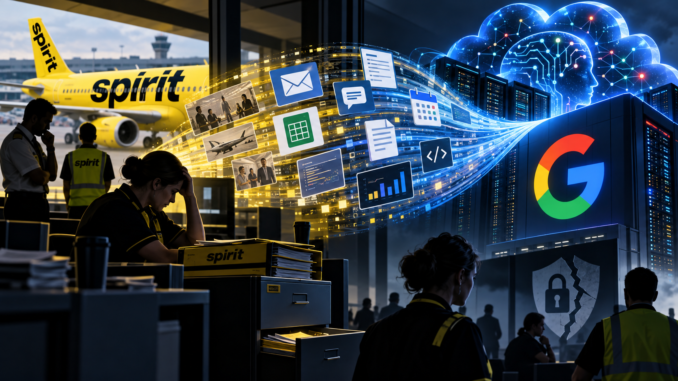

In the wake of Spirit Airlines filing for bankruptcy last May, tech giant Google has stepped in with a $10 million cash bid for the failed airline’s vast trove of internal data.
Google outbid a $7.5 million offer from AI data company Mercor for the massive data archive. However, the U.S. Bankruptcy Court delayed the approval hearing for the sale until September 9.
The hearing, originally scheduled for August 19, was postponed following an objection filed by the Association of Flight Attendants (AFA), which represents Spirit crew members.
The AFA said it is seeking restrictions on the sale of flight attendant employee data, as well as additional protections for workers if the transaction is approved.
Included in the massive data set are reportedly 100 million employee emails, 500 million Microsoft Teams messages, spreadsheets, calendars and extensive marketing, productivity and operational data, along with approximately 30 million lines of code.
Spirit has said the data will be de-identified by a third party before being delivered to Google. However, the union argues that because the sale agreement requires links between certain data sets to be preserved, there is concern that individual information could potentially be reconstructed.
Google, meanwhile, plans to use the data for product development and training its artificial intelligence models.
The most obvious concern is that, once again, a major technology company will use third-party data to develop and train large language models that could ultimately automate jobs currently performed by people.
But beyond that, and the potential risks to employee privacy, the sale could set a broader precedent.
The transaction raises the possibility that other companies facing financial difficulties—or simply looking for new sources of revenue—could decide to sell internal business and employee data they no longer consider critical to their operations.
Nonprofit digital rights organizations such as the Electronic Frontier Foundation (EFF) have argued that neither solvent nor bankrupt companies should be allowed to sell employee-generated data without the consent of the individuals who created it.
Another reason some technology ethicists and business observers are wary of the Spirit deal is the potential impact of training AI systems on vast, detailed collections of data covering nearly every aspect of a third-party company’s operations.
With access to that kind of information, AI systems could increasingly be trained to run entire business units, not simply perform individual jobs.
In theory, that could allow Google and other AI developers to train autonomous systems not only to reproduce the output of individual employees, but also to understand and replicate how teams, departments and even entire companies function.
The concerns mirror Meta’s move last April to install software designed to track employee activity—including mouse clicks, keystrokes and screenshots—in an effort to collect real-world data for training autonomous AI agents.
Strong employee pushback and internal protests reportedly caused Meta to scale back the effort before ultimately suspending it after a security mistake left sensitive data accessible to employees who should not have been able to view it.
Over the last 18 months, one of the biggest trends in artificial intelligence has been the rise of reinforcement learning (RL) environments, a training method that has contributed to rapid improvements in models capable of working independently for extended periods.
These RL environments are essentially simulations of commonly used software in which AI agents can perform sequences of actions independently. If an action produces the desired result, the system receives a reward signal and becomes more likely to take similar actions in the future.
Still, reinforcement learning environments are only as useful as the data used to populate them.
And while Spirit was a failed company, its internal data still contains potentially valuable information about how people perform their jobs, collaborate toward shared goals and operate within the norms and constraints of the aviation industry.
Unlike software coding, where success or failure can often be determined quickly and objectively, office work is far more nuanced.
Because of that, it remains unclear whether feeding real-world corporate data such as Spirit’s into reinforcement learning environments will allow AI companies to automate white-collar work as quickly as AI has advanced through parts of the software industry.

Be the first to comment