

At the last Federal Reserve meeting, the Federal Open Market Committee, the arm of the
Federal Reserve that sets interest rates, voted to hold interest rates steady for the fifth
consecutive meeting. While the move was expected, there does seem to be some ripples
of disagreement coming from the Reserve governors, in that, unlike the June meeting which
resulted in a unanimous vote to keep rates the same, at the July 29 meeting, three
dissenting voices voted to hike rates by a quarter of a point, compared to nine who voted to
keep rates steady.
The overnight, or benchmark, lending rate remains at 3.5%-3.75%, after lowering rates six
times in the last two years.
The sticking point for the committee likely boils down to the usual concern: inflation. The
voices calling for a rate hike will likely increase if inflation remains above 2% and the labor
market continues to remain strong.
The takeaway for the home loan market is likely to remain volatile, especially if inflationary
pressures increase.
While the Fed benchmark rate has little effect on home mortgage rates directly, the
expectation of future rate hikes and lingering inflation means mortgage rates are unlikely to
fall in the coming months. The Fed simply cannot lower mortgage rates by rate cuts alone.
The Federal funds rate is the ‘overnight finance rate’, or what institutions charge each other
to borrow money, and fixed rates on long-term mortgages are not tied to this borrowing rate.
Despite the central bank’s six rate cuts over the past two years, home borrowing rates have
largely remained the same, fluctuating between 6% and 7% for a thirty-year fixed loan.
Potential home buyers should understand that mortgage rates move on economic
expectations long before the central bank acts. And given current Fed chair Kevin Warsh’s
tendency to remain quiet about future central bank moves, variables in the housing market
remain high.
“A lot of buyers think the next Fed meeting will tell them whether it’s a good time to buy a
home,” said Bill Banfield, chief business officer at Rocket Mortgage. “In reality, mortgage
rates are forward-looking. They’re constantly responding to what investors expect will
happen in the economy, not just what the Fed announces on a given day. That’s why
mortgage rates can fall before a Fed rate cut or even rise afterward.”
The Fed can only really affect mortgage rates through a process called ‘quantitative easing’
in which the central bank buys up mortgage-backed securities, as it did during the Covid
pandemic, which resulted in very low borrowing rates during the crisis.
Currently, the Fed is not in a quantitative easing period, but rather in a neutral phase in
which they maintain its current holdings while keeping interest rates unchanged.
More precisely, the 30-year mortgage rate more closely follows the 10-year U.S. Treasury
yields. The bond market is influenced by several factors, including future Fed policy
decisions and expectations for inflation.
In recent months, the U.S. war with Iran has had a huge impact on inflation. As oil prices
increased exponentially, while the cost to produce, manufacture and transport goods spike
upward as well. High oil prices drive up bond yields, and the mortgage rates follow, as
investors demand higher returns to offset inflation.
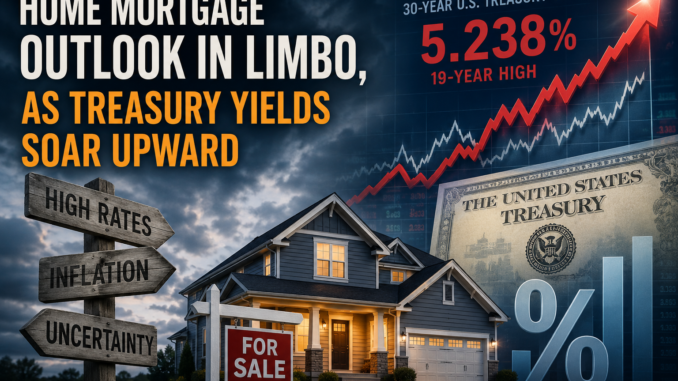
Last week, the 30-year U.S. Treasury yield rose to a 19-year high of 5.238% following the
Fed’s decision, while the rise in Treasury yields caused yields on European government
bonds to increase as well, bringing the 30-year German Bund yield to a two-month high of
3.687%. Analysts noted Warsh’s lack of sufficient detail as to why the rates were being
held, leaving the market even more uncertain.
“Markets were giving Fed Chairman Kevin Warsh credibility on bringing down inflation
following his first press conference in June,” wrote a TD Securities analyst. “The
honeymoon period has ended with a bang as long-end rates have moved sharply higher
amid a rebound in inflation expectations.”
Warsh’s approach to not issue any type of forward guidance makes it difficult for markets to
form a coherent analysis of Fed policy. Yields are likely to remain high if hostilities in the
Middle East continue, creating more inflationary pressure, and if the markets continue to
question the Fed’s desire to stifle inflation.
The big concern for investors is that inflationary pressures could gather speed if the Fed
doesn’t raise rates sufficiently in the future.
Longer dated Treasurys were hit particularly hard and the yield spread between 30-year and
2-year Treasurys widened to nearly 92.5 basis points by the next day’s close from around 78
basis points earlier in the day.
As for any future insight, lenders have always demanded compensation for inflationary
risk, uncertainty and the time value of money. Thus, for all the sway of the Fed’s lending
terms, mortgage rates are more influenced by the millions of investors making judgements
about the future. And right now, those investors remain cautious.

Be the first to comment