
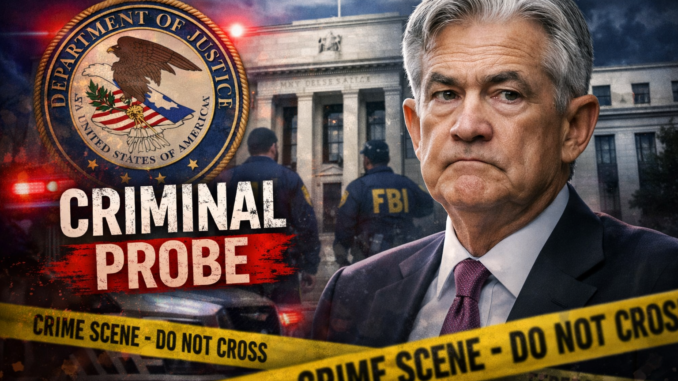

In what some consider the administration’s latest effort to exert greater influence on
economic policy, the Justice Department has issued a criminal probe into Federal Reserve
Chairman Jerome Powell, stemming from Powell’s comments to Congress last summer
regarding the building renovation project to the Federal Reserves’ Washington
headquarters.
President Trump has long expressed his dissatisfaction with the Federal Reserve, and
Chairman Powell in particular, even threatening to relieve Powell from his position, and
publicly chastising him for not lowering interest rates more aggressively.
The U.S. central bank has long functioned with complete autonomy and with no
accountability to the President or any other elected official. The independence of the
central bank, at least in setting interest rates to control inflation, is long considered the
central pillar of a robust economic policy, insulating Reserve board members from any
outside or political pressure, ensuring they make the best decisions based on monetary
policy, and longer-term efforts to keep prices relatively stable.
Both lawmakers and former Fed Reserve chairs have spoken up in resistance to the probe,
and in defense of the central bank to maintain its independence from political influence.
Former Fed chairs Janet Yellen, Ben Bernanke and Alan Greenspan expressed their
concerns early in the week.
“This is how monetary policy is made in emerging markets with weak institutions, with
highly negative consequences for inflation and the functioning of their economies more
broadly,” they wrote. Global central bankers including the chiefs of the French and
Canadian central banks publicly offered solidarity.
Republican Senator Thom Tillis called the move a “huge mistake” and, as a member of the
Senate Banking Committee that vets future Fed nominees, vowed to oppose any Trump
nominee to the Fed, including Powell’s future replacement, until any legal matter is fully
resolved.
Those sentiments were echoed by fellow Republican Senators Kevin Cramer of North
Dakota and Lisa Murkowski of Alaska, who posted on X that “the stakes are too high to look
the other way: if the Federal Reserve loses its independence, the stability of our markets
and the broader economy will suffer.”
Treasury Secretary Scott Bessent, a Trump ally and possible candidate for Powell’s
replacement at the close of his term, reportedly told the President he “made a mess” with
the criminal probe and could be bad for financial markets.
For the week, the Dow finished slightly down, dropping 83 points (0.17%), as once again,
gold hit an all-time high, tipping the scale at $4,600+ late in the week, while Nasdaq inched
down 0.06% as well. The S&P 500 rose slightly on Friday but will still end the week at a loss.
Powell’s comments last summer, surrounding a reported $2.5 billion renovation of the
historic Federal Reserve Headquarters in Washington, drew the ire of President Trump,
culminating with a tense visit to the work site, where Trump openly barbed the Chairman
about his reluctance to lower interest rates.
In a comment on social media about the renovation, Trump stated, “It is what it is and,
hopefully, it will be finished ASAP. The cost overruns are substantial but, on the positive
side, our Country is doing very well and can afford just about anything.”
In the three Federal Reserve meetings in the fall, the central bank reduced the benchmark
lending rate by 0.25% at each interval, lowering the baseline borrowing rate to 3.5%-3.75%.
Trump had been demanding must steeper cuts to facilitate greater economic growth, but
the Fed proceeded cautiously with the national inflation rate still near 3%, higher than the
Fed’s preferred inflation rate of 2% to accommodate deeper rate cuts.
On Jan 11, Powell went public that the Justice Department issued subpoenas in advance of
a possible criminal indictment related to the ongoing renovation project. As the cost for the
project has ballooned, some Trump allies have called for an investigation. Powell maintains
it is just another example in a long history of the president trying to exert political influence
on the autonomous and independent nature of the central bank.
Powell was nominated by Trump in 2017 and confirmed by the Senate in early 2018. His
term as Chairman ends in May, but he is not obligated to leave the Board of Governors until
2028, and given the administrations latest move, the belief is that Powell will defiantly
remain with the Board of Governors once his Chairmanship is expired.
Powell stated on Sunday that “I have deep respect for the rule of law and for accountability
in our democracy. No one–certainly not the chair of the Federal Reserve–is above the
law.”
“But this unprecedented action should be seen in the broader context of the
administration’s threats and ongoing pressure” for lower interest rates and more broadly,
for greater say over the Fed, he said.
Given the pushback from Republican lawmakers, past chairpersons’ concerns, and Wall
Street’s shaky reaction, the ongoing sparring match between the Fed and the
administration may be heading to more tenuous grounds.
As for the Trump, he claimed aloofness to the Justice Department probe: “I don’t know
anything about it,” said Trump Sunday. “But he’s certainly not very good at the Fed, and he’s
not very good at building buildings.”

Be the first to comment