
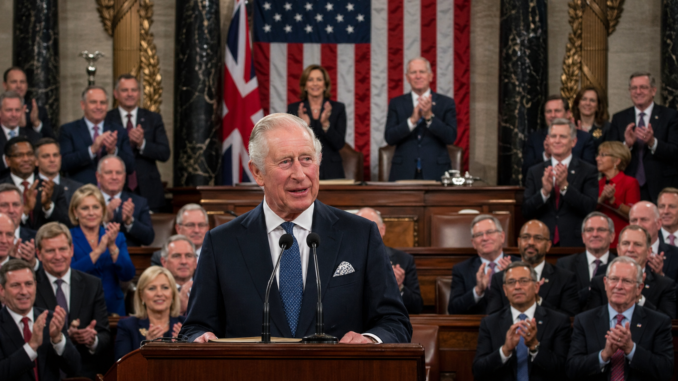

For the first time in over three decades, a British monarch addressed a group meeting of
the U.S. Congress, and achieved something rarely seen in any congressional gathering in
nearly the same amount of time—a nearly universal positive response. For the first time
since 1991, a British monarch, King Charles III, spoke before the U.S. Congress and elicited
equally positive reactions from both sides of the legislative hall–and that from a group of
lawmakers remiss to the idea of monarchs in general.
In a subtle and precise address, King Charles reminded the Congress and us of our shared
American values: the rule of law, democracy and the power of its international example.
Charles defended the pillars of Western democracy—domestic checks and balances,
alliances and interfaith tolerance—while noting that friends can disagree without fracturing
forever held bonds, a subtle, veiled reference to the U.K.s refusal to join the war with Iran.
Members of both parties clapped at most of the same applause lines, laughed at the well-
placed royal jokes, and, unlike any recent State of the Union address, engaged in standing
ovations that were rarely partisan. Sometimes Democrats stood more eagerly, as when
Charles said, “executive power is subject to checks and balances”, while at other
moments, Republicans were quicker to stand and applaud, as when the King said, “the
Christian faith is a firm anchor”.
While there was plenty of irony apparent—a real king rooted in a constitutional, limited
monarchy offering an implied contrast to a current chief executive that some critics warn is
seeking his own imperial powers—Charles showed deep respect for the hosts, describing
the union of the two countries as “priceless and eternal”, and his speech was replete with
praise for American historic achievements.
Though some perceive current relations somewhat strained because of the U.K.’s
unwillingness to back the U.S. in the ongoing conflict with Iran, as Britain initially withheld
permission for U.S. planes to use its bases in air attacks, President Trump was not only
welcoming, but openly supportive of the monarch, and Britain as a whole. In a welcoming
speech, he made direct illusions to the landmark alliance between then President Franklin
Roosevelt and British Prime Minister Winston Churchill, joining forces to fight tyranny in
World War II.
“If they could see us today, our ancestors would surely be filled with awe and pride that the
Anglo-American revolution in human freedom was never, ever extinguished but carried
forward across centuries, across oceans, and across history until it became a fire that lit
the entire world,” Trump said.
Beyond that, Trump has always made his fondness for the monarchy, and King Charles in
particular, very clear. Trump spoke emotionally of his late mother’s Scottish roots and her
respect for Charles’ mother, Elizabeth II.
Charles also twice condemned the alleged assassination attempt at the White House
Correspondence Dinner on Saturday night and even presented a unique gift to the
President—the original bell from the conning tower of the HMS Trump, a Royal Navy
submarine that saw service in the Pacific in World War II.
“Should you ever need to get a hold of us, give us a ring!”, said Charles.
While the primary purpose of Charles’ visit was to celebrate the 250th anniversary of
American independence, he also sought to smooth over any antagonism regarding the
U.K.s initial decision to withhold U.S. planes from using their bases.
“With the spirit of 1776 in our minds,” said the King, “We can perhaps agree that we do not
always agree — at least in the first instance!”
As the legislative branch remains entrenched in a quagmire in which they cannot agree on
even fundamental civic values, somehow, even 250 years after the Revolution, the
monarchy, though perennially troubled and scandal-tainted, somehow avoids the partisan
chasms that have become endemic throughout American society.
But again, that irony, a monarch endowed by divine right exhibiting continuity, and a term-
limited chief executive whose permanence is outlawed by American freedoms won 250
years ago, is what brought both countries together to begin with.
