

In the latest Bureau of Labor Statistics report, a pair of developments are giving policymakers pause about what is really happening in the labor market—and whether a future interest rate hike is as likely as it once appeared.
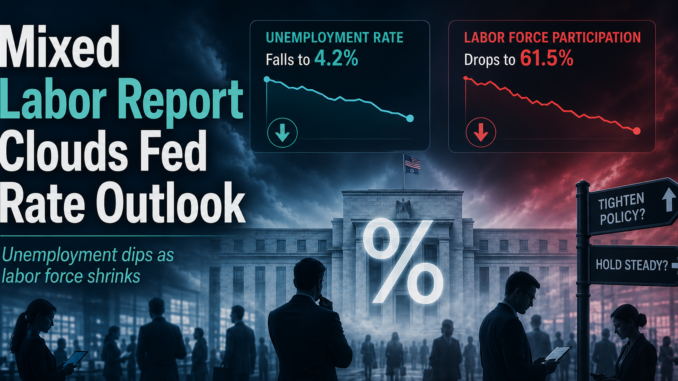
For starters, despite downward revisions to previous job gains in April and May, the unemployment rate fell slightly, from 4.3% to 4.2%.
At the same time, the report indicates that the number of people available for work is declining, potentially because of an aging population and a reduction in the number of immigrants entering the labor force.
The number of people reporting themselves as unemployed fell by 213,000. Labor force participation dropped by roughly 700,000 people, bringing the participation rate down to 61.5% in June, its lowest level since March 2021.
Meanwhile, the number of people reporting that they were employed fell by roughly half a million, reinforcing the broader decline in labor force participation. Reportedly, about 1.5 million fewer people were working in June than in January 2025, the start of President Donald Trump’s second term.
Economists have estimated that the economy now needs to create somewhere between zero and 50,000 jobs per month to keep pace with growth in the working-age population.
That so-called “break-even” rate has fallen as tighter immigration policies have reduced growth in the labor force, which in turn has helped keep the unemployment rate lower than it otherwise might be.
Historically low levels of layoffs have also played an important role in supporting payroll growth. After the uncertainty created by last year’s tariffs and this year’s conflict in the Middle East, companies have shown a reluctance to let workers go, particularly after struggling to find enough labor during the post-pandemic recovery.
“The unemployment rate’s decline to 4.2% is a case of good news for the wrong reasons: it was driven by people leaving the labor force, not by more hiring. This points to a labor market that’s stubbornly refusing to reaccelerate, despite recent optimism,” said Daniel Zhao, chief economist at job site Glassdoor.
The challenge for the Federal Reserve is determining how to interpret those conflicting signals.
A lower unemployment rate can indicate a tighter labor market, while declining labor force participation can point to weaker underlying growth.
While high inflation remains a major concern for the Federal Reserve, uncertainty over whether job growth can be sustained makes future interest rate decisions more complicated.
Although financial markets had been betting that the Fed would raise borrowing costs again soon, uncertainty over which risk requires the most attention—persistent inflation or weakening job growth—could give policymakers reason to leave rates unchanged, according to some Fed observers.
It is also worth remembering that June has historically been one of the more volatile months for job revisions.
Last year, after the BLS initially reported strong job gains for June, revisions released in the July and August reports ultimately reduced the estimate by 160,000 jobs, turning the month into a net loss.
Job gains for April and May have already been revised downward by a combined 74,000 jobs, making the possibility of further revisions to June particularly important for understanding the broader labor market trend.
The Federal Reserve debated the impact of immigration policy on the workforce last year, and while new Chairman Kevin Warsh has not focused heavily on the issue, it could play a larger role in the U.S. employment outlook going forward.
The key question is whether monthly job creation remains sufficient relative to the number of people available to work. The implications for future economic growth depend not only on how many people are employed, but also on how productive they are.
Warsh noted in comments to a European economic council last Wednesday that a recent increase in U.S. productivity has occurred even as the average number of hours worked has remained relatively flat.
“Potential growth looks like it’s trended up,” Warsh said, pointing to higher productivity, while noting that “labor market hours worked are relatively flat.”
Warsh remained optimistic about the broader implications, while acknowledging that the timing remains uncertain.
“Nothing is in the bank at this time of consequence, but if the last four quarters are an indication, which is really largely before the advent of the new surge in what artificial intelligence can do, there’s reason to be optimistic. Does that optimism convey into policy in the next six or nine months? Still too soon to say.”
The moderation in payroll growth brings the government data more closely in line with other labor market surveys, including small-business hiring plans, which have pointed to more modest employment growth.
Traders have now priced in a much smaller chance of a Federal Reserve rate hike this month, though expectations for tighter monetary policy later in the year remain.
Short-term interest-rate futures are reflecting roughly a 60% chance of an increase in September, down from about 75% before the jobs report.
The Federal Reserve left its benchmark interest rate unchanged at 3.50% to 3.75% at its June meeting, while updated quarterly projections still showed that policymakers expected to raise borrowing costs later this year.
