
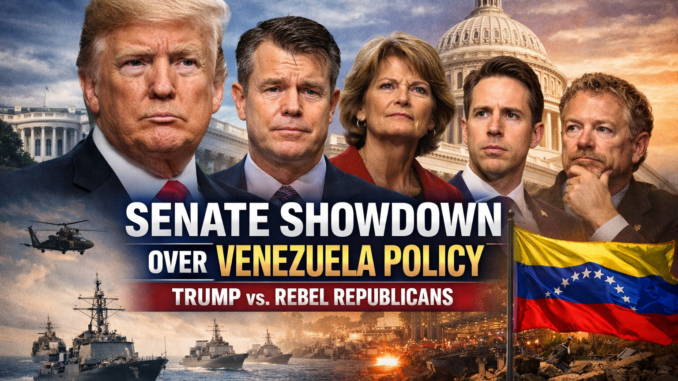

After a war powers resolution act was approved by the U.S. Senate just days ago, aimed at
curbing President Trump’s ability to further call military strikes on Venezuela, the same act
is at risk of being overturned, as the White House has increased pressure on the five
Republicans who voted for the resolution.
Republicans could use a procedural move to block the measure, arguing that the resolution
should no longer be “privileged” because the U.S. is not currently engaged in hostilities
with Venezuela. This move would give the matter priority on the Senate floor.
Senate Majority Leader John Thune of South Dakota previewed the argument in floor
remarks on Wednesday. “Today, we expect a vote on a resolution to direct the removal of
U.S. forces from hostilities in or against Venezuela, even though the U.S. is not currently
engaged in hostilities in or against Venezuela,” Thune said. “We have no troops on the
ground in Venezuela. We’re not currently conducting military operations there.”
Following the U.S. capture of Venezuelan President Nicolas Maduro and his wife last week,
Democrat Senator Tim Kaine advanced a resolution limiting Trump’s ability to further strike
Venezuela and received backing from five Republican Senators. Pervious attempts for such
a measure in the upper chamber failed.
The GOP senators who voted with Democrats to advance the measure were Todd Young of
Indiana, Lisa Murkowski of Alaska, Susan Collins of Maine, Rand Paul of Kentucky and Josh
Hawley of Missouri.
President Trump immediately expressed his disappointment with the action, and with the
GOP Senators who supported it, stating they “should never be elected to office again” and
calling them “real losers”.
The Republican Senators all had reservations about further military action in the country,
and some said they had been contacted directly by either President Trump or Secretary of
State Marco Rubio.
“I’m not speaking to final passage,” said Todd Young on Tuesday. “I’m certainly glad the
president and his team gave me a call, but I found it important to vote for the resolution at
least procedurally.”
Josh Hawley objected to troops being put on the ground in Venezuela but stated he would
now vote with the GOP to kill the effort. Hawley said Rubio confirmed the U.S. “has no
ground troops currently in Venezuela” and that if the administration plans to put troops in
Venezuela, “they would abide by the War Powers Act and they would come to Congress for
congressional authorization.”
“The secretary told me directly that the administration will not put ground troops in
Venezuela,” Hawley said.
Kaine maintained early Wednesday he expected all five GOP members to remain
supportive of the resolution.
Lawmakers claimed that, prior to Maduro’s ouster, they had received insufficient answers
from the Trump administration about whether it’s end goals included regime change, while
the administration launched strikes against alleged drug running boats, imposed an oil
blockade, bulked up a military presence and threatened land strikes. Republicans who
voted to advance the measure last week were concerned with Trump’s comments to run
the country of Venezuela and the potential for U.S. forces to be deployed there.
A day after the initial vote, Trump called off a so-called “second wave” of attacks against
Venezuela, claiming that the “two countries are working well together”, but maintained
that U.S. naval forces would remain in the region for “safety and security purposes.”
Senator Kaine claimed the second attack was called off due to the war powers vote.
On late Wednesday, the Senate squashed the war powers resolution, with Vice President
JD Vance casting the tie breaker vote. Sens Hawley and Young flipped their vote, after
being assuaged by the White House. Hawley indicated that Rubio addressed his concerns
about troop deployment, while Young maintained he did not cave to pressure from the
president, but rather he had “secured some valuable reassurances and deliverables” from
the White House regarding their efforts in Venezuela.
