
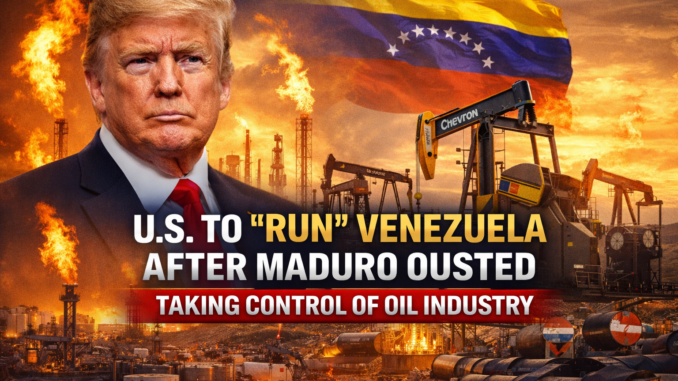

With the ousting of Venezuelan President Nicolas Maduro, U.S. President Donald Trump
immediately expressed that the United States would “run” Venezuela for an unspecified
“period of time”, and perhaps more explicitly, that the U.S. would take a significant role in
running the Venezuelan oil industry.
“We’re going to be taking out a tremendous amount of wealth out of the ground,” Trump said
following Maduro’s arrest, suggesting U.S. oil companies would benefit greatly from the oil-
rich reserves.
Maduro and his wife, Cilia Flores, are among six defendants named in a four-count
superseding indictment that accused them of conspiring with dangerous drug traffickers for
the last 25 years. Maduro was indicted on related charges in 2020. He has long denied all the
allegations, and he pleaded not guilty at his initial hearing. Flores also pleaded not guilty.
Some have expressed concern of whether the U.S. is within the boundaries of international
law, including comments from the United Nations Secretary General António Guterres, of
whetherinternational law has been respected in the takeover. Trump defends his
administration’s actions, describing it as a law enforcement operation rather than a military
attack.
Venezuela holds the largest proven oil reserves in the world, but efforts to extract the lucrative
resources face numerous financial and political hurdles.
According to the U.S. Energy Information Administration, Venezuela holds the largest proven
oil reserve of any country, an estimated 300 billion barrels, approximately 17% of the worlds’
reserves.
In 2025, Venezuela exported about 749,000 barrels per day, totaling less than 1% of the global
supply, underscoring their decades long struggle to match demand with strategic output.
Plus, their oil reserve is made up primarily of heavy crude, creating greater challenges than
extracting lighter crudes, even though it commands a lower sale price.
While U.S. refineries in the gulf coast region are equipped to refine the oil, the infrastructure
necessary to ramp up oil production would reportedly require billions of dollars in investment
over several years. And should political instability remain in Venezuela, American oil
companies may balk at having to invest heavily in a dicey political climate.
According to Jorge Leon, a geopolitical analyst at Rystad Energy, the venture would require
about $110 billion to increase output to 2 million barrels per day by the early 2030s. With oil
prices hovering near their lowest level since 2021, U.S. companies may find less potential
upside in such a venture, than if the price was higher.
Low oil prices stem from a surplus of available oil alongside relatively slow economic growth,
which has constricted demand for fossil fuels.
Plus, U.S. firms involved in the process would face risks. Currently, Chevron is the only U.S. oil
firm operating in Venezuela, as part of a joint venture with the country’s state-owned local
operator. ExxonMobil and ConocoPhillips stopped doing business with Venezuela in 2007,
after then-President Hugo Chavez nationalized the sector.
Upon being cited for unlawful seizure of assets belonging to the two oil giants, the World
Bank’s International Center for Settlement of Investment ordered Venezuela to pay the firms
billions of dollars. To this time, Venezuela has only paid a small share of the debt owed to
ExxonMobil and ConocoPhillips. If the political situation remains unstable, U.S. companies
will remain reluctant to do business with the country.
Trump expressed confidence that U.S. companies would spend money to improve the nations
infrastructure and output. “We’re going to have our very large United States oil companies —
the biggest anywhere in the world — go in, spend billions of dollars, fix the badly broken
infrastructure, the oil infrastructure,” Trump said last weekend.
So far, the major oil firms have made lukewarm comments regarding the venture.
In its only public statement, ConocoPhillips offered: “ConocoPhillips is monitoring
developments in Venezuela and their potential implications for global energy supply and
stability. It would be premature to speculate on any future business activities or investments,”
the company said.
ExxonMobil CEO Darren Woods bluntly stated that Venezuela is “uninvestible”, and that
durable legal protections, functioning legal frameworks and changes to hydrocarbon laws
would have to be enacted before ExxonMobil would consider investing billions in Venezuela.
Trump retorted that he would be inclined to “keep Exxon out”of Venezuela. “I didn’t like their
response,” said Trump. “They’re playing too cute.”
Chevron said in a statement it continues to focus on its current operations.
“Chevron remains focused on the safety and wellbeing of our employees, as well as the
integrity of our assets. We continue to operate in full compliance with all relevant laws and
regulations.”
