
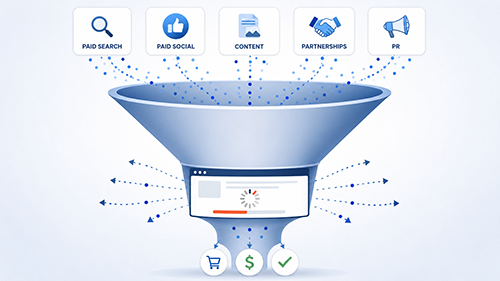

Strategic marketing conversations tend to focus on the channels at the top of the funnel. Paid search, paid social, content, partnerships, and PR get attention because they are visible and because budgets attach to them cleanly. Site performance gets less attention, even though it sits between every channel and every conversion. From where I sit, having worked on more than 1,500 website optimization projects since 2020, I would argue that site speed is one of the most undervalued line items on a marketing leader’s strategic plan.
This is not a technical argument. It is a financial one. Here is how it shows up in practice.
Paid acquisition costs more when your site is slow
Google has built page experience signals into both Search and Ads for years now, and the connection has only gotten tighter. Core Web Vitals influence organic ranking, and slow landing pages reduce Quality Score, which raises cost per click on paid search.
The translation for a marketing leader is straightforward. If a competitor with a faster landing page is paying $3.40 per click while you are paying $4.80 for the same keyword, you are absorbing a cost penalty that has nothing to do with creative or bid strategy. Speed is a paid media discount you do not get to take advantage of until your site is fast enough.
Conversion rate compounds at every step
Research from Google and its partners has consistently measured a meaningful conversion lift from improvements as small as a tenth of a second in mobile page load. The findings have held up across the work my team has done. On a Shopify Plus store we audited last year, a 0.8 second improvement in Largest Contentful Paint moved checkout completion measurably across all paid campaigns within thirty days, with no change to creative, audiences, or bids.
The compounding effect matters. If add to cart, checkout start, and checkout complete each move by one or two percentage points, the impact at the bottom of the funnel is much larger than any of the individual changes. That is exactly the kind of multiplier strategic marketing leaders are paid to find.
The competitive case has changed
Five years ago, being slow was the category norm. Today, being slow puts a brand behind its category. The Chrome User Experience Report tracks how millions of sites are performing, and the median continues to improve. Brands that have not invested in performance are not staying still while everyone else moves forward. They are falling behind on a metric that customers and search engines both notice.
This is the part that surprises many business leaders. They believe their site is fine because nobody has complained. The people who would have complained have already left for a competitor whose site loaded faster. Slow sites lose silently.
How to put performance on the strategic plan
Three habits separate the marketing organizations that get this right from the ones that do not.
First, they include site performance in their quarterly business review, alongside CAC, LTV, and conversion rate. They report on Largest Contentful Paint and Interaction to Next Paint from field data, not from a one time lab test.
Second, they assign an owner. In smaller teams, that is often the head of growth or the senior marketing operations lead. In larger teams, it is a partnership between marketing and engineering with a shared dashboard. Without an owner, the work falls between the cracks.
Third, they audit before they redesign. Many marketing leaders learn the hard way that a brand new site, designed with heavy hero videos and a thousand new tags, performs worse than the site it replaced. A pre launch performance budget is a small investment that prevents a large regret.
The strategic takeaway
Marketing leaders are taught to find leverage. Site performance is leverage. It raises paid media efficiency, conversion rate, organic visibility, and customer experience scores at the same time, with a single underlying improvement. Treating it as a one time engineering task is what keeps it off the strategic plan. Treating it as an ongoing growth discipline is what gets it on the plan and starts moving the numbers that boards care about.
