
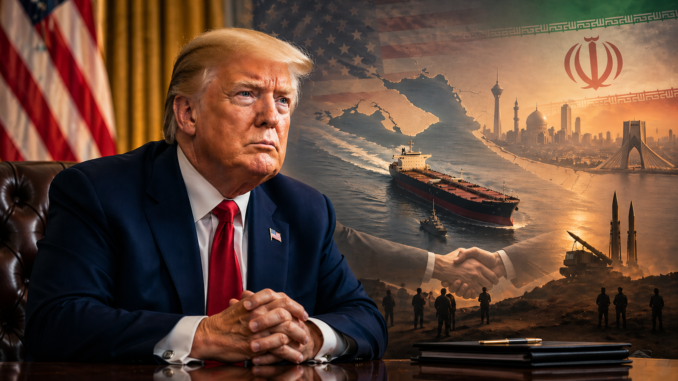

President Donald Trump met with his national security team again last Tuesday to discuss the next step in the ongoing conflict with Iran.
Trump’s latest deadline was fast approaching. He had demanded that Iran reopen the Strait of Hormuz to unrestricted shipping and reach an agreement over its enriched uranium stockpile and other unresolved issues, or face the possibility of renewed U.S. military strikes.
At the time, a resumption of diplomatic talks in Islamabad had not been confirmed, and efforts to communicate through Pakistani intermediaries had produced little visible progress.
It remained unclear whether Tehran was deliberately withholding a response or whether damage to Iran’s communications infrastructure had made internal coordination more difficult.
Some U.S. officials believed the lack of response reflected fractures within Iran’s leadership and an inability to quickly reach consensus over the Strait of Hormuz, the country’s uranium stockpile and other major negotiating points.
There has also been considerable uncertainty surrounding Supreme Leader Mojtaba Khamenei’s role in the government. His limited public visibility has fueled speculation about the extent of his influence and whether Iran’s military leadership has assumed greater control over day-to-day decision-making.
U.S. officials have also suggested that Khamenei’s efforts to remain out of public view may have complicated internal government discussions. Iranian officials, however, have disputed speculation about his condition.
With no clear path toward renewed negotiations and no certainty over when formal talks might resume, Trump opted to extend the ceasefire without specifying a new expiration date.
Trump acknowledged that Iran had only a limited amount of time to respond, but he did not publicly define that timeframe.
In the meantime, the U.S. blockade affecting Iranian ports has remained in place. Tehran has repeatedly argued that the blockade must be lifted before meaningful negotiations can resume, while the Trump administration has maintained that restrictions will remain until a broader agreement is reached.
The standoff has placed significant economic pressure on both sides.
Iran’s maritime trade and oil exports have been heavily disrupted, while elevated global energy prices have continued to strain consumers and businesses in the United States and abroad. Brent crude has remained above $100 per barrel amid the ongoing instability in the region.
Without a firm negotiating deadline, some Trump advisers have expressed concern that Iran could attempt to prolong talks in order to buy time to restore military capabilities damaged during the conflict.
Among the most difficult unresolved issues are Iran’s future ability to enrich uranium, the fate of its existing enriched uranium stockpile and the extent to which U.S. sanctions might be lifted as part of any agreement.
Those questions remain central to negotiations between Washington and Tehran. Recent mediation efforts have focused heavily on the sequencing of potential concessions, including reopening the Strait of Hormuz, easing sanctions and addressing Iran’s nuclear program.
Trump remained publicly patient when speaking to reporters from the Oval Office, saying he was in “no hurry” to finalize an agreement.
“I don’t want to rush it, I want to take my time, and I want to get a great deal,” Trump said. “I want to get a deal where our nation and the world is safe from lunatics with nuclear weapons.”
