
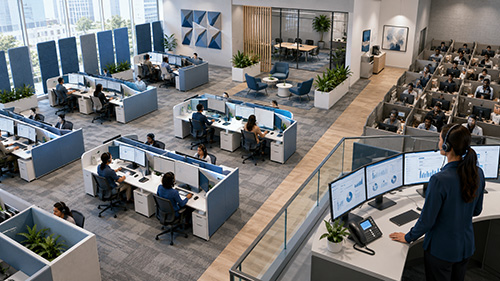

Growth puts pressure on call center space before it affects anything else. Adding desks might seem like the quickest fix, yet crowded workstations rarely address the underlying operational strain. What call centers need, besides more desks, is a workplace that supports clear communication and steady focus without introducing new friction.
A Layout Built Around Call Flow
A call center floor should reflect how work moves through the day. Supervisors need visibility without hovering over every conversation, while agents need enough separation to stay focused through long call blocks. When planning only measures how many people fit in the room, the layout starts working against the team. Stronger planning begins with how calls are handled and supported.
Acoustic Control for Better Focus
Noise is one of the fastest ways for a dense workspace to lose efficiency. Even skilled agents struggle when nearby conversations bleed into their headset or make it harder to process customer details. Acoustic panels and careful workstation orientation reduce distractions without isolating employees from the team. In a call center, sound control directly shapes accuracy and tone.
Technology Access That Fits the Work
More desks do little good when power and equipment placement fall behind. Agents need reliable access to tools without awkward cable runs or cramped surfaces that
interfere with notes and devices. Managers should consider whether each station supports the work comfortably before adding another seat. A dense floor performs best when the infrastructure behind it receives the same attention as the furniture.
Support Space Away From Active Calls
High-volume phone work demands real recovery space away from the floor. A break area does not need to be large, but it should give employees a clear mental shift before they return to customer conversations. Without that separation, stress from one call could carry into the next interaction. Better support space keeps the main workspace sustainable during busy periods.
Flexibility for Changing Staffing Needs
Call centers rarely stay the same size for long. Seasonal demand and training groups change how the floor needs to operate. Flexible furniture gives managers more control than a fixed grid of desks. For example, high-density workspace planning for call centers works best when density leaves room for supervision, comfort, and future adjustments rather than only squeezing in more seats.
A productive call center depends on more than fitting another person into an open spot. The best workspace choices reduce strain before it shows up as problems in daily workflow. What call centers need besides more desks is a floor plan that respects the people doing the work and the pace they are expected to maintain.