
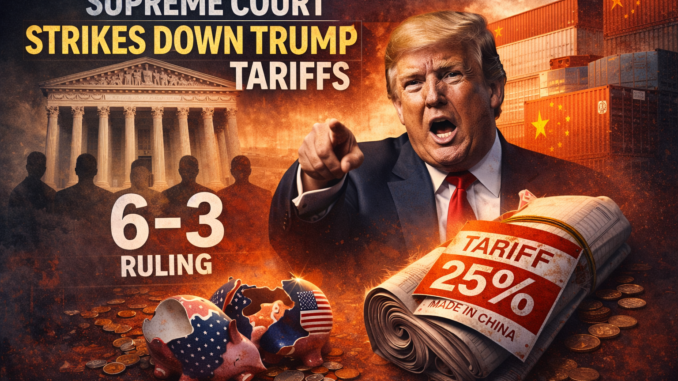

The Supreme Court handed down a 6-3 decision last week, ruling that President Donald
Trump exceeded his authority under the International Emergency Economic Powers Act
(IEEPA) by imposing significant, broad-based tariffs on imported goods. The decision marks
a major set back for the Trump administration after nearly one year of employing a “big
stick” approach with tariffs—wielded as a bargaining tool in everything, to setting trade
policy, to geo-political negotiations and tactics, to incentivize home-based
manufacturing—in short, the cornerstone of the administration’s economic policy.
The decision comes just as reports have emerged of what Trump’s tariff policy has
ultimately cost American households over the last year.
While not yet fueling the inflationary spike many feared, new analysis is showing that
Trump’s tariffs amounted to an average tax increase of $1,000 per household in 2025, with
the prediction that the cost is likely to rise to $1,300 per household in 2026, if the policies
remain in place.
That seems unlikely given the high courts decision, however Trump is already exploring
other legal avenues to keep his tariff policies in place.
Research published by the non-partisan Tax Foundation detailed that, in 2022, the
weighted average applied tariff was 1.5%. Prior to the ruling against the IEEPA, U.S. imports
faced an applied tariff rate of 13.8%, though Tax Foundation estimated that while the
Section 122 tariffs (allowing 15% for 150 days) are in effect, the applied rate would be
12.1%. After Section 122 expires, the rate would drop to 6.7%.
Prior to the court’s decision, Trump published an op-ed in the Wall Street Journal praising
his tariff policy as “creating an American economic miracle”, citing recent better than
expected economic growth, announced investments in America and stock market highs.
All of which has occurred without the inflationary explosion expected by others.
However, some claim the reason the worst of the inflationary fears have not materialized is
because Trump shifted his tariff policy throughout the year—the initial roll-out, pull-back,
expansion and pausing and scaling back—that have blunted the full impact economists
expected.
A recent study from the Kiel Institute for World Economy found that, ultimately, importers
and consumers in the United States are bearing 96% of the tariff burden.
In lieu of greater tax refunds expected thanks to the One Big Beautiful Bill, the Tax
Foundation warns that the economic benefit of the tax cuts will be offset by the increases
paid out due to tariffs, while the tariff revenue itself falls short of paying for those tax
breaks.
“Lower-income filers are, on average, worse off under the combined effect of the tariffs
and tax cuts in 2025,” Erica York, vice president of federal tax policy at the Tax Foundation,
wrote on X.
Still, the inflationary spike that many expected would follow the tariffs has not occurred.
While inflation has edged higher–from 2.3% in April 2025, to 3.0% by September–the rate
ticked back down to 2.7% by the end of the year and is nowhere near the high rates
witnessed under the Biden administration in 2022.
Instead of the broad-based runaway inflation previously seen, the Trump tariffs have been
more of a one-time price jump, affecting some items more than others. Grocery prices,
especially coffee and beef, have seen record increases, while food costs in general have
continued to climb.
As for other retail costs, companies are just starting to see tariff spikes creep into their
pricing.
Since the Supreme Court’s ruling, Trump has announced a 15% global tariff rate under
Statute 122 of the Trade Act of 1974, which is likely to face legal challenges as well.
According to official documents, however, the actual rate is 10%, despite Trump’s
announcement that it would be higher.
An executive order, signed by Trump last Friday said the temporary 10% import duty was
intended to “address fundamental international payments problems and continue the
Administration’s work to rebalance our trade relationships to benefit American workers,
farmers, and manufacturers”.
Following the Supreme Court’s decision, companies have begun filing lawsuits for a full refund
of import taxes they paid under the IEEPA, though experts have expressed doubts regarding the
likelihood of the U.S. handing any money back.
The lack of clarity in trade policy has made it difficult for companies to do business with, or
invest in the United States, as trade policies continue shifting, leaving them unsure as to how
much money to keep aside if the duties increase.
The U.K. stated that no reciprocal action was off the table if the U.S. does not honor its trade
deal but added that “no one wants a trade war.”
The European Union and India will hold off ratifying their recent deals until a final agreement is
reached.
