
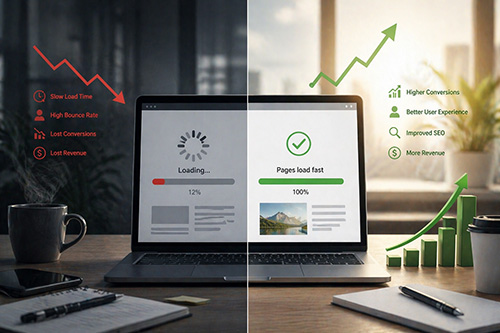

Most business leaders think of website speed as a technical issue. Something for the development team to worry about. A line item on an IT checklist.
That framing is costing companies real money.
Website performance is one of the highest-leverage strategic investments a business can make in its digital presence. When you treat it as an operational concern rather than a strategic one, you accept avoidable revenue losses, higher marketing costs, and a weaker competitive position.
The Revenue Equation Nobody Talks About
The data on this has been consistent for years. Portent found that a site loading in one second converts three times better than one loading in five seconds. Google’s research shows that as load time increases from one to three seconds, the probability of bounce increases by 32 percent.
For a company doing meaningful volume through its website, those percentages represent thousands or hundreds of thousands of dollars annually. The investment required to close that performance gap is almost always a fraction of the revenue being left behind.
Yet in most organizations, website speed rarely makes it onto the executive agenda. It gets delegated downstream, resourced inconsistently, and measured infrequently. The cost of this inattention is diffuse enough that it rarely shows up cleanly on any report, which makes it easy to overlook.
What Slow Sites Cost Beyond Lost Conversions
The direct conversion impact is only part of the picture. Slow websites create compounding problems across multiple areas of a business:
- Advertising efficiency: Google and Meta factor page experience into ad quality scores. A slow landing page raises your cost per click and reduces the reach of your paid campaigns. Two companies running identical ad creative can pay meaningfully different rates based solely on landing page performance.
- Search visibility: Google uses Core Web Vitals as ranking signals. A slow site is a less visible site, which means organic traffic acquisition becomes harder and more expensive over time.
- Customer retention: First impressions in digital environments form in under a second. A slow, unstable page signals to a prospective customer that the business behind it operates the same way. Whether that perception is fair is beside the point. Customers act on it.
- Sales team efficiency: When prospects research your company before a call, their experience on your website shapes the conversation. A poor digital experience reduces the credibility your sales team has to work with before they even speak to a prospect.
The Competitive Landscape Is Not Standing Still
Industries that were slow to invest in digital performance have found themselves outpaced by competitors who took it seriously. E-commerce is the clearest example, where performance differences between fast and slow sites translate directly into market share over time.
The same dynamic is playing out in professional services, healthcare, finance, and B2B markets. As more of the buyer journey moves online, the companies that deliver a faster, more reliable digital experience earn more trust, more leads, and more conversions. The ones that do not lose ground gradually, in ways that are easy to attribute to other causes.
Making the Case Internally
If you are trying to prioritize web performance investment within your organization, the most effective approach is to connect it to metrics leadership already cares about.
Start by quantifying the current cost. Pull your conversion rate from your analytics platform. Run your key pages through Google’s PageSpeed Insights to get a performance score. Then use Google’s own research on the conversion impact of load time improvements to estimate what a one or two second improvement would mean in revenue terms. Most leadership teams find the numbers more compelling than they expected.
From there, frame performance not as a technical upgrade but as a revenue enablement initiative. The conversation changes when web performance sits alongside CRM investment, content strategy, and paid media rather than in a server maintenance budget.
Where to Start
For most organizations, the highest-value starting point is the pages that drive the most revenue or the most leads. Homepage, key landing pages, and product or service pages typically offer the greatest return on a performance investment.
Run a Core Web Vitals assessment on those pages, identify the top two or three issues driving the worst scores, and address those first. Incremental improvement compounds. A site that gets meaningfully faster each quarter creates durable competitive advantages over time.
Website performance is not an IT problem. It is a revenue strategy. Treating it that way changes what gets prioritized, what gets resourced, and what gets measured. For businesses that operate online, that shift in perspective is worth real money.
